
What Is the CII Diploma in Insurance?
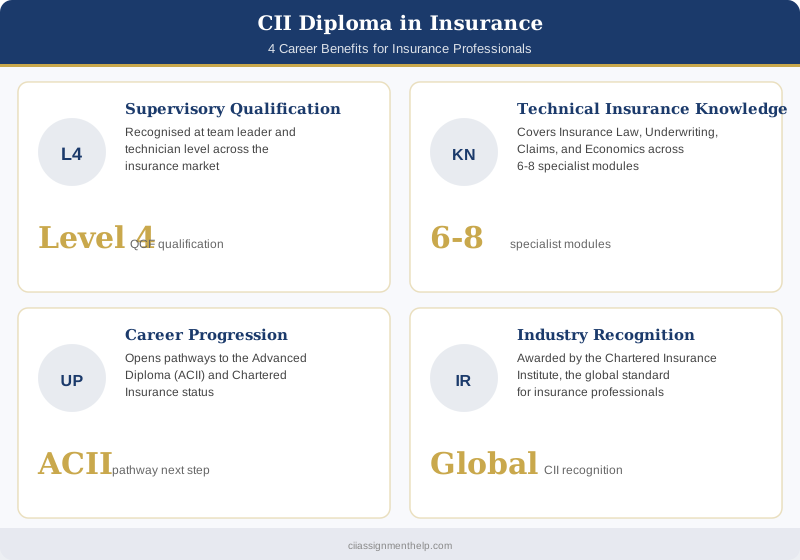
The CII Diploma in Insurance is the intermediate professional qualification awarded by the Chartered Insurance Institute, positioned at RQF Level 4 for its core and most optional units, with certain specialist optional units at RQF Level 6. The Diploma requires completion of three mandatory core units — M05 Insurance Law and Practice (25 credits), M92 Insurance Business and Finance (25 credits), and 530 Economics and Business (30 credits) — alongside a selection of optional specialist units to meet the qualification's total credit threshold. For an overview of support across all CII qualification tiers, see CII assignment help across all qualification levels.
The Most Critical Distinction: Written Examination, Not MCQ
The Diploma uses written examination — not multiple-choice questions. Students progressing from the Certificate in Insurance must shift from selecting the correct answer from four options to producing structured written responses to legal case studies, financial analysis scenarios, and economic reasoning questions. Written examination at Diploma level demands legal reasoning, financial analysis, and the application of economic theory — none of which the MCQ format tests at Certificate level.
All Three Core Units Are Mandatory
No student can complete the CII Diploma in Insurance without passing M05, M92, and 530. This differs from the Certificate in Insurance, where no single IF unit is universally compulsory. The mandatory core requirement means that M05 Insurance Law and Practice — widely regarded as the hardest unit in the Diploma — is unavoidable for every student on this qualification pathway.
The Three Mandatory Core Units of the CII Diploma
All three mandatory core units must be completed to achieve the qualification. The combined credit value is 80 credits (25 + 25 + 30), forming the compulsory foundation before any optional units contribute toward the Diploma credit threshold.
M05 — Insurance Law and Practice (25 Credits)
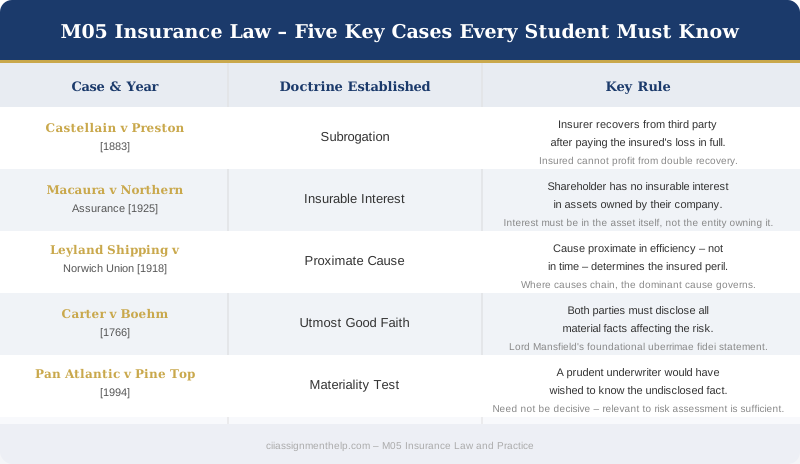
M05 is the single most demanding unit in the CII Diploma. It is assessed through written examination requiring structured legal argument applied to insurance scenario questions. For students requiring targeted support, M05 Insurance Law assignment help provides specialist legal reasoning preparation.
Legislation M05 Requires
- Marine Insurance Act 1906 — foundational insurance law principles
- Insurance Act 2015 — duty of fair presentation reform
- Employers' Liability (Compulsory Insurance) Act 1969
- Road Traffic Act 1988 — compulsory motor liability
- Contracts (Rights of Third Parties) Act 1999
Legal Doctrines Tested by M05
- Utmost good faith (uberrimae fidei) and fair presentation
- Insurable interest — who can insure what
- Subrogation — insurer steps into insured's shoes
- Contribution — between multiple insurers
- Proximate cause — the effective cause of loss
- Indemnity — restoring to pre-loss position
M92 — Insurance Business and Finance (25 Credits)
M92 carries 25 credits and is assessed through written examination covering the structure and financial operation of the UK insurance market. For students working on this unit, M92 assignment help provides focused financial analysis preparation.
Market Structure Content
- Lloyd's market governance and operational structure
- Company market organisation
- Proportional reinsurance: quota share and surplus
- Non-proportional reinsurance: excess of loss and stop loss
- Captive insurance structures
Financial Metrics M92 Tests
- Combined ratio — claims + expenses as % of premiums earned
- Loss ratio and expense ratio components
- Return on equity and investment income
- Underwriting cycle phases: soft market, hard market
- Solvency II capital framework and SCR principles
530 — Economics and Business (30 Credits)
530 carries 30 credits — the highest credit value of the three mandatory core units and the most significant contributor to the Diploma's credit threshold. Students frequently underestimate 530 relative to M05 — its 30-credit weight means a weak 530 performance can materially affect Diploma progression. For targeted support, 530 assignment help covers the economic theory and business analysis content in the insurance market context.
Economic Theory Areas
- Supply and demand dynamics in insurance markets
- Market structures: monopoly, oligopoly, perfect competition
- GDP growth affecting commercial insurance demand
- Inflation affecting claims costs
- Interest rates affecting investment income on float
Business Analysis Frameworks
- Porter's Five Forces applied to insurance market segments
- PESTLE analysis — Political, Economic, Social, Technological, Legal, Environmental
- Strategic business planning applied to insurance entities
- International economic factors affecting reinsurance pricing cycles
Why Is M05 Insurance Law Known as the Hardest CII Diploma Unit?
Five Reasons M05 Is More Demanding Than Any Other Diploma Unit
M05 requires simultaneous knowledge of multiple Acts of Parliament that must be applied to scenarios combining two or more statutes simultaneously. The Insurance Act 2015 modified the traditional common law duty of utmost good faith — answering M05 scenarios correctly requires knowing both what the law was and how it changed. The written examination removes the MCQ safety net: partial legal knowledge produces partial answers and partial marks. For non-UK students, English common law and UK statute are entirely unfamiliar legal systems. And unlike product knowledge exams, M05 requires structured legal argument — identifying the applicable rule, stating it accurately, and applying it to the scenario fact pattern.
Students who passed Certificate units through product knowledge and regulatory familiarity encounter a genuinely different intellectual task in M05. For specialist support, M05 Insurance Law assignment help focuses specifically on legal reasoning technique for M05 written examinations.
How Do CII Diploma in Insurance Written Exams Work?
What the Exam Paper Looks Like
Each paper presents a scenario — a described insurance event, financial analysis situation, or economic policy context — and asks students to apply their unit knowledge to specific questions about it. Core unit exams combine a case study requiring extended written analysis with shorter structured questions requiring precise factual and applied answers.
Assessment Criteria
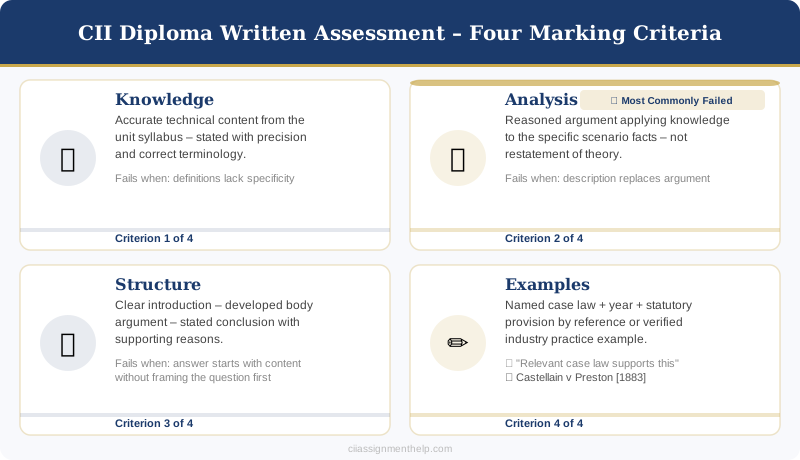
Examiners evaluate: the accuracy of insurance law, financial, or economic knowledge; the quality of analytical reasoning — explaining WHY a principle or ratio produces a particular outcome; and the structure and clarity of written expression. Bullet points are accepted in many sections; extended case study sections require paragraph-form analysis.
Format vs Certificate MCQ
In Certificate MCQ exams, partial knowledge can eliminate two incorrect options and improve selection odds. In Diploma written exams, partial knowledge produces a partial answer. Students who passed Certificate units through product familiarity encounter a genuinely different intellectual task — constructing complete legal and financial arguments rather than identifying the best option from a list.
The 18 Optional Units of the CII Diploma in Insurance
Beyond the three mandatory core units, students select from optional specialist units across underwriting, claims, broking, and specialist insurance class categories. Most optional units carry 20 credits; specialist class units carry 25 credits. All are assessed through written examination.
| Category | Unit Code | Unit Title | Credits | Level |
|---|---|---|---|---|
| Core Units (Mandatory — All Three Required) | ||||
| Core | M05 | Insurance Law and Practice | 25 | 4 |
| Core | M92 | Insurance Business and Finance | 25 | 4 |
| Core | 530 | Economics and Business | 30 | 4 |
| Underwriting Optional Units | ||||
| Underwriting | M80 | Commercial Lines Underwriting | 20 | 4 |
| Underwriting | M81 | Personal Lines Underwriting | 20 | 4 |
| Underwriting | M82 | Aviation Insurance | 20 | 4 |
| Underwriting | M83 | Reinsurance | 20 | 4 |
| Underwriting | M97 | Insurance Broking Practice | 20 | 4 |
| Underwriting | M98 | Marine Insurance Practice | 20 | 4 |
| Claims Optional Units | ||||
| Claims | M85 | Commercial Lines Claims | 20 | 4 |
| Claims | M86 | Personal Lines Claims | 20 | 4 |
| Claims | M87 | Liability Claims | 20 | 4 |
| Claims | M88 | Motor Claims | 20 | 4 |
| Broking Optional Units | ||||
| Broking | M89 | Insurance Broking Fundamentals | 20 | 4 |
| Broking | M90 | Advanced Broking | 20 | 4 |
| Broking | M91 | Commercial Broking | 20 | 4 |
| Specialist Classes Optional Units | ||||
| Specialist | M93 | Medical Malpractice | 25 | 4 |
| Specialist | M94 | Professional Indemnity | 25 | 4 |
| Specialist | M95 | Construction Insurance | 25 | 4 |
| Specialist | M96 | Engineering Insurance | 25 | 4 |
| Specialist | P05 | Financial Planning in Insurance | 20 | 4 |
| Specialist | 990 | Risk Management | 20 | 4 |
Working on a Core Unit or Optional Specialist Module?
This service covers all three mandatory core units and all 18 optional specialist modules. Contact us with your unit code, sitting date, and assignment brief.
Get a Free Quote 💬 WhatsApp UsChoosing Your Optional Units — Career-Aligned Selection
Underwriting professionals typically select from M80, M81, M82, M83, or M98. Claims professionals select from M85, M86, M87, or M88 based on their claims portfolio. Broking professionals select from M89, M90, or M91. Students in specialist insurance classes — medical malpractice, professional indemnity, construction, or engineering — select M93, M94, M95, or M96. Units selected out of alignment with professional experience typically require significantly more preparation time, as exam scenarios are framed around the operational context of that specialism.
Career Roles Requiring CII Diploma in Insurance
The Diploma qualifies practitioners for intermediate and senior professional roles in the UK general insurance market where recognised qualification above Certificate level is required.
Underwriting
Senior underwriters handling commercial lines accounts at major composite insurers and Lloyd's syndicates frequently hold Diploma in Insurance as a minimum professional qualification.
Claims Management
Claims team leaders managing portfolios in liability, commercial property, and motor functions require Diploma-level qualification. Team leader roles commonly specify DipCII as a minimum.
Insurance Broking
Insurance brokers conducting FCA-regulated distribution activities increasingly require CII Diploma progression to meet continuing competence expectations under ICOBS and IDD obligations.
Progressing From Diploma to Advanced Diploma
The Diploma provides the direct qualification pathway to the CII Advanced Diploma in Insurance. M05, M92, and 530 completed at Diploma level carry credit recognition into the Advanced Diploma framework. The Advanced Diploma's three core units — 820, 930, and 960 — are assessed at RQF Level 6 and require strategic-level analysis. Successful completion confers the ACII designation. For students planning the progression, CII Advanced Diploma assignment help covers the full Advanced Diploma structure.
Frequently Asked Questions About CII Diploma in Insurance Assignment Help
How many optional units do I need to pass for the CII Diploma in Insurance?
Students must complete all three mandatory core units (M05, M92, and 530 — totalling 80 credits combined) plus sufficient optional units to reach the CII Diploma's credit threshold. Because most optional units carry 20 credits each, most students need two to three optional units beyond the core. Students selecting 25-credit specialist class optional units (M93, M94, M95, M96) may reach the threshold with fewer units. Confirm your specific credit target with the CII or your enrolment documentation.
Can I pass M05 Insurance Law without knowing detailed case law?
The M05 written examination applies legal principles — not isolated cases — to scenario questions. However, knowing named statutes (Marine Insurance Act 1906, Insurance Act 2015) and foundational legal doctrines (subrogation, insurable interest, proximate cause) is not optional for M05. The examiner expects students to understand how the Insurance Act 2015 modified the traditional common law duty of utmost good faith. Specialist M05 tutors guide students on which legal knowledge is most likely to be examined and how to structure written answers to demonstrate applied legal reasoning effectively.
What is the difference between M05 and IF1 for insurance law content?
IF1 (Insurance, Legal and Regulatory) covers foundational insurance law principles at RQF Level 3 through MCQ examination — contract formation, regulatory framework, basic insurance principles. M05 (Insurance Law and Practice) covers the same field at RQF Level 4 through written examination requiring structured legal argument applied to case study scenarios. M05 requires knowledge of named statutes at a depth that IF1 does not require. The MCQ format of IF1 means partial knowledge is viable; M05's written format requires a complete legal argument to score full marks.
Is the CII Diploma in Insurance available to students who have not completed the Certificate?
Yes — the CII Diploma does not formally require prior Certificate completion. Students can enrol for Diploma units directly if they meet the CII's enrolment requirements. However, foundational insurance law and product knowledge from Certificate level — particularly IF1 principles — significantly supports M05 preparation. Students who enrol directly for the Diploma without Certificate-level grounding often find M05 more challenging because they are simultaneously building foundational insurance knowledge while developing the written legal reasoning skills M05 demands.
Does the service help with specialist class optional units like professional indemnity or construction?
Yes — the service provides written examination support for all specialist class optional units including M93 (Medical Malpractice), M94 (Professional Indemnity), M95 (Construction Insurance), and M96 (Engineering Insurance). These specialist class units require sector-specific knowledge that goes beyond standard general insurance product coverage. The service matches students to tutors with relevant specialist market experience for these units, ensuring scenario questions are answered at the knowledge depth the examiner expects.
Need Support With Your CII Diploma in Insurance?
This service covers all three mandatory core units and all 18 optional specialist modules. Contact us with your unit code, sitting date, and assignment brief.
Get Your Free Quote 💬 WhatsApp Us Now