
What Is the CII Certificate in Insurance?
CII Certificate in Insurance assignment help is the professional support service for students studying IF-series units, specialist units, and international variant qualifications at RQF Level 3 — the entry-level tier of the Chartered Insurance Institute's insurance qualification framework. The Certificate awards 15 credits per unit, assesses all units through computer-based MCQ scenario examinations, and covers 21 unit codes across three categories: the 11 standard IF units (IF1 through IF11), three specialist units (GR1, LM3, and R05), and seven international variant units.
RQF Level 3 — The Foundation of CII Insurance Qualifications
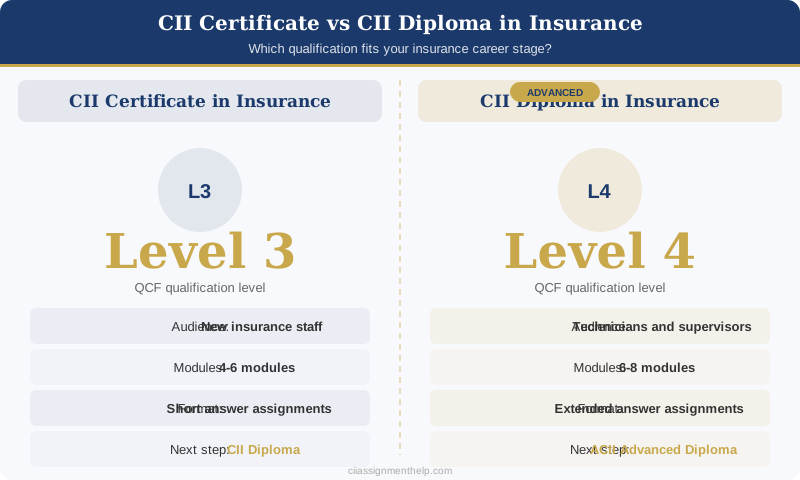
The Certificate is positioned at RQF Level 3 on the Regulated Qualifications Framework — the entry-level classification for professional qualifications in the UK. UK insurance employers across underwriting, claims, and broking consistently require or recommend Certificate units for entry-level roles. The qualification progresses directly into the CII Diploma in Insurance at RQF Level 4, where written examinations replace the MCQ format. Completion of the Certificate qualifies students for the Cert CII membership designation.
CII Certificate in Insurance vs Award in Insurance
The CII Award in Insurance requires a minimum of one unit at 15 credits. The Certificate in Insurance requires students to complete a minimum of two units meeting the CII's current credit threshold. Both are awarded by the CII, but the Certificate carries greater professional weight as it demonstrates broader qualification engagement across at least two insurance knowledge domains. Most students working toward a recognised professional qualification complete two to four IF units depending on employer requirements.
Which Units Are Available in the CII Certificate in Insurance?
Eleven standard units form the core unit list, each assessed at 15 credits through MCQ scenario-based computer-based examination. Three specialist units extend the qualification into group risk, London market, and financial protection subjects. Seven international variant units adapt the standard MCQ format for non-UK insurance markets.
Standard IF Units (IF1 to IF11)
| Unit Code | Unit Title | Core Subject Area | Credits |
|---|---|---|---|
| IF1 | Insurance, Legal and Regulatory | Contract law, insurance principles, UK regulatory framework (FCA/PRA) | 15 |
| IF2 | General Insurance Business | Insurance market structure, Lloyd's market, distribution channels, pricing fundamentals | 15 |
| IF3 | Insurance Underwriting Process | Risk assessment principles, proposal evaluation, underwriting pricing, risk selection | 15 |
| IF4 | Motor Insurance Products and Regulations | UK motor insurance law (Road Traffic Act), motor product types, claims process, FNOL, total loss | 15 |
| IF5 | Accident and Health Insurance | Personal accident, travel insurance, health products, occupational definitions, benefit triggers | 15 |
| IF6 | Household Insurance Products | Buildings and contents cover, domestic property policies, standard exclusions, claims settlement | 15 |
| IF7 | Fire and Perils Insurance | Commercial fire coverage, perils definitions, business interruption fundamentals, underwriting fire risk | 15 |
| IF8 | Liability Insurance | Public liability, employers' liability, product liability, indemnity limits, claims-made vs occurrence | 15 |
| IF9 | Marine Insurance | Hull insurance, cargo insurance, marine liability, Institute Clauses, voyage and time policies | 15 |
| IF10 | Commercial Property and Business Interruption Insurance | Material damage cover, BI extensions, indemnity periods, increased cost of working | 15 |
| IF11 | Financial Planning | Financial services products bridging the insurance-to-financial-planning pathway | 15 |
| Specialist Certificate Units | |||
| GR1 | Group Risk Insurance | Group life assurance, group income protection, group critical illness — employee benefits | 15 |
| LM3 | London Market Insurance | Lloyd's market principles, subscription business, London insurance and reinsurance market | 15 |
| R05 | Financial Protection | Life assurance, income protection, critical illness — financial planning pathway | 15 |
| International Variant Units | |||
| WCE | Commercial Lines (International) | Non-UK commercial lines insurance principles | 15 |
| WCA | Claims (International) | Claims handling in non-UK insurance market contexts | 15 |
| WUE | Underwriting (International) | Underwriting principles adapted for international markets | 15 |
| WUA | Accident and Health (International) | Accident and health products outside UK regulatory framework | 15 |
| W04 | London Market (International) | London Market principles for international market practitioners | 15 |
| IMU | Motor Insurance (International) | Motor insurance products and regulations in international markets | 15 |
| IMP | Motor Insurance Products (International) | Motor product structures for the Indian insurance market | 15 |
Unit-Specific Help Available
IF1 assignment help covers the legal and regulatory foundations that underpin every subsequent IF unit. IF3 assignment help provides focused support with risk assessment and proposal evaluation scenarios. IF4 assignment help targets the motor insurance law and product knowledge tested in that examination. Arabic-market and Indian-market students sitting WCA, WUA, IMU, and IMP are fully supported.
How Do CII Certificate in Insurance MCQ Scenario Exams Work?
MCQ scenario-based examinations are the assessment format used across all 21 Certificate unit codes. The examination is delivered by computer at an authorised CII venue, presenting students with multiple-choice questions, each offering four answer options (A, B, C, D).

The Scenario Structure
Each question presents a real-world insurance situation before asking you to select the most appropriate response. A typical scenario describes a commercial property fire claim and asks which action the claims handler should take first — testing applied knowledge, not memorised definitions.
Why All Four Options Can Be "Correct"
All four answer options may describe legally and factually accurate actions. The correct answer requires identifying which action is most appropriate given insurance law, product terms, and professional standards as they apply to the described situation. This is why Certificate exam preparation requires more than reading study materials once.
Pass Mark and Grade Setting
The standard pass mark is a minimum of 50%, but the CII applies a grade-setting process per sitting that may adjust the effective threshold based on question difficulty distribution. Students should target 65%+ in preparation sessions to provide a safe margin.
Applied Knowledge — Not Recall Alone
MCQ scenario preparation requires two distinct skills: accurate knowledge of insurance principles, products, and regulations — and the ability to apply that knowledge to described situations without being misled by plausible but incorrect options. Students who pass using only recall often find themselves selecting the wrong answer when all four options are factually accurate descriptions.
Which CII Certificate Units Are Compulsory?
No Single Universally Compulsory Unit
Unlike the CII Diploma in Insurance, the Certificate has no single IF unit that is universally compulsory across all qualification routes. Students select which units to sit, subject to the credit threshold required for the Certificate designation. However, employer requirements frequently determine which units students prioritise in practice.
Employer-Driven Unit Selection
- Motor insurance employers commonly specify IF4
- Liability-focused employers often require IF8
- Underwriting teams may require IF3
- Confirm with your employer before enrolling
The Case for Starting with IF1
- IF1 content underpins every other IF unit's scenario logic
- Contract law and insurance principles apply in IF3, IF4, IF8
- Many employers specify IF1 as the first unit to complete
- Students skipping IF1 often find scenario answers unclear
Need Help Deciding Which IF Unit to Sit First?
Our specialists cover all 21 Certificate unit codes — from IF1 foundations to international variants. Contact us with your employer requirements and we will confirm the best preparation approach.
Get a Free Quote 💬 WhatsApp UsProgressing From Certificate in Insurance to CII Diploma
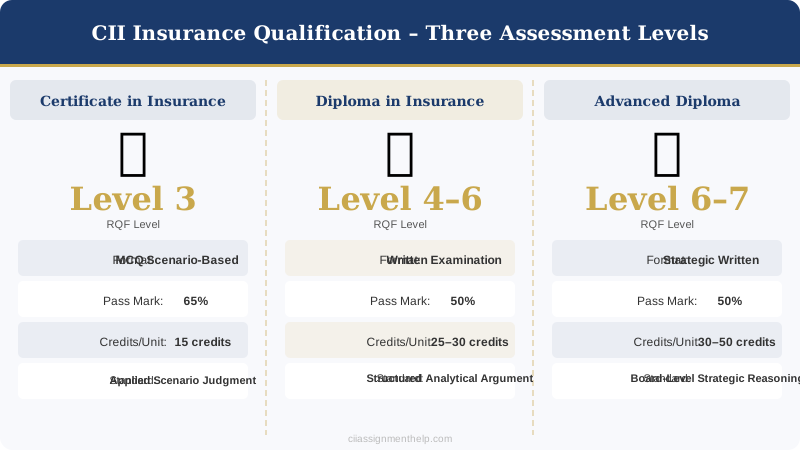
The CII Certificate in Insurance at RQF Level 3 is the direct entry point to the CII Diploma in Insurance at RQF Level 4 and Level 6. Certificate credits can contribute toward Diploma credit requirements. The progression represents a significant shift in assessment format: Certificate units use MCQ scenario-based computer exams worth 15 credits each, while Diploma units use written examinations worth 20–30 credits per unit.
What Changes at Diploma Level
- MCQ format replaced by written examination
- 20–30 credits per unit (vs 15 at Certificate)
- Legal reasoning applied to named statutes
- Financial ratio analysis and economic theory
Three Mandatory Diploma Core Units
- M05 Insurance Law and Practice (25 credits)
- M92 Insurance Business and Finance (25 credits)
- 530 Economics and Business (30 credits)
Students who found IF1 (insurance law principles) challenging at Certificate level often find M05 the most demanding Diploma unit, as it requires written legal argument rather than MCQ selection. For students ready to move to the next tier, CII Diploma in Insurance assignment help covers all three core units and the full range of optional specialist modules.
Career Roles That Require CII Certificate in Insurance
The Certificate qualifies students for entry-level and intermediate insurance industry roles where employer-recognised professional qualification is required.
Insurance Broking
Insurance brokers working in FCA-regulated advisory capacities require CII qualification progress. Certificate units represent the initial step toward meeting regulatory competency expectations.
Underwriting
Underwriting assistants at Lloyd's syndicates and company market insurers frequently hold Certificate units — commonly IF3 (underwriting process) and IF8 (liability) — as part of employer-mandated qualification programmes.
Claims Handling
Claims handlers in motor and property lines typically require IF4 and IF6 respectively. UK general insurance employers increasingly link salary progression to CII qualification completion.
CII Membership From Certificate in Insurance
Completion of Certificate units qualifies students for the Cert CII membership designation — the Chartered Insurance Institute's entry-level professional membership grade. Students at Certificate level are beginning a qualification trajectory that culminates in ACII status — Associate of the Chartered Insurance Institute — which senior insurance employers require for progression into senior roles. For students planning the full qualification journey, CII Advanced Diploma and ACII designation represents the qualification outcome at the top of the framework.
Frequently Asked Questions About CII Certificate in Insurance
How many IF units do I need to pass to complete the CII Certificate in Insurance?
The number of units depends on whether you are pursuing the Award (minimum one unit at 15 credits) or the Certificate (minimum two units meeting the CII's current credit threshold). Most students working toward the Certificate complete two to four IF units depending on employer requirements. This service covers any combination of IF units from IF1 through IF11, GR1, LM3, R05, and all seven international variants.
Can I get help with international variant CII Certificate units like WCE or WUA?
Yes — the service provides exam preparation and assignment help for all seven international variant units: WCE (Commercial Lines International), WCA (Claims International), WUE (Underwriting International), WUA (Accident and Health International), W04 (London Market International), IMU (Motor Insurance International), and IMP (Motor Insurance Products International). International variant units follow the same MCQ scenario-based format as standard IF units, adapted for non-UK insurance market contexts.
Is IF1 compulsory for the CII Certificate in Insurance?
IF1 (Insurance, Legal and Regulatory) is not universally compulsory as a formal requirement, but its content — contract law, insurance principles, insurable interest, the UK regulatory framework — underpins every other IF unit's scenario logic. Many employers specify IF1 as the first unit employees must complete. Students who sit IF3, IF4, or IF8 without prior IF1 knowledge frequently encounter scenario questions where the correct answer depends on insurance law principles that IF1 covers.
How does the MCQ scenario exam for IF units differ from standard multiple-choice tests?
CII Certificate MCQ exams present realistic insurance scenarios and require the student to select the most appropriate response from four options. All four options may be factually accurate — the correct answer requires applying insurance principles, product knowledge, and professional standards to the specific situation described. Simple fact recall is insufficient; the scenario format tests whether students can identify the most appropriate action in context.
What is the pass mark for CII Certificate in Insurance MCQ exams?
The standard pass mark is a minimum of 50%, but the CII applies a grade-setting process to each sitting, meaning the effective pass threshold can shift slightly based on the difficulty distribution of questions. Students should target 65%+ in preparation sessions to provide a safe margin. This service builds both subject knowledge accuracy and scenario-based question technique to maximise performance across the full range of possible question types.
Need Support With Your CII Certificate in Insurance?
Contact the service with your unit code and sitting date. We cover every IF unit from IF1 through IF11, all three specialist units, and all seven international variants.
Get Your Free Quote 💬 WhatsApp Us Now