990 Insurance Corporate Management Assignment Help — CII Advanced Diploma in Insurance
Unit 990 — Insurance Corporate Management is a 30-credit Level 6 written examination unit within the CII Advanced Diploma in Insurance. It covers corporate governance applied to insurance firms, the Senior Managers and Certification Regime (SMCR), the Solvency II governance framework including the Own Risk and Solvency Assessment (ORSA), strategic management of insurance companies, stakeholder management at Board level, and ESG leadership in insurance. The unit is taken by senior insurance managers and those targeting C-suite roles — Chief Risk Officers, Chief Compliance Officers, Heads of Internal Audit, and Non-Executive Directors. What distinguishes Level 6 from lower-level written exam answers is the requirement for critical analysis and evaluation of governance frameworks: examiners expect candidates to assess whether a governance arrangement is adequate, evaluate a strategic choice against available alternatives, and identify where regulatory frameworks interact or conflict — not to describe what those frameworks are.
What Does Unit 990 Cover? — The Five Syllabus Areas at Level 6
Unit 990 organises its syllabus around five substantive areas, each defined by a specific regulatory or strategic framework. Generic corporate governance knowledge — the kind applicable to any listed company — is insufficient. The exam tests governance as it applies to regulated insurers under dual obligations from both the UK Corporate Governance Code and Solvency II Pillar 2.
Corporate Governance in Insurance — UK Corporate Governance Code and Board Composition
The UK Corporate Governance Code (the Code) applies on a comply-or-explain basis to premium-listed UK companies, including listed insurers. For insurers regulated under Solvency II, the PRA also imposes governance requirements through its Governance Conditions — so listed insurers operate under dual governance obligations: the Code and Solvency II Pillar 2. A 990 exam question requires candidates to evaluate whether a given board arrangement satisfies both sets of requirements, not just one.
Board composition under the Code requires the Chair and CEO roles to be separated — a single individual cannot hold both. For FTSE 350 companies, half the board (excluding the Chair) must be independent non-executives; for smaller listed companies, the minimum is one-third. The Chair must be independent on appointment.
Board skills matrix for insurers: An insurance company board requires specific competencies not addressed by the Code in generic form. The PRA expects insurance boards to collectively possess expertise in actuarial and reserving, underwriting (for general and specialist lines), claims management, risk management including catastrophe modelling and stress testing, investment management, regulatory affairs covering SMCR and Solvency II, technology and cyber risk, and financial management including capital allocation and reinsurance purchasing. A 990 exam question will present a board composition and ask candidates to evaluate whether it meets these insurance-specific requirements — identifying the gap is as important as knowing the standard.
Board committees for insurers: (1) The Audit Committee must include at least three independent non-executives; it reviews financial reporting, internal audit work, and external audit independence. For insurers, the Audit Committee specifically reviews reserving adequacy. (2) The Risk Committee — for insurers, the Risk Committee is typically separate from the Audit Committee (unlike many non-financial companies where the two are combined); it reviews the risk appetite statement, the ORSA, and stress and scenario testing, with its Chair reporting directly to the Board. (3) The Remuneration Committee must ensure that remuneration policy does not incentivise excessive risk-taking; the PRA imposes specific requirements on remuneration for material risk takers, which overlaps with the SMCR Certified Persons regime.
SMCR — Senior Managers, Certified Persons, and Conduct Rules
The Senior Managers and Certification Regime (SMCR) was extended to insurers by the FCA and PRA in December 2019, replacing the Approved Persons Regime and introducing individual accountability for named senior individuals at three tiers.
Tier 1 — Senior Managers are individuals holding a Prescribed Responsibility (PR). Each Senior Manager must have a Statement of Responsibilities (SoR) — a document mapping their specific area of responsibility within the firm. The key Prescribed Responsibilities for insurers include: responsibility for the firm's Solvency II compliance, responsibility for the ORSA, responsibility for the internal audit function, responsibility for the actuarial function, and responsibility for the compliance function.
The duty of responsibility is the central individual accountability mechanism. If a regulatory breach occurs in a Senior Manager's area of responsibility, the Senior Manager is personally liable unless they can demonstrate they took reasonable steps to prevent the breach. The evidential burden sits with the Senior Manager — they must prove they acted appropriately, not the regulator proving they failed to act.
Tier 2 — Certified Persons perform Significant Harm Functions — typically material risk takers and senior managers who are not FCA/PRA-approved but whose roles could cause significant harm. The firm (not the regulator) must certify their fitness and propriety annually against criteria including honesty, integrity, reputation, competence, capability, and financial soundness. Failure to certify means the individual cannot perform the function.
Tier 3 — Conduct Rules apply to all staff including non-executive directors. The five Individual Conduct Rules are: (1) act with integrity; (2) act with due skill, care, and diligence; (3) be open and cooperative with the FCA, PRA, and other regulators; (4) pay due regard to the interests of customers and treat them fairly; (5) observe proper standards of market conduct. Senior Managers are additionally subject to four Senior Manager Conduct Rules: (6) take reasonable steps to ensure the business of the firm for which you are responsible complies with regulatory requirements; (7) take reasonable steps to ensure effective control over the business; (8) be responsible for appropriate handover when taking on a new role; (9) disclose appropriately any information the FCA or PRA would reasonably expect.
Critical 990 Exam Distinction
A Board that satisfies the UK Corporate Governance Code structurally may still have SMCR failures if individual Senior Manager responsibilities are not clearly mapped in Statements of Responsibilities. The two frameworks operate on different axes — collective board adequacy versus individual named accountability — and both must be satisfied.
Solvency II Governance — Four Key Functions and the ORSA
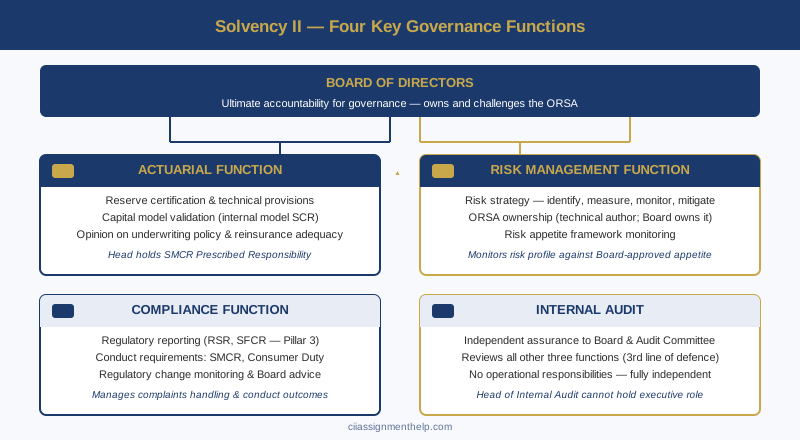
Solvency II Pillar 2 mandates four governance Key Functions within every insurer. Each function has a distinct role and reporting line that the 990 exam requires candidates to articulate precisely.
(1) Actuarial Function: Responsible for calculating and certifying the technical provisions (reserves) — the insurer's estimate of future claims liabilities. For insurers using an internal model for SCR calculation, the Actuarial Function provides an opinion on the model's assumptions and methodology. It also provides an opinion on the overall underwriting policy (whether the insurer is pricing risk adequately) and on reinsurance adequacy. The Head of the Actuarial Function holds a Prescribed Responsibility as a Senior Manager under SMCR.
(2) Risk Management Function: Implements the risk management system. Owns the risk strategy — the firm's approach to identifying, measuring, monitoring, and mitigating risks. Produces the ORSA: the Risk Management Function is the technical author of the ORSA, though the Board is responsible for owning and challenging it. Monitors the risk profile continuously against the Board-approved risk appetite.
(3) Compliance Function: Monitors compliance with all applicable regulatory requirements — Solvency II, SMCR, FCA conduct rules, ICOBS, Consumer Duty, and any other sector-specific requirements. Advises the board and senior management on their compliance obligations. Manages regulatory reporting, including the Regular Supervisory Report (RSR) and Solvency and Financial Condition Report (SFCR) under Solvency II Pillar 3. Manages conduct risk including complaints handling and Consumer Duty outcomes monitoring.
(4) Internal Audit: Provides independent assurance to the board that the risk management system, internal controls, and governance arrangements are effective. Internal Audit must be operationally independent — the Head of Internal Audit cannot hold any executive management role. It reports to the Audit Committee and through it to the Board. Internal Audit must audit the ORSA process, the Actuarial Function outputs, and the compliance function — providing third-line assurance within the three lines of defence model.
ORSA at Board Level — Persistent 990 Exam Error
A persistent 990 exam error is framing the ORSA as a PRA calculation or a risk management function deliverable. The ORSA is the Board's own assessment: the Board must own it, not merely receive it. Boards that cannot demonstrate genuine engagement with the ORSA process face PRA supervisory action.
ORSA at Board level: The ORSA is the insurer's own assessment of its overall solvency needs, beyond the regulatory minimum Solvency Capital Requirement (SCR). The Board must approve the ORSA process and methodology, actively challenge the ORSA outputs (not merely receive them), ensure the ORSA reflects the firm's actual risk profile rather than a box-ticking exercise, and submit the ORSA to the PRA at least annually. The ORSA must include forward-looking scenarios — stress tests covering, for example, a 1-in-200-year catastrophe event, a sustained underwriting loss period, or a major cyber incident — capital planning projections, and any material deviation from the SCR standard formula assumptions.
Insurance Company Strategy at Level 6 — What 990 Examines
The 990 exam does not test whether candidates can list strategic options for an insurance company. It tests whether candidates can evaluate strategic choices as tradeoffs — identifying the rationale, the risk, and the conditions under which each option makes more or less sense.
M&A Strategy in Insurance — MGAs, Portfolio Acquisition, and Run-Off
MGA acquisition: A Managing General Agent (MGA) is a delegated authority vehicle that underwrites on behalf of a capacity provider. Acquiring an MGA provides distribution reach without proportionate capital consumption (the MGA earns a management fee plus profit commission; the capital is the insurer's), specialist underwriting expertise in a niche class, and technology-driven distribution. The strategic tradeoffs: the MGA is dependent on continued capacity provision; if capacity is withdrawn, the MGA's business model collapses. Adverse selection risk exists if underwriting controls within the MGA are weak. Conduct risk is a Board-level issue — the capacity provider retains regulatory liability for the MGA's underwriting decisions even when those decisions are made at arm's length.
Portfolio company acquisition: Acquiring another insurer's in-force portfolio provides immediate scale, geographic or class diversification, and established policyholder relationships. The critical evaluation issues: reserving adequacy of the acquired book (adverse reserve development post-acquisition can erode the acquisition value); integration of underwriting and claims systems; and retention of key staff and broker relationships. A 990 exam question will ask candidates to evaluate the strategic fit and risk profile of a given portfolio acquisition — not simply to define what an in-force book acquisition is.
Run-off acquisition: A run-off specialist takes on a legacy portfolio of long-tail liabilities — employers' liability, product liability, asbestos-related claims — from an insurer wishing to exit the market. The strategic rationale is the technical profit opportunity if reserves prove adequate. The evaluation issue: this requires specialist legacy expertise (actuarial modelling, commutations with reinsurers, adverse development cover structuring) not present in all insurers. Attempting run-off acquisition without that expertise introduces rather than reduces risk.
| Acquisition Type | Strategic Rationale | Primary Risk | Capital Intensity |
|---|---|---|---|
| MGA acquisition | Distribution reach, specialist expertise, fee income | Capacity dependency, conduct risk, adverse selection | Low — fee-based model |
| Portfolio/in-force book | Immediate scale, diversification | Reserve adequacy, integration, staff retention | Medium — book value acquisition |
| Run-off acquisition | Technical profit from reserve management | Requires specialist legacy expertise | Variable — long-tail liability exposure |
Insurtech Strategy — Partnership, Build, or Buy
The 990 exam regularly tests strategic decision-making frameworks. For Insurtech strategy, candidates must evaluate the three options against the insurer's capabilities and strategic objectives — not simply list what each option involves.
Partnership: The insurer provides distribution, regulatory authorisation, and capital; the Insurtech provides technology, data science, and speed to market. Lower investment required; the insurer retains optionality. Evaluation: the Insurtech partner may develop competing distribution capability independently or exit the partnership if a larger acquirer becomes available.
Build: The insurer develops Insurtech capability internally through innovation labs, data science hiring, and proprietary platform development. Full control and intellectual property ownership. Evaluation: high cost, slow execution relative to specialist Insurtechs, and significant organisational culture resistance are the consistent failure modes.
Buy: Outright acquisition of an Insurtech provides immediate technology access and talent. Evaluation: loss of the entrepreneurial culture that drove the Insurtech's innovation; integration complexity; overvaluation risk as Insurtech valuations are frequently based on growth metrics rather than profitability.
Stakeholder Management — Rating Agencies, PRA, FCA, and Lloyd's
PRA and FCA Dual Regulation at Board Level
The PRA's primary statutory objective is the safety and soundness of PRA-regulated firms; its insurance-specific objective is the protection of policyholders. The Board must demonstrate to the PRA through its governance and capital management arrangements that it meets Solvency II Pillar 2 requirements. The FCA's three statutory objectives — consumer protection, market integrity, and promoting competition — create a separate conduct obligation. The Board must own the conduct risk framework, not delegate it entirely to the compliance function.
Rating Agency Methodology and Key Ratios
The major rating agencies — S&P, Fitch, Moody's, and AM Best — each apply insurer-specific rating methodologies. For 990 purposes, the key metrics and processes are:
| Rating Agency | Focus | Key Input Metrics |
|---|---|---|
| S&P / Fitch / Moody's | Financial strength rating (FSR) + Issuer Credit Rating (ICR) | Combined ratio, capital adequacy, reserve adequacy, risk management quality |
| AM Best | Best's Financial Strength Rating (FSR) | Combined ratio, underwriting leverage, liquidity, management quality |
The combined ratio is the primary underwriting profitability metric: (incurred claims + expenses) ÷ net earned premium. A combined ratio below 100% indicates an underwriting profit; above 100% indicates an underwriting loss. Rating agencies target combined ratios sustainably below 100% as evidence of underwriting discipline. The annual rating review process involves management presentations to the rating agency, financial model submission, and active management of rating outlook — a Board-level relationship, not an IR function exercise.
The financial strength rating (FSR) is critical for reinsurance purchasing (reinsurers require cedants' counterparties to meet minimum FSR thresholds) and for large commercial policyholder confidence. A downgrade to the FSR can trigger policyholder cancellation rights under some commercial programme policies.
Lloyd's Franchise Board Oversight
For insurers operating through the Lloyd's market, an additional layer of stakeholder management applies. The Franchise Performance Directorate (FPD) reviews each syndicate's Syndicate Business Plan (SBP) annually — assessing proposed premium volumes, class mix, realistic disaster scenario results, and projected combined ratios. The Decile 10 initiative removes the least profitable 10% of classes from the Lloyd's portfolio annually, creating mandatory class exits for underperforming syndicates. Managing agents must manage their Lloyd's stakeholder relationship as actively as their PRA relationship.
ESG in Insurance Leadership — TCFD, Sustainable Underwriting, and Greenwashing Risk
The TCFD (Task Force on Climate-related Financial Disclosures) framework provides the mandatory structure for climate risk disclosure for premium-listed UK insurers and large firms. The four pillars with insurance-specific content are:
Governance: Board committee oversight of climate risk — typically the Risk Committee reports to the Board on climate risk scenarios and underwriting exposure. Board skills matrix must include climate risk expertise.
Strategy: Climate scenario analysis using IPCC pathways (1.5°C, 2°C, 4°C scenarios) applied to both the underwriting portfolio (physical risk impact on cat models) and the investment portfolio (transition risk — stranded assets in coal and fossil fuel holdings). Financial planning must reflect climate risk scenarios over short, medium, and long timeframes.
Risk Management: Integration of climate risk into the enterprise risk management (ERM) framework. Physical risk: acute events (increased wildfire frequency, Atlantic hurricane intensification, UK flood frequency increase) affect the underwriting book's loss models. Chronic physical risk (sea level rise, temperature increase) creates long-term structural change to property underwriting assumptions.
Metrics and Targets: GHG emissions scope 1/2/3 disclosure, physical risk metrics including PML adjusted for climate trajectory, and transition risk metrics including coal and oil exposure in the investment portfolio.
Sustainable underwriting restrictions: Lloyd's ESG policies include restrictions on new coal underwriting from 2022 onwards with a fossil fuel phase-out timeline. Insurers continuing to underwrite fossil fuel operations face reputational risk, regulatory risk, and increasing climate attribution litigation from activists.
Greenwashing risk: The FCA's Consumer Duty and ESG product claims requirements create regulatory enforcement risk for insurers that mislabel products as sustainable or green without substantive evidence. The Board must own ESG claims governance — greenwashing is a regulatory compliance obligation with enforcement consequences, not a soft aspiration.
How to Write a 990 Written Exam Answer at Level 6
The 990 exam rewards structured evaluation, not comprehensive description. Six rules distinguish Level 6 answers from lower-level responses:
(1) Identify the framework before structuring the answer. The exam question will embed a governance, regulatory, or strategic issue. Name the specific framework being tested before analysing it — SMCR, ORSA, TCFD, UK Corporate Governance Code — not a paraphrase.
(2) Define the framework precisely. Use the regulatory name and its specific content. "The Senior Manager has a duty of responsibility" not "the Senior Manager is responsible." "The ORSA must be Board-owned and challenged" not "the ORSA is submitted to the PRA." Precision signals Level 6 command of the material.
(3) Apply the framework to the scenario facts. Generic answers that do not engage with the specific scenario score poorly at Level 6. If the scenario describes a board that has delegated ORSA challenge to the Risk Committee without board-level review, the answer must evaluate whether this satisfies the Solvency II requirement that the Board own and challenge the ORSA — not merely define what the ORSA is.
(4) Evaluate rather than describe. Identify what works, what fails, and what the alternative approach should have been. "Evaluate whether" and "assess the extent to which" are the appropriate analytical registers. Description-only answers do not demonstrate Level 6 capability.
(5) Use sub-headings to separate governance framework identification, application, and evaluation. Examiners mark structured answers more reliably.
(6) Avoid these common errors: (a) Confusing SMCR Senior Manager Conduct Rules with Individual Conduct Rules — they apply to different tiers and cover different obligations. (b) Stating the ORSA is a PRA calculation or a risk management function deliverable — it is the Board's own assessment. (c) Treating ESG and TCFD as a soft governance aspiration rather than a regulatory compliance obligation with enforcement risk.
Get Expert Help with Your 990 Exam
Our 990 support team includes ACII-qualified writers with Level 6 governance and regulatory expertise. We provide structured answer preparation, framework application coaching, and written exam practice tailored to the SMCR, Solvency II, and ORSA content the 990 exam tests.
💬 WhatsApp Us NowUnit 990 in the CII Advanced Diploma Pathway
Unit 990 operates at the intersection of regulatory compliance, governance frameworks, and strategic management — a combination that reflects the actual responsibilities of Board members, NEDs, and C-suite executives in regulated insurers. The governance knowledge from 990 directly supports the risk management framework analysis in 993 (Advances in Strategic Risk Management), where the ORSA and stress testing appear again in the context of systemic and emerging risks. The Solvency II capital framework introduced in M92 (Insurance Business and Finance) at Diploma level provides the financial context for the ORSA governance obligations that 990 examines at Board level.
Unit 990 is an optional unit within the CII Advanced Diploma in Insurance (ACII). The Advanced Diploma is the highest qualification in the CII insurance pathway — completion confers the ACII designation, the globally recognised benchmark for senior insurance professionals. The core units of the Advanced Diploma (820 and 821) cover advanced claims and strategic insurance management; optional units such as 990 allow candidates to specialise according to their career focus.
A candidate working in governance, risk, or C-suite roles would typically combine 990 with 993 strategic risk management — the SMCR and ORSA knowledge from 990 directly connects to the Board-level risk governance examined in 993. For the full Advanced Diploma qualification pathway, see CII assignment help.
Frequently Asked Questions about Unit 990
Q1: Is 990 the right unit for a senior insurance manager?
Unit 990 is specifically designed for professionals operating at or aspiring to Board level, C-suite, or senior risk and governance roles in insurance firms. The syllabus directly maps to the responsibilities of Chief Risk Officers, Chief Compliance Officers, Heads of Internal Audit, and Non-Executive Directors under SMCR. If your role involves governance oversight, ORSA responsibility, rating agency relationships, or ESG strategy, 990 is the most relevant Advanced Diploma optional unit for building exam-assessed capability at Level 6. Candidates in underwriting or claims roles who are not moving toward governance functions may find 991 or 994 a better fit for their career trajectory.
Q2: How long does it take to prepare for the 990 written exam?
Most candidates with senior insurance experience require 150–180 hours of structured study. The exam tests the ability to apply specific regulatory frameworks — SMCR Prescribed Responsibilities, Solvency II governance function definitions, ORSA requirements — with precision and evaluate strategic choices under exam conditions. Industry knowledge alone is insufficient; the exam rewards structured analytical technique. Candidates newer to governance and regulatory roles typically require 180–220 hours. 990 rewards structured answer technique as much as content knowledge.
Q3: What is the difference between SMCR and the UK Corporate Governance Code in the 990 exam?
The UK Corporate Governance Code governs the structure and accountability of the board as a collective body — composition, committees, director independence, and board evaluation. SMCR governs individual accountability: it assigns Prescribed Responsibilities to named Senior Managers, imposes a personal duty of responsibility, and creates direct regulatory enforcement exposure for individuals. A Board that satisfies the Code may still have SMCR failures if individual Senior Manager responsibilities are not clearly mapped in Statements of Responsibilities. The 990 exam tests both frameworks and requires candidates to understand how they interact, where they overlap, and where compliance with one does not guarantee compliance with the other.
Q4: How often does the ORSA need to be submitted to the PRA?
At least annually, and additionally after any significant change in risk profile — for example, a major acquisition, entry into a new class of business, or a significant catastrophe loss. The PRA does not prescribe a precise format for the ORSA but expects it to be a genuine Board-level document: challenged and approved by the Board, not merely produced by the risk management function and rubber-stamped. The 990 exam frequently tests what constitutes a high-quality ORSA versus a compliance exercise — candidates must evaluate the difference, not simply state the submission frequency.
Q5: Does 990 cover Lloyd's of London specifically?
Yes — 990 includes Lloyd's governance within both the corporate governance and stakeholder management sections. This covers the Lloyd's Franchise Board and its role in oversight of syndicate performance through the Syndicate Business Plan (SBP) process. It also covers the strategic choice facing insurers between operating through the Lloyd's market and operating through the company market — and the specific regulatory and stakeholder considerations that apply in each structure. Candidates working in the Lloyd's market should expect exam questions that require them to apply SMCR and Solvency II governance frameworks specifically to the Lloyd's operating structure.
Need Support With 990 Insurance Corporate Management?
SMCR framework application, ORSA governance analysis, Solvency II key function evaluation, ESG regulatory compliance, and M&A strategy assessment — all structured to the Level 6 analytical standard the CII examiner requires.
Get Your Free Quote 💬 WhatsApp Us Now