
930 Advanced Insurance Broking Assignment Help — CII Advanced Diploma in Insurance
CII unit 930, Advanced Insurance Broking, is a 30-credit Level 6 written examination unit and one of three compulsory core units in the CII Advanced Diploma in Insurance. It is designed for senior insurance broking professionals — client directors, broking firm leaders, and senior account executives — who are required to demonstrate strategic analytical thinking about multinational programme design, captive management, alternative risk transfer, and broker regulatory obligations at firm level. The written examination does not reward descriptions of how broking works; it rewards the ability to evaluate strategic choices, compare programme structures, and apply regulatory requirements to complex scenarios. This service provides expert 930 assignment help covering every major syllabus area, the analytical depth the CII examiner expects at Level 6, and structured written exam technique for the broking route to ACII.
What Does 930 Advanced Insurance Broking Cover?
930 covers the strategic dimensions of advanced broking practice — multinational programme architecture, captive insurance design, alternative risk transfer, and regulatory leadership at broker firm level. Every topic is examined through the lens of strategic decision-making and evaluation, not process description.
Multinational Insurance Programme Design
A multinational corporation (MNC) operating across 30 countries cannot be adequately served by a single insurance policy. Each country has its own regulatory requirements, compulsory cover mandates, and premium tax rules. The 930 broker's task is to design a programme structure that simultaneously achieves: compliance with each country's insurance regulations; consistent coverage standards across all territories; premium tax efficiency; and clarity of claims recovery procedures. This is a strategic architecture question — not a country-by-country administrative exercise.
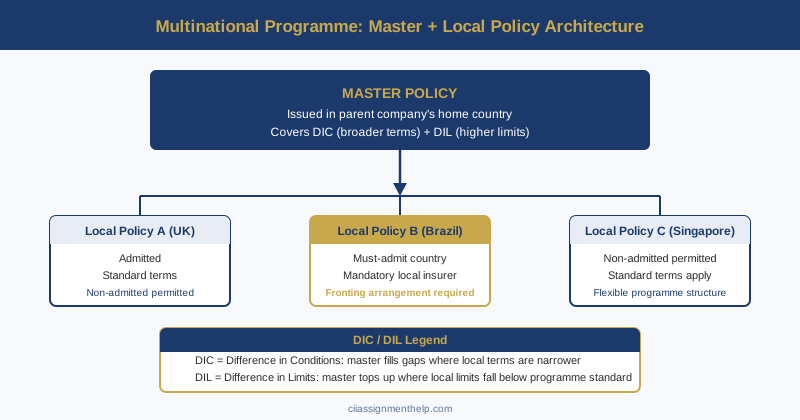
The master policy, issued in the parent company's home country, provides the corporate-level cover and the DIC/DIL top-up mechanism. Local policies are issued in each operating country by locally licensed insurers and are calibrated to meet that country's regulatory requirements. The relationship between the master and local policies is governed by two mechanisms that are central to 930 examination content.
DIC (Difference in Conditions): Where the local policy terms are narrower than the master programme standard, the master policy responds to fill the gap. A worked example: an MNC's local property policy in a particular territory excludes flood because that exclusion is market-standard in that country. The multinational programme standard includes flood coverage. The master policy's DIC section responds to any flood loss in that territory — the local policy does not respond, but the master provides cover up to the programme standard. Without the DIC mechanism, the MNC would have an unintended territorial coverage gap.
DIL (Difference in Limits): Where the local policy limit is lower than the multinational programme standard — either because local market capacity is limited or because compulsory insurance rules set a lower minimum limit — the master policy tops up the difference between the local policy limit and the programme standard limit. DIL is critical in jurisdictions with compulsory minimum limits that fall below the MNC's risk appetite, such as countries with statutory employers' liability or motor third party liability caps.
Admitted vs Non-Admitted Insurance: This is the structural compliance question that determines programme viability. Admitted insurance means the policy is issued by an insurer locally licensed in the country where the risk is located. Must-admit countries — including Brazil, China, India, and Saudi Arabia — require all policies covering risks in their territory to be issued by locally licensed insurers. Non-compliance exposes both the insured and the broker to regulatory penalties, premium tax liability, and potential unenforceability of the policy. Non-admitted insurance (a policy issued by a non-locally-licensed insurer) is permitted in many jurisdictions including the UK, Singapore, and Bermuda, but the insured may lose local regulatory protection. For multinational programme design, the broker's first strategic task is identifying which countries in the programme are must-admit jurisdictions and arranging locally licensed fronting partners accordingly.
Captive Insurance Management
A captive is an insurance company owned by the insured to underwrite the parent organisation's own risks. The advanced broker's role is not to describe what a captive is — it is to evaluate whether captive formation is justified, which structure is appropriate, which domicile is optimal, and how the fronting arrangement should be designed.
Captive feasibility analysis requires assessing whether captive formation is economically justified. The minimum premium threshold to justify formation and operating costs is typically £500,000 to £1 million annual premium equivalent — below this level, the fixed costs of maintaining a licensed captive entity (regulatory capital, management fees, audit, board governance) exceed the savings from risk retention. Minimum capital requirements vary by domicile: a Bermuda Class 1 captive requires minimum capital of $120,000, though typical capitalisation is substantially higher in practice.
Captive types for 930:
- Single-parent captive: A wholly owned insurance subsidiary of one parent organisation — the most common structure, providing maximum control and full retention of underwriting profit and investment income.
- Protected Cell Company (PCC): A single legal entity with multiple legally separated cells. Each cell's assets are ring-fenced from every other cell's liabilities — a loss in one cell cannot be satisfied from the assets of another. PCCs are the dominant structure in Guernsey and the Isle of Man, where they are established by statute, and are commonly used by organisations whose premium volume does not justify forming a standalone captive company.
Fronting arrangement mechanics: Must-admit country compliance requires a locally licensed insurer (the fronter) to issue the policy. The fronter cedes substantially all of the risk — typically 90–95% — back to the captive via a reinsurance arrangement. The fronter charges a fronting fee of between 0.5% and 5% of premium, reflecting its regulatory capital deployment, licence exposure, and administrative cost. The fronter retains a small percentage of the risk to satisfy local regulatory requirements that the locally licensed insurer retain a meaningful net position.
Captive domicile selection: Bermuda, Cayman Islands, Guernsey, Isle of Man, and Dublin each offer different regulatory capital regimes, tax treatment, supervisory approaches, and reputational positioning. The 930 broker must evaluate domicile selection against the parent's risk profile, preferred regulatory environment, and tax strategy — not simply default to Bermuda as the largest captive domicile.
Alternative Risk Transfer
Parametric insurance triggers payment on the occurrence of a defined physical parameter — for example, sustained wind speed exceeding 120 mph at a specified weather station, or earthquake magnitude exceeding 6.5 on the Richter scale at a defined geographic reference point — rather than on actual loss. No loss adjustment is required: payment is made automatically on trigger confirmation, typically within days of the event, providing faster liquidity than indemnity-based claims settlement.
The strategic challenge of parametric insurance is basis risk: the risk that the trigger event and the actual loss are misaligned. Two forms of basis risk must be addressed in programme design. A false trigger occurs when the trigger event is met (wind speed exceeds the threshold) but the insured suffers minimal actual loss — the insured receives a payout that exceeds its real loss. A basis risk gap occurs when the insured suffers a significant actual loss but the trigger is not met — the insured receives no payment despite the loss. The broker's analytical task is to design the trigger index, geographic reference point, and threshold levels to minimise both forms of basis risk for the specific insured's risk profile and exposure concentration.
Structured and finite risk solutions provide multi-year risk financing arrangements combining risk transfer with risk retention, typically used to smooth earnings volatility over a multi-year period. Weather derivatives provide financial instruments whose payoff is linked to a meteorological index — used primarily by energy, agriculture, and event management clients to manage revenue exposure to weather variation outside the catastrophe range.
How Does 930 Differ from M81?
The difference between 930 and M81 is not a difference in topics — it is a difference in the level of analysis required. M81 asks: how does a broker place a risk? 930 asks: how should a broker firm design its strategic approach to complex multinational clients?
At M81 level, a question about multinational insurance asks the candidate to describe the components of a multinational programme — the master policy, local policies, and the DIC/DIL mechanism. A competent M81 answer explains how the programme structure works. At 930 level, the same topic asks the candidate to evaluate: whether a DIC/DIL structure is appropriate for this client given the countries in scope; which countries require admitted policies; whether a captive is economically justified; how the fronting arrangement should be structured given the must-admit jurisdictions involved; and what the regulatory and tax consequences of the programme design choices are.
Similarly, at M81 level, a question about captive insurance asks for a description of captive types and their main characteristics. At 930 level, the question presents an organisation with a specific premium volume, risk profile, and geographic footprint and asks whether captive formation is justified — the candidate must apply the feasibility threshold, evaluate the domicile options, assess the fronting requirement, and recommend a specific structure with analytical justification.
The 930 written examination penalises candidates who answer at M81 level. Describing how multinational programmes work earns partial marks at best. Evaluating which programme architecture best serves the strategic needs of a defined client scenario — and defending that evaluation against alternative structures — is what 930 marks are awarded for.
FCA Regulatory Obligations at Senior Broker Level
Senior broker leadership carries regulatory accountability that is tested in 930 at firm governance level — not as a description of FCA rules but as an analysis of how those rules shape broker firm strategy and conduct obligations.
IDD Remuneration Disclosure and Conflicts of Interest
The Insurance Distribution Directive (IDD), implemented in the UK through FCA ICOBS rules, requires insurance intermediaries to disclose the nature of their remuneration to commercial clients on request. Disclosure must specify whether remuneration is fee-based, commission (brokerage) based, or a combination. The IDD requirement at senior broker level is not merely disclosure compliance — it is the governance obligation to maintain a documented conflicts of interest policy at firm level, identifying categories of conflict (contingent commissions, placement with affiliated insurers, volume bonus structures) and managing them in a way that demonstrates the broker is acting in the client's best interests.
FCA IDD rules require brokers to document identified conflicts of interest, implement management measures, and disclose residual conflicts to clients where management measures are insufficient to prevent damage to client interests. At 930 level, the analytical question is: how does a broker firm design its remuneration and conflict governance framework to comply with IDD obligations while maintaining commercial viability? Volume overriders, profit commissions, and facility arrangements all create potential conflicts that must be actively managed.
FCA Consumer Duty and TCFD Climate Obligations
The FCA Consumer Duty applies to broker firms with retail components, requiring firms to demonstrate that products and services deliver good outcomes for retail customers across four outcome areas: products and services, price and value, consumer understanding, and consumer support. At broker firm director level, Consumer Duty requires strategic review of product governance frameworks, fair value assessments, and customer communication standards — not simply compliance monitoring.
The Task Force on Climate-related Financial Disclosures (TCFD) imposes climate risk reporting requirements on large FCA-regulated broker firms. The phased UK implementation applies mandatory TCFD disclosures to the largest brokers first (Tier 1: those with annual premium income above £1 billion, mandatory from the earliest phase), with smaller firms phased in subsequently. Brokers subject to TCFD must disclose governance arrangements for climate risk, risk management approaches, metrics and targets, and scenario analysis. Beyond the regulatory obligation, 930 tests brokers' ability to advise corporate clients on physical and transition climate risk within their insurance programmes — understanding how climate change affects both the insurability of assets and the liability profile of businesses.
How Is 930 Assessed?
930 Advanced Insurance Broking is assessed by a single written examination worth 30 credits at Level 6. The examination requires structured analytical written answers — it is not MCQ and does not reward recall of isolated facts or description of broking processes.
The 930 examination presents scenario-based questions requiring candidates to evaluate strategic choices, compare programme structures, analyse regulatory obligations, and make recommendations with analytical justification. A typical question might present a multinational corporate client with operations in a defined set of countries — including must-admit jurisdictions — and ask the candidate to evaluate the appropriate programme structure, assess whether a captive is justified, and identify the regulatory compliance requirements. The answer expected is not a description of what multinational programmes are — it is a structured analysis of what this specific client's programme should be and why.
The examination is set at Level 6 — the same level as a bachelor's degree with honours. Answers must demonstrate the ability to synthesise multiple areas of the syllabus (programme design, captive management, regulatory compliance) within a single analytical response. Study hours are typically 120–150 hours across 15–20 weeks.
How to Structure Your 930 Written Answers
930 written answers must be structured for strategic analysis, not information delivery. The four-stage structure for 930 scenario questions is:
First, identify the strategic issue: is this a multinational programme design question (DIC/DIL, admitted vs non-admitted), a captive feasibility analysis, an alternative risk transfer evaluation, or a regulatory compliance question? Naming the issue correctly signals to the examiner that you are operating at the right analytical level.
Second, state the analytical framework: what are the key decision criteria for this type of issue? For a captive feasibility question, the criteria are premium threshold, domicile characteristics, fronting requirement, and tax treatment. For a parametric insurance question, the criteria are basis risk design, trigger selection, and the client's liquidity need. Apply the framework to the scenario facts — not generically.
Third, evaluate the options: 930 marks are earned by comparing alternatives. Do not recommend a single solution without addressing why the alternatives are less suitable for the specific facts presented.
Fourth, state a recommendation with justification: what is the optimal solution for this client, and what are the conditions under which that recommendation would change?
Common 930 exam failures: describing multinational programme mechanics without evaluating the specific programme design problem in the scenario; discussing captive types without assessing feasibility for the organisation described; naming must-admit countries without explaining the fronting arrangement implications; discussing parametric insurance without addressing basis risk.
Need expert help with your 930 written exam?
Contact us today for strategic exam preparation support.
💬 WhatsApp Us NowHow Does 930 Fit into the Advanced Diploma — and What Is ACII?
930 Advanced Insurance Broking is the designated core unit for the broking route through the CII Advanced Diploma in Insurance. Passing 930 — alongside 820 Advanced Claims Management and 960 Advanced Underwriting, and holding or completing the Diploma core units at M05, M92, and 530 level — satisfies the qualification requirements for the Advanced Diploma and confers ACII (Associate of the Chartered Insurance Institute) designation.
ACII is the primary senior professional qualification for UK insurance practitioners and is recognised across Lloyd's, the London market, and international insurance markets as the benchmark for broking, claims, and underwriting leadership. The 930 unit specifically signals broking-route competence at the strategic level required for client director and broking firm leadership roles.
930 is one of three core units required for the CII Advanced Diploma in Insurance — alongside 820 Advanced Claims and 960 Advanced Underwriting. Completion of all three core units and the required optional units, combined with the Diploma core unit credits, makes candidates eligible to apply for ACII designation.
Candidates who have completed M81 Insurance Broking Practice at Diploma level will find that 930 builds directly on that foundation — but operates at a categorically different analytical level. M81 provides the practice foundation; 930 requires strategic leadership-level analysis of the same subject matter. CII assignment help is available across the full CII qualification pathway, from Certificate through Advanced Diploma.
Frequently Asked Questions about 930
Q1: How hard is 930?
930 is one of the three hardest CII units because it requires genuinely strategic thinking — not just knowledge of broking processes but the ability to evaluate strategic choices, compare programme structures, and apply regulatory requirements to complex scenarios. The written examination specifically penalises candidates who describe how broking works rather than analysing strategic decisions. Candidates with senior client-facing experience find the content more accessible but often need structured support to translate their practical knowledge into the analytical written responses the Level 6 examiner requires.
Q2: How long does 930 take to study?
120–150 hours across 15–20 weeks is a typical preparation timeline for 930. The most common challenge is the shift from practical broking knowledge — which senior broking professionals hold in depth — to written analytical responses at the academic level the CII examiner expects. Candidates who work extensively in multinational broking often know the content instinctively but benefit significantly from structured practice in constructing analytical written answers that demonstrate evaluation and recommendation rather than description.
Q3: What is the difference between admitted and non-admitted insurance?
Admitted insurance means the policy is issued by an insurer locally licensed in the country where the risk is located — required in must-admit jurisdictions including Brazil, China, India, and Saudi Arabia. Non-admitted insurance means the policy is issued by an insurer not locally licensed in that country — permitted in many jurisdictions but potentially creating regulatory exposure for the insured and the broker. For multinational programme design, correctly identifying which countries require admitted policies and arranging fronting partners for those jurisdictions is a core strategic competency tested in 930.
Q4: What is DIC/DIL and why does it matter?
DIC (Difference in Conditions) and DIL (Difference in Limits) are the master policy mechanisms that close gaps between local policy terms and limits and the multinational programme standard. Without DIC/DIL, a local policy with narrower terms or lower limits creates an unintended coverage gap for the multinational insured. The master policy's DIC section fills term gaps — for example, providing flood coverage where the local policy excludes it — and the DIL section tops up limit differences between the local policy cap and the programme standard limit. Designing effective DIC/DIL coverage requires the broker to compare local policy terms against the programme standard line by line for every country in scope.
Q5: Do I need 930 to become ACII?
ACII status requires completing the CII Advanced Diploma in Insurance, which includes the three core units (820, 930, 960) and sufficient optional units alongside the Diploma core unit credits. 930 is the designated core unit for the broking route — it is required for candidates pursuing the Advanced Diploma through the broking pathway. Candidates who have already completed M81 at Diploma level will find that 930 content builds directly on that broking practice foundation, but at a strategic analytical level that demands a fundamentally different approach to examination preparation.
Need Support With 930 Advanced Insurance Broking?
Multinational programme design analysis, captive feasibility frameworks, alternative risk transfer evaluation, and regulatory compliance answer models — all structured to the Level 6 strategic analytical standard the CII examiner requires.
Get Your Free Quote 💬 WhatsApp Us Now