
CII Insurance Qualification Assignments
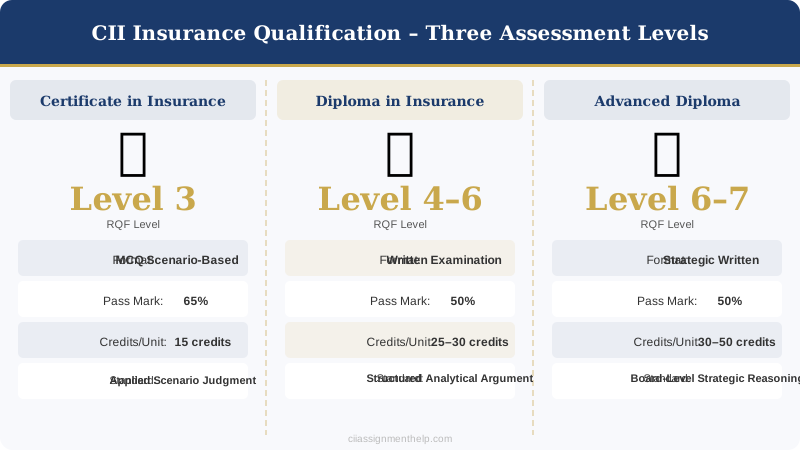
CII insurance qualification assignments are formally assessed components of the Chartered Insurance Institute qualification framework — a Regulated Qualifications Framework (RQF) structure spanning Certificate in Insurance (Level 3), Diploma in Insurance (Level 4–6), and Advanced Diploma in Insurance (Level 6–7). Each qualification requires students to pass individually assessed units, taking the form of MCQ scenario-based examinations at Certificate level or written examinations and structured coursework at Diploma and Advanced Diploma level. This service provides expert CII assignment help across all three qualification tiers, for every unit, for UK and international students.
Certificate in Insurance (Level 3)
- MCQ scenario-based examinations
- Pass mark: 65%
- 15 credits per unit
- IF1–IF11, GR1, LM3, R05 and international variants
- Applied professional judgment — not rote recall
Diploma in Insurance (Level 4–6)
Advanced Diploma in Insurance (Level 6–7)
- Strategic written assignments
- Level 6 core: 820, 930, 960
- Level 7 optionals: 991, 993, 994 (50 credits each)
- Portfolio and director-level reasoning required
- Pathway to ACII designation
What Is a CII Insurance Qualification Assignment?
A CII insurance qualification assignment requires a student to demonstrate applied professional knowledge within a defined assessment format, under the marking standards set by the Chartered Insurance Institute. The precise format — and therefore the nature of the challenge — differs between qualification levels.
MCQ Scenario-Based Exams — Certificate in Insurance
At Certificate in Insurance level, assessments are MCQ scenario-based examinations: each question presents a realistic professional insurance situation and the student must identify the correct professional action, policy interpretation, or legal position from four answer options. The pass mark is 65%. Rote memorisation of insurance definitions does not meet this standard — the examination requires applied judgment in a live professional context.
Applied Judgment, Not Definition Recall
A student who has read the IF3 syllabus and memorised the definition of an insurance warranty will not automatically know which of four scenario outcomes correctly reflects the effect of an Insurance Act 2015 section 10 breach under the given fact pattern. The scenarios require the student to reason from principle to outcome — under examination conditions, within the time limit, without reference materials.
Written Examinations and Coursework — Diploma and Advanced Diploma
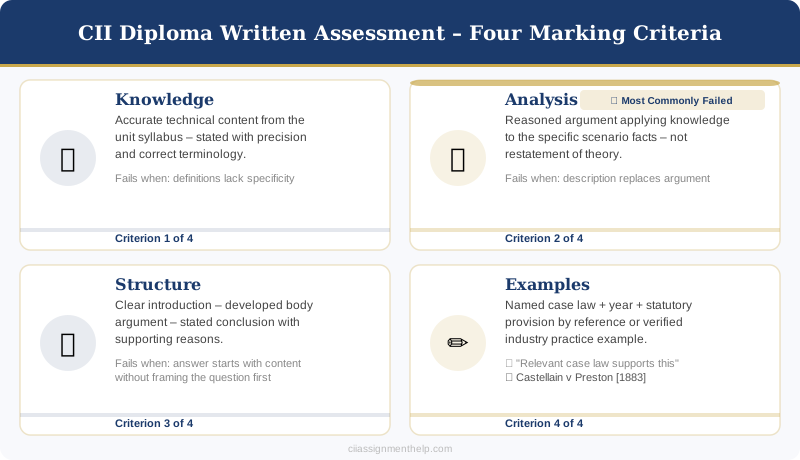
At Diploma in Insurance and Advanced Diploma in Insurance level, assessments are written examinations and structured coursework with a pass mark of 50%. The four marking criteria are applied separately and weighted independently:
Knowledge
Accurate technical content drawn from the unit syllabus — correct statements of insurance law principles, statutory provisions, financial metrics, or economic models.
Analysis
Reasoned argument applying knowledge to the specific question or scenario — identifying what the rule means for the given facts and why one outcome follows from the applicable principle. This is the most commonly failed criterion at Diploma level.
Structure
Logical sequencing with a clear introduction that frames the question, a developed body addressing each element in turn, and a conclusion stating the position with reasons.
Examples
Specific, verifiable citations: named case law with year and outcome, named regulatory provisions by reference, or named industry practice examples. General references do not score marks.
Why Most Diploma Students Who Fail Are Close to Passing
Most students who fail CII written assessments do so not because their Knowledge is insufficient, but because their Analysis is underdeveloped and their Examples are too general to score marks. "Relevant case law supports this position" is not an Example. "Castellain v Preston [1883]: the insurer's right of subrogation arises only after the insurer has paid the full amount of the insured's loss" is an Example that scores marks.
CII Certificate in Insurance — Assignment Types and Units
Each unit within the CII Certificate in Insurance covers a distinct professional insurance discipline and is assessed by a scenario-based MCQ examination worth 15 credits at RQF Level 3. The Certificate requires accumulation of units to achieve the award — students may combine IF series units, specialist units (GR1, LM3, R05), and approved international variant units.
| Unit | Module Title | Credits | Level |
|---|---|---|---|
| IF Series — Core Certificate Units | |||
| IF1 | Insurance: Legal and Regulatory | 15 | 3 |
| IF2 | General Insurance Business | 15 | 3 |
| IF3 | Insurance Underwriting Process | 15 | 3 |
| IF4 | Insurance Claims Handling Process | 15 | 3 |
| IF5 | Motor Insurance | 15 | 3 |
| IF6 | Household Insurance | 15 | 3 |
| IF7 | Healthcare Insurance | 15 | 3 |
| IF8 | Packaged Commercial Insurances | 15 | 3 |
| IF9 | Customer Service in Insurance | 15 | 3 |
| IF10 | Insurance Broking Fundamentals | 15 | 3 |
| IF11 | Risk and Insurance | 15 | 3 |
| Specialist Certificate Units | |||
| GR1 | Group Risk | 15 | 3 |
| LM3 | London Market Broker | 15 | 3 |
| R05 | Financial Protection | 15 | 3 |
| International Variant Units | |||
| WCE | Insurance Claims (International English) | 15 | 3 |
| WCA | Insurance Claims (Arabic) | 15 | 3 |
| WUE | Insurance Underwriting Process (International English) | 15 | 3 |
| WUA | Insurance Underwriting Process (Arabic) | 15 | 3 |
| W04 | Customer Service in Insurance (International) | 15 | 3 |
| IMU | India Motor Underwriting | 15 | 3 |
| IMP | India Motor Practice | 15 | 3 |
Unit-Specific Certificate Assignment Help
The most frequently requested Certificate-level units:
Need Help With a Certificate Unit?
Expert support for every IF unit, specialist unit, and international variant — scenario technique, applied rule application, and exam preparation
Get a Free Quote 💬 WhatsApp UsCII Diploma in Insurance — Core and Optional Module Support
Three compulsory core units form the foundation of the CII Diploma in Insurance — M05 Insurance Law and Practice, M92 Insurance Business and Finance, and 530 Economics and Business. All three must be passed before the Diploma award is conferred. These core units are assessed by written examination at a materially higher level of analytical demand than Certificate-level MCQ units — they require structured argument, case law citation, and demonstration of professional-level reasoning across all four marking criteria.
M05 Insurance Law and Practice
25 credits, RQF Level 4. Precise application of English contract law principles — the six elements of contract formation, misrepresentation and non-disclosure rules, classification of policy terms, and Insurance Act 2015 reforms to warranty law (s.9–s.11: warranties now operate as suspensive conditions, not absolute discharge triggers).
M92 Insurance Business and Finance
25 credits, RQF Level 4. Insurance company financial operations — premium setting, loss ratio and combined ratio analysis, reinsurance structures (proportional and non-proportional), Solvency II three-pillar framework (SCR/MCR; ORSA; SFCR disclosure), and distribution channel analysis.
530 Economics and Business
30 credits, RQF Level 6. Microeconomic and macroeconomic theory applied to the insurance market — demand elasticity, adverse selection, moral hazard, the underwriting cycle, macroeconomic factors (GDP, claims inflation, interest rates), and Porter's Five Forces applied to insurance market dynamics.
M05 — The Five Key Cases
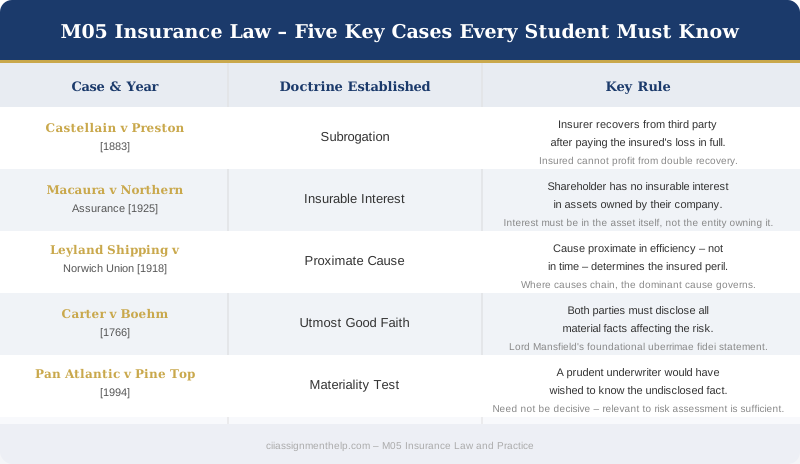
M05 Insurance Law and Practice demands the most intensive use of named case law of any unit in the CII Diploma. Five cases appear frequently across M05 assessments and must be understood at the level of the doctrine each establishes — not merely as names:
| Case | Doctrine Established |
|---|---|
| Castellain v Preston [1883] | Subrogation: after an insurer pays a claim in full, the insurer acquires the right to stand in the insured's place and recover from any third party responsible for the loss. The insured cannot profit — if they have already recovered from the third party, the insurer can reclaim the amount paid. |
| Macaura v Northern Assurance [1925] | Insurable interest: a shareholder does not have an insurable interest in the assets owned by the company in which they hold shares, even if they are the sole shareholder. Insurable interest must be a legally recognised financial interest in the subject matter itself, not in the entity that owns it. |
| Leyland Shipping v Norwich Union [1918] | Proximate cause: where a loss results from a chain of causes, the cause that is proximate in efficiency (not necessarily proximate in time) determines whether the loss falls within the scope of the insured peril. |
| Carter v Boehm [1766] | Utmost good faith (uberrimae fidei): Lord Mansfield's foundational statement that both parties to an insurance contract must disclose all material facts that would affect the other's decision — the insurer knows the general probability of risk; the insured knows the specific circumstances. |
| Pan Atlantic Insurance v Pine Top Insurance [1994] | Materiality test for disclosure: a fact is material if a prudent underwriter would have wished to know it before deciding whether to accept the risk and on what terms. It does not need to have been decisive — it merely needs to have been relevant to the prudent underwriter's assessment. |
Optional Specialist Units — Diploma Pathways
Beyond the three compulsory core units, Diploma students select optional specialist units aligned to their professional practice area:
Underwriting Professionals
M80 Underwriting Practice (30cr) — process and strategy of professional underwriting
Claims Professionals
M85 Claims Practice (30cr) — complex claims handling, large loss strategy, coverage dispute management
Insurance Brokers
M81 Broking Practice (30cr) — professional broking obligations, client management, market access strategy
London Market and Specialty
M97 Reinsurance · M90 Cargo · M98 Marine Hull · M96 Liability · M94 Motor · M91 Aviation (30cr each)
Life and Protection
P61 Life Underwriting · P62 Life Claims · P63 Long-term Insurance · P64 Private Medical Insurance (30cr each)
Commercial Property and BI
M93 Property and Business Interruption (30cr)
Risk Management
M67 Risk Management (30cr)
Delegated Authority / MGA
M66 Delegated Authority (30cr)
Policy Drafting / Personal Lines
M21 Contract Wording · M86 Personal Lines (30cr each)
CII Advanced Diploma in Insurance — Strategic Assignment Support
The Advanced Diploma in Insurance requires candidates to demonstrate strategic management capability at RQF Level 6 and Level 7 — not practice-level operational description. Completion of the Advanced Diploma and fulfilment of the CII's Chartered status requirements leads to the ACII designation — the recognised professional credential in the UK and international insurance market for experienced practitioners.
Strategic Reasoning — Not Operational Description
A unit 820 assignment that describes how a claims team processes a large loss claim — rather than analysing how a claims portfolio strategy should be adjusted in response to systemic frequency deterioration in a commercial property class — does not meet the Level 6 standard. Advanced Diploma assignments must argue at portfolio, strategy, and director level.
Core Level 6 Units — 820, 930 and 960
820 Advanced Claims Management
30 credits, Level 6. Strategic management of complex claims portfolios — how a portfolio of large loss claims affects the combined ratio and reinsurance recovery position; litigation strategy for coverage disputes exceeding delegated authority; coordination of major losses across multiple insurers, reinsurers, and loss adjusters.
930 Advanced Insurance Broking
30 credits, Level 6. Senior professional reasoning about corporate client broking — placement strategy decisions, market access choices, regulatory compliance architecture, and corporate client relationship management at director level.
960 Advanced Underwriting
30 credits, Level 6. Portfolio underwriting strategy — designing a risk appetite framework, constructing a reinsurance programme, pricing model design at the class of business level, and strategic underwriting decisions about risk selection and pricing adequacy.
Level 7 Optional Units — 991, 993 and 994

50 Credits Each — The Highest Weighting in the CII Framework
Units 991, 993, and 994 each carry 50 credits at Level 7 — the single highest credit weighting of any unit in the entire CII qualification framework. These require sustained strategic analysis and argument at executive or board level. Students undertaking these units are typically senior insurance professionals — directors, senior managers, or experienced specialists operating at a level where the written assignment must reflect board-level strategic reasoning.
991 London Market Specialisation
50 credits, Level 7. Lloyd's syndicate structure and governance, IUA market, Lloyd's Franchise Performance Directorate, global positioning relative to Bermuda/Singapore/Zurich, strategic implications of InsurTech and emerging risks for the London market.
993 Strategic Risk Management
50 credits, Level 7. ERM framework design, risk appetite articulation and governance, the interface between insurance purchasing strategy and the enterprise risk management framework, strategic implications of emerging risks (climate, cyber, geopolitical, supply chain disruption).
994 Insurance Market Specialisation
50 credits, Level 7. Deep specialisation in a chosen insurance market segment — expert, board-level understanding of that segment's strategic dynamics, competitive positioning, regulatory environment, and future trajectory.
How Our CII Assignment Help Service Works
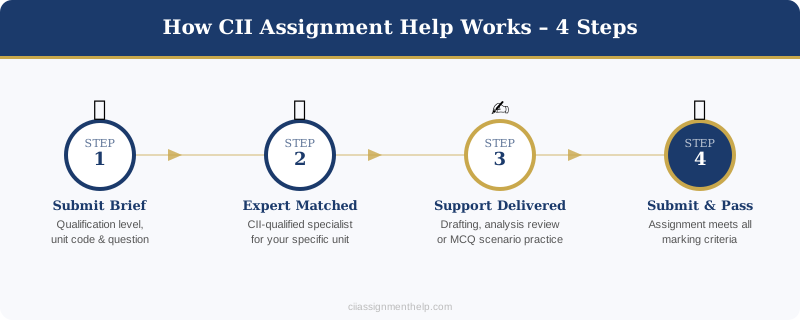
Students submit three pieces of information: their qualification level (Certificate in Insurance, Diploma in Insurance, or Advanced Diploma in Insurance), their unit code (for example, IF3, M05, or 820), and their assignment brief or examination topic. This information is used to match the request to a CII-qualified insurance professional or experienced unit tutor with demonstrated competence in the specific unit and assessment format.
Certificate Level Support
- MCQ scenario technique — reading and interpreting scenario questions systematically
- Unit-specific applied practice aligned to the named IF unit syllabus
- Explanation of the specific rules that appear in that unit's examination scenarios
- IF3: Insurance Act 2015 warranty provisions; IF4: subrogation timing; IF5: MIB scheme conditions
Diploma Level Support
- Written assignment drafting addressing all four marking criteria
- Case law explanation and application for M05 (doctrine, case name, year, outcome)
- Financial analysis support for M92 (combined ratio, reinsurance structure, Solvency II)
- Economic model application for 530 (underwriting cycle, PED, Porter's Five Forces)
Advanced Diploma Level Support
- Strategic written answer development for 820, 930, and 960 at portfolio and strategy level
- High-credit strategic analysis for Level 7 optional units (991, 993, 994)
- Analytical review and feedback on drafted strategic arguments
- Expert strategic drafting assistance — not study guidance
Submit Your Unit Code and Assignment Brief
All support is matched to the specific unit and assessment format — Certificate, Diploma, or Advanced Diploma
Get a Quote 💬 WhatsApp UsCII Assignment Help for International, Arabic-Speaking and Indian Students
The CII qualification framework includes a full range of international variant units designed for students sitting CII examinations outside the UK, in regulatory environments that differ from the FCA/PRA framework. International variant units cover the same core subject matter disciplines as their IF series equivalents but replace UK-specific statute references with general insurance principles applicable across jurisdictions.
International Variant Units
International variant units available within the CII Certificate framework include WCE and WCA (Insurance Claims — non-UK English and Arabic language variants), WUE and WUA (Insurance Underwriting Process — non-UK English and Arabic variants), and W04 (Customer Service in Insurance — international variant). These units test the same core knowledge as their UK IF equivalents — but the regulatory and statutory frame of reference is general insurance law principles, not the Insurance Act 2015 or ICOBS specifically.
Arabic-Language Units
Students who speak Arabic as their primary language may sit WCA (Claims — Arabic), WUA (Underwriting — Arabic), and at Advanced Diploma level, unit 590 Takaful Insurance in its Arabic-language variant. Arabic-language tutoring support is available for these units.
India Market — IMU and IMP
IMU (India Motor Underwriting) and IMP (India Motor Practice) are assessed under the IRDAI regulatory framework — the Motor Vehicles Act 1988 (India), IRDAI detariffication of Own Damage rates, IDV calculation, NCB scale, IRDAI's 5-year long-term third-party policy mandate, and the Solatium Fund. Support reflects the correct IRDAI regulatory context — not UK RTA 1988 content.
590 Takaful Insurance
Unit 590 is the most commonly requested CII unit among Arabic-speaking students in GCC markets. Takaful operates on Shariah-compliant principles — tabarru (mutual contribution), wakalah (agency model), and mudarabah (profit-sharing). Different GCC markets use different model combinations. Support requires genuine understanding of these models — not surface awareness that Takaful is "Islamic insurance."
Frequently Asked Questions
CII MCQ scenario-based examinations are used at Certificate in Insurance level. Each question presents a realistic professional insurance scenario — a claims dispute, an underwriting decision, a regulatory obligation — and the student must select the correct professional outcome from four answer options. The pass mark is 65%. The examination tests applied professional judgment: the ability to identify the correct rule and apply it to a described professional situation. It does not test recall of definitions in isolation.
CII written examinations are used at Diploma in Insurance and Advanced Diploma in Insurance level. The student writes structured answers to questions or analyses scenarios, marked independently on four criteria: Knowledge, Analysis, Structure, and Examples. The pass mark is 50%. The two formats require fundamentally different preparation — scenario-based MCQ requires practised applied interpretation; written examinations require structured argument construction supported by case law and regulatory citation.
CII assignment help is available for every unit in the qualification framework — including all optional specialist units at Diploma and Advanced Diploma level. At Diploma level, optional units include M80 Underwriting Practice, M81 Broking Practice, M85 Claims Practice, M96 Liability Insurance, M97 Reinsurance, M93 Property and Business Interruption, M94 Motor Insurance, M98 Marine Hull, M90 Cargo Insurance, M91 Aviation Insurance, M67 Risk Management, M66 Delegated Authority, P61 Life Underwriting, P62 Life Claims, P63 Long-term Insurance, P64 Private Medical Insurance, M21 Contract Wording, and M86 Personal Lines. At Advanced Diploma level, optional units include 590 Takaful, 545 Insurance Marketing, 990 Corporate Management, 991 London Market Specialisation, 992 Risk Management, 993 Strategic Risk Management, 994 Insurance Market Specialisation, 995 Strategic Underwriting, 996 Strategic Claims Management, and 997 Risk Financing. Submit your unit code and assignment brief and the request is matched to a specialist with competence in that unit.
The standard CII unit enrolment window is 12–18 months from the date of unit registration. Students must sit their unit examination within this window. A student who does not sit within the enrolment window must re-enrol and pay the unit registration fee to obtain a new examination sitting opportunity. Seeking CII assignment help early in the enrolment window — not in the final weeks before the examination date — allows sufficient time for preparation, practice, and review. For official enrolment window durations and extension policies, consult the Chartered Insurance Institute directly, as these may vary by unit and examination session.
CII assignment help is available to international students worldwide — including students sitting international variant units. International variant units supported include: WCE and WCA (Insurance Claims — non-UK English and Arabic), WUE and WUA (Insurance Underwriting Process — non-UK English and Arabic), W04 (Customer Service in Insurance — international variant), IMU (India Motor Underwriting — assessed under the IRDAI regulatory framework), IMP (India Motor Practice — IRDAI-aligned), and the Arabic-language variant of unit 590 (Takaful Insurance). All these units are awarded by the Chartered Insurance Institute but their content is assessed on the regulatory and market context relevant to the student's jurisdiction — not the UK FCA/PRA framework. Arabic-language tutoring support is available for Arabic-variant units.
Diploma written assignments are marked on four independently weighted criteria. Knowledge requires accurate technical content from the unit syllabus — correct statements of insurance law, regulatory provisions, financial concepts, or economic models. Analysis requires the student to reason from that knowledge to a conclusion about the specific question or scenario — not to restate theory, but to apply it and explain what it means for the situation described. Structure requires logical sequencing: a clear introduction that frames the question, a developed body that addresses each element in order, and a conclusion that states the student's position with supporting reasons. Examples require specific, verifiable citations — named case law with year and outcome (Macaura v Northern Assurance [1925]: shareholder has no insurable interest in company assets), named regulatory provisions by reference (Insurance Act 2015 s.3: duty of fair presentation), or named industry practice examples. Diploma answers that demonstrate adequate Knowledge but underdeveloped Analysis and insufficient Examples consistently fail — because Analysis and Examples carry substantial independent marking weight.
Get CII Assignment Help Now
Tell us your unit and qualification level. Supporting Certificate, Diploma and Advanced Diploma students across all units.
Get Your Free Quote 💬 WhatsApp Us Now