991 London Market Insurance Specialisation Assignment Help — Level 7 CII Advanced Diploma
Unit 991 — London Market Insurance Specialisation is a 50-credit Level 7 written examination unit within the CII Advanced Diploma in Insurance. It carries the highest credit value and the highest academic level of any single unit in the CII insurance qualification system. The exam requires analytical evaluation of Lloyd's strategic governance, market reform, international operations, and the company market context at a standard equivalent to postgraduate academic writing. The unit is taken by senior Lloyd's and London company market professionals — underwriters, brokers, claims managers, and market analysts — pursuing the ACII designation. A candidate cannot approach 991 as a factual recall exercise: every section of the exam demands argument, evidence, and evaluation, not description of how Lloyd's operates.
What Does 991 Cover? — The Syllabus at Level 7 Depth
Unit 991 covers five interconnected areas: the governance architecture of Lloyd's, Lloyd's performance management mechanisms, the Blueprint Two digital reform programme, Lloyd's international operations and post-Brexit positioning, and the IUA company market. What the 991 exam measures across all five areas is not what these structures are — candidates at Level 7 are expected to know that — but why they are structured as they are, what their governance implications are, and how the market is evolving.
Lloyd's Governance Structure at Strategic Depth
The Society of Lloyd's is a corporate entity governed by the Council of Lloyd's — the ultimate governing body of the market. The Council holds statutory powers under the Lloyd's Acts: it admits members, makes Lloyd's byelaws, and provides constitutional governance oversight. The Council has delegated substantial operational authority to the Franchise Board, which is responsible for the commercial management of Lloyd's on a day-to-day basis.
The Council vs the Franchise Board — a distinction 991 examines directly: The Council sets the constitutional framework; the Franchise Board runs the market. Council composition includes working Names, corporate members, external members, and nominated Council members. The Franchise Board is chaired by the Lloyd's CEO and includes non-executive directors and managing agent representatives. The 991 exam regularly presents governance scenarios requiring candidates to identify whether a particular action or decision falls within the Council's constitutional authority or the Franchise Board's operational authority — and to analyse the implications of that distinction for accountability.
Funds at Lloyd's (FAL): Every member — whether a corporate member or an individual Name — must maintain capital as a deposit against underwriting obligations. The FAL level is set by Lloyd's annually using an Economic Capital Assessment (ECA) — a bottom-up calculation of each member's capital requirement based on their underwriting profile, class mix, and RDS (Realistic Disaster Scenario) results. The ECA methodology ensures that FAL requirements reflect the actual risk each member is writing, not a flat rate.
Chain of Security: Lloyd's financial security structure operates in three layers, each layer providing successively deeper protection for policyholders:
| Layer | Mechanism | Function |
|---|---|---|
| 1 — Premium Trust Funds (PTFs) | Policyholder premiums held in trust by managing agent | First call against claims — ring-fenced from managing agent's own assets |
| 2 — Member-level assets | Each member's individual Funds at Lloyd's (FAL) | Second call — individual capital posted as security |
| 3 — Central Fund (Central Assets) | Lloyd's mutual backstop, funded by annual levies on members | Last-resort protection — mutualisation mechanism |
The Chain of Security is the foundation of Lloyd's S&P A+ financial strength rating. For 991, candidates must evaluate why this three-layer structure exists — the mutualisation in Layer 3 provides policyholder protection regardless of individual member insolvency, but it also means performing members cross-subsidise failing members. The Decile 10 performance management mechanism exists partly to limit the systemic drag on the Central Fund from persistently unprofitable underwriting.
Lloyd's Performance Management — FPD, SBP, and Decile 10
The Franchise Performance Directorate (FPD) is the Lloyd's executive unit responsible for performance management of managing agents and their syndicates. The principal mechanism is the Syndicate Business Plan (SBP).
SBP process: Each managing agent submits an SBP annually — typically by October for the following underwriting year. The SBP specifies proposed premium volumes by class, geographic mix, pricing assumptions, projected combined ratios, and RDS (Realistic Disaster Scenario) results. The FPD reviews each SBP against Lloyd's performance standards: proposed volumes must be justifiable, RDS exposure must fall within Lloyd's aggregate tolerance, and the projected combined ratio must demonstrate a credible path to profitability. Lloyd's may restrict, modify, or reject an SBP that does not meet these standards. This gives the Franchise Board direct operational control over each syndicate's capacity deployment — a degree of top-down market management that has no equivalent in the company market.
Decile 10: Lloyd's annually ranks all business classes written across the market by profitability on a 10-year rolling basis. The worst-performing 10% are subject to mandatory capacity restriction — syndicates writing Decile 10 classes must either exit those classes or accept reduced capacity. The strategic implication for 991: Decile 10 creates tension between managing agent commercial autonomy (syndicates may have reasons to maintain positions in currently unprofitable classes for cycle reasons) and the Franchise Board's mandate to protect the market's aggregate portfolio quality. The 991 exam expects candidates to evaluate this tension, not simply describe the mechanism.
Realistic Disaster Scenarios (RDS): Lloyd's mandates that each managing agent calculate its RDS exposures — modelled losses from a defined set of catastrophe events (Gulf of Mexico windstorm, US earthquake, Japanese earthquake, European windstorm, and others). Aggregate RDS results across the market inform Lloyd's decisions on capacity limits per class and geographic concentration. The RDS framework is the basis for Lloyd's aggregate exposure management.
Blueprint Two — London Market Digital Reform
Blueprint Two is Lloyd's and the London market's programme to modernise the placement and processing of insurance contracts — addressing a structural inefficiency that had accumulated over decades of paper-based processes, inconsistent data, and fragmented back-office services.
The strategic context — why Blueprint Two was necessary: The London market's reliance on physical broker visits to Lloyd's underwriting boxes, paper slip documentation, and manual data re-keying at each stage created delays measured in days for contract binding, data inconsistencies across market participants, and processing costs far in excess of comparable digital markets. By the mid-2010s, the London market was visibly losing share of international business to competing centres (Bermuda, Singapore, Zurich) where digital infrastructure was more developed. Blueprint Two is the market's structural response.
Key components of Blueprint Two:
| Component | What It Is | What It Does |
|---|---|---|
| PPL (Placing Platform Limited) | Electronic placing solution | Replaces paper-based Lloyd's slip for standard risks; digital contract captures data at source, feeds directly into downstream processing systems |
| CDRC (Central Data Repository and Contract) | Market data standard | Standardises contract data capture across all market participants; eliminates re-keying and data inconsistency |
| LIMOSS (London Market Operations and Shared Services) | Centralised back-office services | Consolidates premium processing, claims processing, and settlement across the market; replaces fragmented broker and underwriter back-office operations |
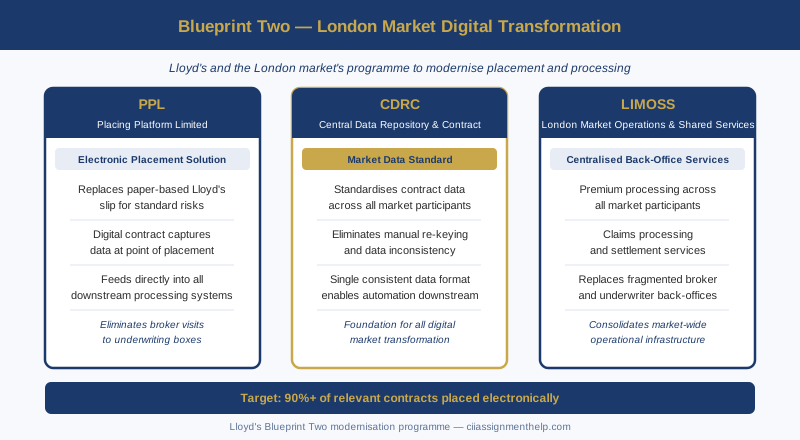
Strategic implications for 991: Blueprint Two is not simply an IT programme — it requires culture change, system investment, and managing agent commitment across a market of competing commercial entities with historically autonomous operations. The 991 exam expects candidates to evaluate the barriers to implementation (incumbent system investment, data sovereignty concerns among managing agents, broker resistance to transparency in placing), the strategic risks if Blueprint Two is only partially adopted, and the competitive implications of successful digitalisation for Lloyd's international market position.
Lloyd's Brussels (Lloyd's Insurance Company SA — LIC SA): Post-Brexit, Lloyd's established Lloyd's Insurance Company SA as an EU-authorised insurance entity incorporated in Belgium. LIC SA allows Lloyd's to write EU risks on an admitted basis — policies underwritten via LIC SA carry full EU regulatory protection and can be sold across EU member states under the EU passport framework. For 991, the establishment of LIC SA tests the candidate's understanding of why passporting rights mattered to Lloyd's post-Brexit and how the market has structurally adapted to preserve EU market access.
Lloyd's International Operations and Post-Brexit Positioning
Lloyd's operates in over 200 territories — the broadest geographic licence footprint of any insurance market in the world. This reach is maintained through a combination of Lloyd's global licences (held by the Society of Lloyd's or local fronting vehicles) and Lloyd's Trust Funds — premium held locally in countries that require premium deposit as a condition of admitted market access.
Lloyd's global licence structure: In some markets, Lloyd's operates as a non-admitted surplus lines carrier (notably the United States, where Lloyd's operates under E&S surplus lines regulation in most states). In others, Lloyd's holds admitted licences — allowing Lloyd's syndicates to write regulated insurance without a local fronting vehicle. The distinction matters for 991: E&S business provides flexibility but limits the policyholder base (only commercial insureds who cannot obtain cover in the admitted market can access E&S carriers), while admitted business is more broadly accessible but requires compliance with local regulatory requirements.
Lloyd's Asia: Singapore is Lloyd's primary Asian hub. Lloyd's Asia is authorised by the Monetary Authority of Singapore (MAS) and operates as an admitted insurance vehicle for Southeast Asian business. The Singapore hub reduces the need for Lloyd's syndicates to rely on fronting arrangements for Southeast Asian business and supports Lloyd's positioning in the growing Asian specialty market.
Post-Brexit impact on European business: Before Brexit, Lloyd's could write EU business under UK regulatory authorisation using the EU single market passport. Post-Brexit, Lloyd's Insurance Company SA (Brussels) provides the EU admitted entity. The transition required Lloyd's to migrate EU policyholders to LIC SA and establish a fully operational Belgian regulatory infrastructure — a significant operational project alongside continued market reform under Blueprint Two.
IUA and the London Company Market
The International Underwriting Association (IUA) is the trade body for London company market insurers and reinsurers — the segment of the London market that operates through company structures rather than Lloyd's syndicates. IUA member companies include major global reinsurers with London offices: Munich Re London, Swiss Re London, Zurich, AXA XL, Convex, and others.
| Lloyd's Market | IUA Company Market | |
|---|---|---|
| Regulatory structure | Lloyd's syndicates, regulated by Lloyd's and PRA | Authorised insurance companies, regulated by PRA/FCA |
| Governance | Franchise Board oversight, SBP process, Chain of Security | Individual company governance under SMCR and Solvency II |
| Programme design | Syndicate participation (lead + follow) on Lloyd's slip | Company market participates directly on programme structures |
| IUA role | N/A — Lloyd's is governed separately | IUA provides model wordings, statistical reporting, market standards |
The IUA publishes market standard policy wordings, manages statistical reporting for the company market segment, and represents company market interests alongside Lloyd's in market-wide initiatives including Blueprint Two (through the Joint London Initiative — JLI). For 991, candidates must understand that the London market is not synonymous with Lloyd's — the company market is a substantial separate segment, and the largest specialty risks are frequently placed across both segments simultaneously.
How Does 991 Differ from LM3? — The Level Distinction
LM3 (Level 3, 15 credits) and 991 (Level 7, 50 credits) both address the London insurance market, but they operate on entirely different intellectual planes. The distinction is not a matter of more detail — it is a matter of a fundamentally different analytical task.
LM3 describes; 991 analyses and evaluates. LM3 requires candidates to know that the Chain of Security has three layers and to describe each. 991 requires candidates to evaluate why the three-layer structure exists, what its implications are for policyholder protection versus member cross-subsidisation, and how the Decile 10 mechanism serves as a risk management response to the Central Fund's mutualisation exposure.
LM3 states; 991 argues. A Level 3 answer on Blueprint Two would explain what PPL is and what CDRC does. A Level 7 answer on Blueprint Two must construct an argument: assess the strategic rationale for digitalisation, evaluate the barriers to implementation given the London market's fragmented commercial structure, and reach a reasoned conclusion about the conditions under which Blueprint Two succeeds or fails as a market reform.
LM3 presents a single perspective; 991 weighs competing perspectives. The Franchise Board's mandate to maintain portfolio quality through SBP control is legitimate; a managing agent's argument for commercial autonomy in class selection is also legitimate. 991 exam answers must engage with both perspectives, evaluate the evidence, and reach a justified conclusion — not simply present one side.
| LM3 | 991 | |
|---|---|---|
| Level | Level 3 | Level 7 |
| Credits | 15 | 50 |
| Assessment standard | Certificate — knowledge recall | Advanced Diploma — academic analytical writing |
| Answer requirement | Describe what structures exist | Evaluate why structures exist and what their strategic implications are |
| Evidence requirement | None — knowledge sufficient | Required — reference to market data, governance outcomes, reform progress |
How Is 991 Assessed?
Unit 991 is assessed by written examination. At Level 7, the exam requires academic-standard analytical essays — not knowledge recall answers. The examination tests the candidate's ability to construct evidence-based arguments about Lloyd's governance, market reform, and international operations.
Structure of a Level 7 991 answer: (1) Establish the analytical question the examiner is posing — what governance principle, market reform issue, or strategic question is being tested. (2) Present the relevant framework or structure with precision — use correct terminology (Franchise Performance Directorate, not "Lloyd's performance team"; Syndicate Business Plan, not "Lloyd's annual plan"). (3) Develop an analytical argument — evaluate competing perspectives, weigh evidence, and construct a reasoned position. (4) Reach a justified conclusion — not a neutral summary, but a reasoned conclusion that follows from the argument.
Common Level 7 failures in 991: Listing the components of Blueprint Two without evaluating why the reform is difficult to implement. Describing the Chain of Security without analysing its governance implications. Stating that the Franchise Board approves SBPs without evaluating what criteria it applies and how that creates tension with managing agent autonomy. At Level 7, description without analysis does not demonstrate the required academic standard.
How Does 991 Fit into the Advanced Diploma — and Why Does 50 Credits Matter?
At 50 credits, unit 991 carries a weight that reflects both the breadth of its syllabus and the academic depth it requires. The Advanced Diploma in Insurance requires candidates to accumulate a specified total credit value across core and optional units to achieve ACII eligibility. Candidates taking 991 as their primary optional unit — alongside a 30-credit core unit such as 960 (Advanced Underwriting) — contribute 50 credits from a single optional unit, substantially reducing the number of separate examinations required to complete the Advanced Diploma.
The 50-credit weight also signals the exam's scope: 991 covers Lloyd's governance, performance management, digital reform, international operations, and the company market context, each at Level 7 analytical standard. A candidate cannot prepare selectively — all major syllabus areas are examinable, and the exam is long enough to test multiple areas within a single sitting.
Get Expert Help with Your 991 London Market Exam
Our 991 support team includes Lloyd's specialist experts with Level 7 academic writing capability. We provide analytical argument coaching, Blueprint Two and governance framework preparation, and written exam practice calibrated to the 50-credit Level 7 standard.
💬 WhatsApp Us NowUnit 991 is an optional unit in the CII Advanced Diploma in Insurance — but at 50 credits at Level 7, it is the highest-weight single unit in the entire CII insurance qualification system. Candidates who combine 991 with a 30-credit core unit such as 960 Advanced Underwriting or 820 Advanced Claims can meet substantial Advanced Diploma credit requirements with just two units beyond the shared core.
For candidates coming from LM3 London market at Certificate level, 991 represents a step change in both academic standard and analytical depth — not a continuation of the same approach. The jump from Level 3 description to Level 7 evaluation requires deliberate preparation of a different kind. CII assignment help is available across the full qualification pathway.
Frequently Asked Questions about 991
Q1: How hard is 991?
Unit 991 is the most academically demanding optional unit in the CII insurance qualification system. Level 7 requires writing at university postgraduate standard — evidence-based argument, analytical framing, and justified conclusions, not knowledge display. Candidates with deep Lloyd's experience often know the content thoroughly but struggle with the academic structure the exam requires: constructing an argument rather than describing a process, and reaching a reasoned conclusion rather than summarising both sides neutrally. The 50-credit weight means the examination is substantially longer and more demanding in scope than any other CII unit. Preparation support focused specifically on analytical writing technique is as important as content preparation.
Q2: Why does 991 carry 50 credits?
The 50-credit value reflects the scope of the 991 syllabus and the academic standard required. The unit covers Lloyd's governance architecture at strategic depth, the Blueprint Two market reform programme, Lloyd's international operations including post-Brexit positioning, and the IUA company market — all at Level 7 analytical standard. For Advanced Diploma credit requirements, 991's 50 credits contribute significantly: candidates who take 991 as their main optional unit alongside a 30-credit core unit can meet substantial qualification credit requirements from two examinations rather than the higher number required if all units carry 30 credits.
Q3: What is the difference between the Council of Lloyd's and the Franchise Board?
The Council of Lloyd's is the ultimate governing body of the Society of Lloyd's — holding statutory powers under the Lloyd's Acts to admit members, make byelaws, and provide constitutional governance oversight. The Franchise Board is an operational body created by the Council to manage Lloyd's commercially on a day-to-day basis — it approves Syndicate Business Plans, sets performance standards, and oversees the Decile 10 initiative. The constitutional principle is that the Council sets the framework within which Lloyd's operates; the Franchise Board manages the market within that framework. The 991 exam tests this distinction through scenario questions requiring candidates to identify which body has authority over a given decision and to evaluate the governance implications of the division of authority.
Q4: What is Blueprint Two and why is it important for 991?
Blueprint Two is Lloyd's and the London market's digital transformation programme, centred on PPL (Placing Platform Limited) for electronic contract placement, CDRC for data standardisation, and LIMOSS for shared back-office services. For 991, Blueprint Two is important not because of what its components are — that is LM3-level knowledge — but because of why the reform was necessary, what barriers exist to implementation across a market of competing commercial entities, and what successful digitalisation would mean for Lloyd's competitive position internationally. The 991 exam expects analytical evaluation of Blueprint Two as a strategic market reform, not a list of its component programmes.
Q5: Do I need to work in Lloyd's to study 991?
Direct Lloyd's or London company market experience provides a significant contextual advantage in studying 991, but it is not a prerequisite. Candidates from broader insurance backgrounds who are entering London market roles, or who wish to develop London market expertise as part of their ACII qualification, can study 991 effectively with appropriate preparation support. The content is learnable; the analytical writing standard is the primary challenge for most candidates regardless of background.
Need Support With 991 London Market Insurance Specialisation?
Lloyd's governance framework analysis, Blueprint Two strategic evaluation, Chain of Security implications, post-Brexit positioning, and IUA company market — all prepared to the Level 7 academic analytical standard the CII examiner requires.
Get Your Free Quote 💬 WhatsApp Us Now