GR1 is a 15-credit Level 3 CII unit assessed by MCQ scenario-based examination, covering employer-sponsored group risk insurance: group life assurance, group income protection, and group critical illness. GR1 is specifically designed for professionals working in employee benefits, group risk broking, HR advisory, or corporate insurance roles where employer-funded protection schemes form part of the job function.
Group Life Assurance – Death in Service Benefits
Benefit Design
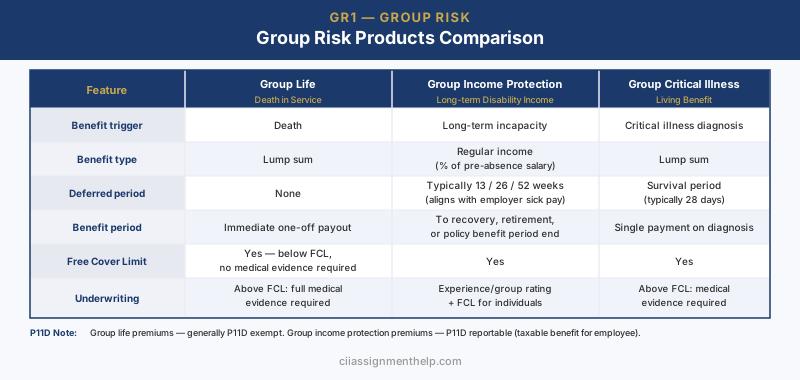
Group life assurance (death in service) benefit is typically expressed as a multiple of the employee's annual salary – for example, 2× or 4× salary. The employer pays the entire premium; the benefit is payable to the beneficiaries upon the employee's death.
Trust Structure
Group life benefits are written in trust. This means the benefit does not form part of the deceased employee's estate and is therefore not subject to inheritance tax or probate delay. The trustees – typically employer representatives – hold the benefit on trust for the beneficiaries and have discretion over who receives it.
Expression of Wishes
The employee nominates preferred beneficiaries via an expression of wishes form. This document is not legally binding on the trustees – it is influential guidance, but the trustees retain final discretion and can depart from it if circumstances justify.
Free Cover Limit (FCL)
The Free Cover Limit is the maximum benefit per member that the insurer will cover without requiring individual evidence of health. Members whose benefit entitlement is at or below the FCL are covered automatically. Members whose benefit exceeds the FCL must provide individual medical evidence for the excess amount. A larger scheme typically attracts a higher FCL.
P11D Tax Treatment
Employer-paid group life assurance premiums are generally exempt from P11D reporting for employees – they do not create a personal income tax liability. Group income protection premiums paid by employers, however, are P11D reportable – they constitute a taxable benefit in kind for the employee.
Group Income Protection – Replacing Employee Income During Long-Term Absence
Benefit Basis
GIP benefits are typically set at 50–75% of the employee's pre-absence salary. The benefit is not designed to replace full salary – preserving the financial incentive to return to work.
Deferred Period
The deferred period is the waiting period before GIP benefits commence. Standard options: 13 weeks, 26 weeks, and 52 weeks. A 52-week deferred period costs significantly less than a 13-week period. Employers with generous occupational sick pay may choose a longer deferred period.
Definition of Disability
| Definition | Description | Impact |
|---|---|---|
| Own occupation | Unable to perform the specific duties of the employee's own job | Most generous – highest premium cost |
| Any occupation | Unable to perform any occupation for which they are suited | Most restrictive – lowest premium cost |
| Activities of daily work (ADW) | Unable to perform a defined list of functional work activities | Intermediate |
Statutory Sick Pay Integration
SSP pays £116.75 per week (2024-25) for a maximum of 28 weeks. Eligibility requires average weekly earnings above the Lower Earnings Limit of £123 per week. Where the GIP deferred period is 52 weeks, a gap exists between SSP exhaustion at week 28 and GIP commencement at week 52 – the employee must claim Employment and Support Allowance (ESA) during this gap.
Rehabilitation Services
Modern GIP insurers provide insurer-funded vocational rehabilitation services – physiotherapy, psychological support, occupational health referrals, and workplace adjustment advice. These are triggered early in absence to reduce total claim duration.
Group Critical Illness – Lump Sum on Diagnosis
ABI Model Definitions
The ABI publishes standardised condition definitions to ensure consistency across insurers. The three core conditions by claim volume:
Cancer
Malignant tumour meeting specified staging criteria – less advanced cancers excluded.
Heart Attack
Death of heart muscle due to coronary artery blockage – evidenced by specific ECG changes and enzyme elevation.
Stroke
Cerebrovascular event causing permanent neurological deficit lasting a minimum specified period – TIAs excluded.
Standard GCI covers 5–7 conditions. Extended GCI covers 30–50 conditions.
Survival Period
Most GCI policies include a survival period – typically 14 or 30 days from diagnosis – before the benefit is paid.
Employer Statutory Obligations – SSP and Equality Act 2010
Statutory Sick Pay
Employers must pay SSP to eligible employees who cannot work due to illness. SSP pays £116.75 per week for a maximum of 28 weeks. When SSP exhausts, the employer's obligation ends and the employee may apply for ESA.
Equality Act 2010 – Disability Definition
Under the Equality Act 2010, a person has a disability if they have a physical or mental impairment that has a substantial and long-term adverse effect on their ability to carry out normal day-to-day activities. "Long-term" means lasting or expected to last at least 12 months.
Reasonable Adjustments
Employers must make reasonable adjustments for employees with disabilities. These may include: modified working hours, adapted equipment, phased return to work, reallocation of specific duties. Failure to make reasonable adjustments constitutes disability discrimination.
Scheme Design – Free Cover Limit, Membership, and Tax Treatment
Actively at Work Clause
Members must be actively at work on the date of scheme commencement to be covered from that date. An employee absent due to illness on the scheme commencement date will not be covered until they return to active employment.
Tax Treatment Summary
| Product | Employer Premium – P11D? | Employee Benefit – Tax? |
|---|---|---|
| Group life assurance | Generally exempt – not P11D | Generally not subject to inheritance tax (trust structure) |
| Group income protection | P11D reportable – taxable benefit | GIP payments are taxable income for the employee |
| Group critical illness | P11D reportable in most cases | Lump sum – broadly no income tax |
How to Pass the GR1 MCQ Exam – Exam Technique
Common GR1 Exam Traps
1. Treating expression of wishes as legally binding – it is not. The trustees retain final discretion.
2. Assuming GIP benefits begin when SSP ends – GIP has a deferred period. With a 52-week deferred period and 28-week SSP, a gap of approximately 24 weeks exists.
3. Treating group life premiums as P11D reportable – they are generally exempt. Group income protection premiums ARE P11D reportable.
4. SSP calculation – know the weekly rate (£116.75) and 28-week maximum duration.
Need GR1 MCQ Exam Support?
Structured topic summaries, product comparison cards, tax treatment reference sheets, and scenario-based MCQ practice covering the full GR1 syllabus.
💬 WhatsApp Us NowGR1 Within the CII Qualification Pathway
GR1 is a specialist Certificate-level unit for professionals in the group risk and employee benefits sector. GR1 complements IF1 insurance legal and regulatory assignment help, which provides the broader insurance law framework within which group risk products operate. For CII Certificate in Insurance assignment help, this service provides structured exam preparation.
Frequently Asked Questions – GR1
Is GR1 the same as the IF unit series?
GR1 is a separate unit within the CII Certificate framework, specifically designed for the group risk and employee benefits sector. It covers employer-sponsored group risk schemes – group life, group income protection, and group critical illness – not the general insurance products addressed in the IF series.
What is the free cover limit in group risk?
The FCL is the maximum benefit per member the insurer covers without individual medical evidence. Members at or below the FCL are automatically covered; members above must undergo individual underwriting for the excess amount. Larger schemes typically attract higher FCLs.
How does group income protection integrate with SSP?
SSP pays £116.75 per week for up to 28 weeks. GIP has a deferred period of 13, 26, or 52 weeks. A 26-week deferred period gives approximate continuity with SSP exhaustion. A 52-week deferred period creates a ~24-week gap during which the employee must claim ESA.
Need Support With GR1 Group Risk?
Structured topic summaries, group risk product comparison cards, tax treatment reference sheets, SSP and GIP integration guides, and scenario-based MCQ practice covering the full GR1 syllabus.
Get Your Free Quote 💬 WhatsApp Us Now