
What Does IF1 Cover?
IF1 Insurance: Legal and Regulatory is a 15-credit Level 3 unit within the CII Certificate in Insurance, assessed by a scenario-based multiple-choice question (MCQ) examination conducted at a test centre or under remote invigilation. The unit covers the legal foundations of insurance — the six principles of insurance law with their statutory sources and case law authorities — alongside the FCA regulatory framework, Insurance Conduct of Business Sourcebook (ICOBS), and the Insurance Distribution Directive (IDD). IF1 is taken by insurance professionals and new entrants to the sector who are working toward the CII Certificate in Insurance qualification. This service provides structured IF1 exam preparation support for all syllabus areas, with particular focus on applying legal principles correctly to MCQ scenario questions.
IF1 assesses your ability to apply the six principles of insurance law — each grounded in statute or case law authority — and to apply the FCA's conduct requirements for insurance distribution to scenario-based questions.
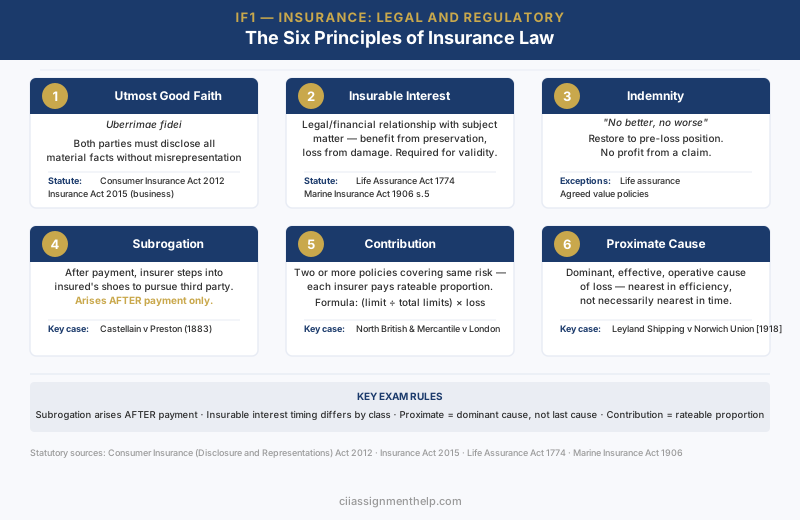
The Six Principles of Insurance Law
1. Utmost Good Faith (uberrimae fidei)
Both parties to an insurance contract owe a duty of the utmost good faith. For consumers, the Consumer Insurance (Disclosure and Representations) Act 2012 replaced the insured's disclosure duty with a duty to take reasonable care not to make a misrepresentation. Inadvertent misrepresentation triggers a proportionate remedy; deliberate or reckless misrepresentation allows the insurer to avoid the policy and retain the entire premium. For business policyholders, the Insurance Act 2015 introduced a duty of fair presentation.
2. Insurable Interest
The insured must have a legal or financial relationship with the subject matter such that they benefit from its preservation and suffer loss from its damage. Under the Life Assurance Act 1774, insurable interest must exist at the time the policy is taken out. For indemnity contracts, insurable interest must exist at the time of the loss (Marine Insurance Act 1906 s.5). The leading case is Macaura v Northern Assurance [1925].
3. Indemnity
Indemnity requires that insurance restores the insured to the same financial position as before the loss — no better, no worse. Indemnity does not apply to life assurance contracts.
4. Subrogation
Once an insurer has indemnified the insured, the insurer acquires all rights and remedies the insured held against any third party responsible for the loss. The authority is Castellain v Preston (1883). Subrogation rights arise only after the insurer has paid the claim — not before.
5. Contribution
Where two or more insurance policies cover the same risk, the same insured, the same peril, and the same insurable interest, each insurer contributes proportionately to the settlement. The authority is North British & Mercantile v London — the rateable proportion method applies.
6. Proximate Cause
The proximate cause is the dominant, effective, or operative cause — not necessarily the first or last event in a chain. The authority is Leyland Shipping v Norwich Union [1918]. A policy responds only if the proximate cause of the loss is an insured peril.
FCA Regulation, ICOBS and the IDD in IF1
FCA dual regulation: The FCA regulates conduct; the PRA regulates financial soundness. The FCA's three statutory objectives are: consumer protection, market integrity, and promoting competition.
ICOBS: Sets conduct standards for all firms distributing insurance products. Key requirements: assessing demands and needs; communicating product information fairly; settling undisputed claims promptly; providing a 14-day cancellation right.
IDD: Applies to all insurance distributors. Pre-contractual requirements include provision of the Insurance Product Information Document (IPID). IDD-regulated firms must complete minimum 15 hours CPD per year.
How Is IF1 Assessed?
IF1 is assessed by a single-sitting scenario-based MCQ examination. The indicative pass mark is approximately 65%. IF1 MCQ questions present a short business scenario followed by four answer options. Candidates typically require 50–80 hours of structured study.
The Six Principles — Depth for IF1 Exam Success
Applying Proximate Cause to IF1 Scenarios
In IF1 MCQ scenarios, the examiner presents a chain of events leading to a loss. In Leyland Shipping v Norwich Union [1918], a torpedoed vessel was moored in harbour and sank as a result of storm damage to the already-weakened hull. The proximate cause was held to be the torpedo damage, not the storm.
Consumer Insurance Act 2012: Proportionate Remedies in Practice
For inadvertent misrepresentation, the three-step proportionate analysis is:
Step 1 — Would the insurer have declined the risk entirely? Insurer may avoid but must return a proportionate premium.
Step 2 — Would the insurer have written on different terms? Those different terms apply from inception.
Step 3 — Would the insurer have charged a higher premium? The claim is reduced: (premium paid ÷ premium that should have been charged) × loss amount.
For deliberate or reckless misrepresentation: the insurer may avoid the policy and retain the entire premium.
How to Structure Your IF1 Answers — MCQ Exam Technique
Step 1 — Identify the principle being tested before reading the options.
Step 2 — Extract the key operative facts from the scenario.
Step 3 — Apply the statutory rule or case law authority to the extracted facts.
Step 4 — Eliminate distractors.
IF1 in the CII Certificate in Insurance Pathway
IF1 is the legal and regulatory foundation on which every other IF unit builds. The legal principles introduced in IF1 are applied in IF3 (Insurance Underwriting Process) and IF4 (Insurance Claims Handling Process).
IF1 is one of the two foundation units of the CII Certificate in Insurance alongside IF2 (General Insurance Business). Candidates who pass IF1 and IF2 typically progress to IF3 insurance underwriting process assignment help or IF4 insurance claims handling process assignment help. Progression from the Certificate leads to the CII Diploma in Insurance, where M05 Insurance Law assignment help extends the IF1 legal framework to written examination at Diploma depth.
For CII Certificate in Insurance assignment help across all IF units, this service provides structured exam preparation at all levels.
Frequently Asked Questions — IF1
How hard is IF1?
IF1 has a moderate pass rate. The most common failure reason is applying general insurance knowledge rather than the precise statutory rule — particularly misidentifying the remedy under the Consumer Insurance Act 2012 or misapplying the proximate cause rule. Structured MCQ practice using scenario walkthroughs corrects this pattern most effectively.
How long does IF1 take to study?
Most candidates with some insurance background require 50–70 hours spread across 6–10 weeks. Candidates new to insurance law typically need 70–90 hours. The Consumer Insurance Act 2012 and Insurance Act 2015 proportionate remedy sections reward practice over reading.
Can I take IF1 without taking IF2 first?
There are no formal prerequisites for IF1. However, most candidates take IF1 and IF2 concurrently, as they form the compulsory pair for the Award in General Insurance.
What happens if I fail IF1?
There is no limit on the number of re-sits. Candidates must observe the minimum 30-day gap between attempts. Most candidates who fail do so because of the proportionate remedy framework and the proximate cause scenarios — targeted revision of those two areas combined with MCQ practice is the most effective re-sit strategy.
Is there a pass mark for IF1?
The indicative pass mark is approximately 65%, with scaled scoring that may vary between sittings. Candidates should aim to achieve competency across all syllabus areas including the regulatory content (ICOBS, IDD).
Need Support With IF1 Insurance Legal and Regulatory?
Structured MCQ scenario walkthroughs, six principles revision cards with statutory authorities, Consumer Insurance Act 2012 proportionate remedy practice questions, and ICOBS/IDD regulatory framework coaching for the CII Certificate in Insurance examination.
Get Your Free Quote 💬 WhatsApp Us Now