
What Is 530 Economics and Business?
530 Economics and Business is a 25-credit Level 4 compulsory core unit of the CII Diploma in Insurance, assessed by written examination — not MCQ. The written exam requires structured application of microeconomic theory and macroeconomic analysis to the insurance market context, alongside business strategy frameworks applied to insurance firms and markets.
Insurance Application Is Non-Negotiable
Every economic concept tested in 530 must be connected explicitly to the insurance industry. Generic economic analysis without insurance application will not achieve pass standard at Diploma level. The examiner is looking for applied economic analysis — not a generic microeconomics or macroeconomics essay with occasional insurance mentions at the end.
530 Syllabus Coverage
530 covers: demand and supply analysis for insurance (price elasticity, income elasticity, adverse selection, moral hazard); supply of insurance — capital, reinsurance, and regulation; the insurance underwriting cycle; macroeconomic factors affecting insurance (GDP, inflation, interest rates, unemployment); Porter's Five Forces applied to the insurance industry; economies of scale in insurance; and written examination technique for the 530 format.
Demand for Insurance — Economic Analysis
Demand for insurance is the quantity of insurance coverage that consumers and businesses seek to purchase at a given price, for a given level of income and risk. Economic analysis of insurance demand applies the standard tools of microeconomics — price elasticity, income elasticity, and information asymmetry — to explain why individuals and organisations buy or do not buy insurance.
Price Elasticity of Demand
PED = % change in quantity demanded ÷ % change in price. PED greater than 1 (elastic) means consumers are price-sensitive. PED less than 1 (inelastic) means consumers are price-insensitive. The PED of insurance varies significantly by whether the cover is compulsory or discretionary.
Motor Third-Party Liability (Compulsory)
Highly price-inelastic. UK law requires all motor vehicle users to hold at least third-party liability cover under the Road Traffic Act 1988. A consumer cannot legally drive without this cover — they cannot abandon the insurance entirely in response to a price increase. PED is typically estimated well below 1.
Travel Insurance (Discretionary)
Significantly more price-elastic than compulsory covers. Travel insurance is not legally required — a consumer can choose to travel uninsured. A substantial price increase may lead a meaningful proportion of consumers to decline cover. PED is higher (closer to 1 or above).
Large Commercial Insurance
Elasticity varies by class and buyer sophistication. Large corporate buyers are informed purchasers with access to market comparison, captive insurance alternatives, and Lloyd's market access. These buyers are more price-elastic — they actively respond to premium changes by adjusting retentions, coverage scope, or switching markets.
Income Elasticity
Insurance demand rises with income — insurance is a normal good (income elasticity > 0). As individuals and businesses become wealthier, they accumulate more insurable assets. This explains why insurance penetration — premiums as a percentage of GDP — is strongly correlated with per-capita income levels.
Adverse Selection and Moral Hazard
Adverse Selection
Arises from information asymmetry at the point of taking out a policy. The insured knows more about their own risk level than the insurer does. Higher-risk individuals have a stronger incentive to seek insurance — making the insured pool riskier than the average market population.
Insurer solutions: Risk-based pricing using telematics and claims history; underwriting screening of proposed risks; no-claims discounts to retain good risks.
Moral Hazard
The change in behaviour that occurs after insurance is purchased. Once insured, an individual may take less care to prevent loss — because the financial consequences are borne by the insurer.
Ex ante: Reduced care before the loss event. Ex post: Inflated or exaggerated claims after the loss.
Insurer solutions: Policy excesses (deductibles); co-insurance; no-claims discounts; claims investigation.
Supply of Insurance — Capacity, Reinsurance, and Regulation
Insurance supply refers to the total amount of risk that the insurance market is willing and able to accept at a given price, at a given point in time. Unlike most goods markets, insurance supply is primarily constrained by capital — the capacity to absorb unexpected claims losses — rather than by physical production constraints.
Capital Availability
Insurers must hold sufficient capital to meet Solvency II capital requirements — specifically the SCR. When insurer capital is depleted by large claims from catastrophes, investment losses, or reserve deterioration, the market's capacity to accept new risk falls. Insurers must either raise new equity, reduce underwriting activity, or exit loss-making classes.
Reinsurance Availability
Reinsurance enables primary insurers to write more risk by transferring a portion to reinsurers. When reinsurance capacity is abundant and premiums are low (soft reinsurance market), primary insurers can write more business for a given capital base. When reinsurance capacity contracts after large catastrophes, primary insurers face higher costs and reduced capacity support.
The Insurance Underwriting Cycle
The insurance underwriting cycle is a recurring pattern of alternating soft and hard market conditions that has been observed across all major insurance markets over multiple decades. Understanding the cycle is one of the most tested areas in 530 written examinations — exam scenarios frequently describe a market situation and ask students to identify the cycle phase and explain the economic forces driving it.
Soft Market Phase
Excess capital in the market; multiple insurers competing for premium volume; aggressive price competition; premiums fall below technically adequate levels; underwriting standards relax; broad coverage terms offered; combined ratios rise.
Market signals: falling premium rates year-on-year, high capacity, new insurer entrants, price comparison websites driving commoditisation.
Hard Market Phase
Capital depleted; reinsurance capacity falls and prices rise; primary capacity contracts; insurers raise premiums sharply; underwriting standards tighten; restrictive coverage terms; some insurers exit unprofitable classes; combined ratios improve.
Market signals: sharp premium increases (20–50%+ in affected classes), coverage restrictions, insurer selectivity on risk quality.
Trigger Events
The transition from soft to hard market is triggered by:
A large catastrophe event that depletes insurer and reinsurer capital simultaneously. A sustained investment market downturn removing the cushion that made below-adequate premiums sustainable. Accumulation of large liability losses revealing reserve inadequacy.
Recovery Phase
Improved profitability in the hard market attracts new capital into insurance — from existing insurers raising equity and from new market entrants (including Lloyd's syndicates backed by ILS capital). As capital rebuilds, competitive pressure returns and the cycle transitions toward the next soft phase.
Real-World Cycle Examples for 530 Exam Answers
Hurricane Katrina (2005): One of the largest insured catastrophe losses in history — triggered significant hardening in property catastrophe reinsurance and US Gulf of Mexico energy insurance.
September 11, 2001: Triggered a sharp market hardening in aviation, liability, and property classes globally.
COVID-19 pandemic (2020): Triggered hardening in business interruption, event cancellation, trade credit, and directors' and officers' liability.
Underwriting Cycle Exam Technique
Draw the cycle first. Label: Soft Market phase characteristics, the Trigger Event(s), Hard Market phase characteristics, Recovery phase characteristics. Then write the analytical response using the drawn cycle as the structural framework. Diagrams without labels score zero — always label axes, stages, and key features.
Macroeconomic Factors Affecting Insurance
Individual insurance companies can optimise their underwriting, pricing, and capital management decisions within the constraints of the economic environment — but they cannot control the macroeconomic forces that affect claims costs, investment returns, and customer demand simultaneously.
GDP and Insurance Demand
Rising GDP increases overall economic activity — more vehicles on the road, more construction activity, more trade flows, more businesses operating. Insurance penetration tends to rise in periods of sustained economic growth and fall during recessions. During recessions, businesses reduce coverage to cut costs and individuals may cancel non-compulsory policies.
Inflation — Claims Inflation
Rising construction costs, medical costs, and legal settlement costs increase the cost of claims independently of the number of claims. Motor bodily injury claims involve medical treatment and lost earnings — both rise with medical and wage inflation. If an insurer priced a multi-year policy using two-year-old cost assumptions and construction inflation has since risen 15%, the loss ratio will be worse than projected.
Inflation — Reserve Adequacy
For long-tail liability classes, claims are settled years or decades after the loss event. During that period, inflation increases the cost of ongoing medical care and rehabilitation. Underestimating future inflation leads to reserve inadequacy, which impairs capital and forces reserve strengthening — increasing current-period loss ratios in future years.
Interest Rates — Investment Income
Insurers invest the premium float in financial assets. Rising interest rates increase the yield available on bond investments, providing a buffer against underwriting losses. A combined ratio of 103% may be sustainably profitable if investment income generates 5% of premium. When interest rates fall, the investment income buffer shrinks — placing greater pressure on underwriting profitability.
Interest Rates — Reserve Discounting
Under some frameworks, insurers are permitted to discount long-tail reserves at current interest rates. Higher interest rates reduce the present value of future claim payments, lowering the reported reserve balance. Falling interest rates increase the present value of future claims, requiring reserves to increase — materially affecting life insurers and liability insurers in prolonged low-rate environments.
Unemployment — Demand and Moral Hazard
Rising unemployment reduces consumer spending power — households may cancel or downgrade discretionary insurance. For employers' liability insurance, higher unemployment is historically associated with a greater propensity of laid-off workers to file occupational injury claims — a moral hazard effect driven by the financial pressure of unemployment.
Critical Distinction: Claims Inflation vs Interest Rate Effects
530 tests two distinct inflation-related effects which must be clearly distinguished. Claims inflation (rising claims costs — worsens loss ratios and requires higher premiums) and interest rate effects on investment income (rising rates increase investment income — provides a buffer against underwriting losses) are separate economic mechanisms with opposite effects on insurer profitability. Exam answers that conflate these two effects will lose marks.
Porter's Five Forces Applied to Insurance
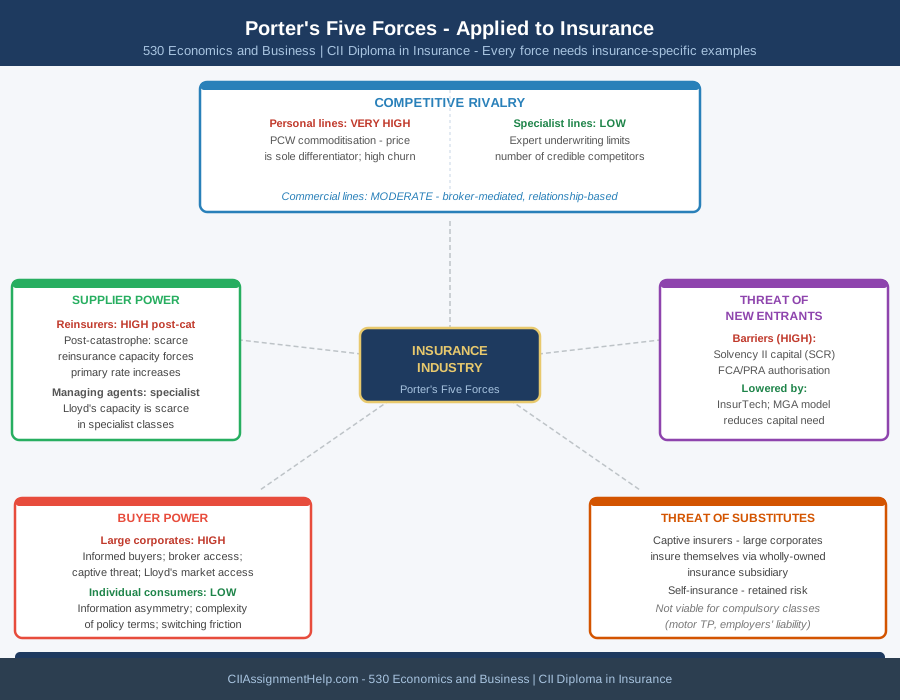
Porter's Five Forces provides a framework for analysing the competitive intensity and profit potential of an industry. In 530, the framework is applied specifically to the insurance industry — each force must be described with insurance-specific examples rather than generic competitive analysis.
Force 1 — Competitive Rivalry
Personal lines: Extremely high rivalry. Price comparison websites have commoditised personal motor and household insurance — consumers switch annually based on premium alone. Combined ratios in personal motor have been consistently above 100% for extended periods.
Specialist lines (marine, aviation, cyber): Lower rivalry due to expertise barriers. Lloyd's specialist syndicates dominate these classes; the risk expertise required limits credible competitors.
Force 2 — Threat of New Entrants
Capital requirements (Solvency II SCR), FCA/PRA regulatory authorisation, actuarial expertise, and established distribution relationships create significant barriers to entry for conventional insurer structures.
However, InsurTech models have reduced some barriers in personal lines. MGA/coverholder structures allow new specialists to access underwriting capacity without holding their own capital.
Force 3 — Threat of Substitutes
Captive insurance: Large corporations establish wholly-owned insurance subsidiaries to underwrite some or all of their risks — a genuine substitute for commercial insurance in many classes.
Self-insurance: Corporations retain risk directly using internal reserves. Feasible only for risks where the maximum probable loss is within the organisation's financial capacity.
Force 4 — Buyer Power
Individual consumers: Low buyer power individually — information asymmetry and complexity of policy terms reduce consumer leverage.
Large corporate buyers: High buyer power. A large multinational insuring a global property portfolio has significant negotiating leverage — these buyers employ risk managers, access multiple insurance markets, and can credibly threaten to move to a captive or self-insurance structure.
Force 5 — Supplier Power
Reinsurers as capacity suppliers: After large catastrophe events, reinsurers can impose significant price increases and coverage restrictions because their capacity is scarce. Reinsurer supplier power is highest immediately after a major catastrophe.
Repair networks and medical providers: For claims handling, these suppliers have pricing power, particularly in specialist medical fields.
Economies of Scale
Large insurers benefit from economies of scale: fixed IT and technology costs spread over a larger premium base; volume pricing with repair networks; regulatory compliance costs largely fixed; brand recognition reduces marketing cost per acquired customer.
Economies of scale explain consolidation of the personal lines market through mergers and acquisitions.
Porter's Five Forces Applied to Lloyd's
Competitive rivalry: Moderate — the specialist nature of Lloyd's risks limits the number of credible underwriting competitors, reducing price competition compared to personal lines.
Threat of new entrants: Low — Lloyd's membership, regulatory requirements, and specialist underwriting expertise create high barriers. ILS vehicles have provided a new form of capital entry into catastrophe capacity.
Buyer power: High for large, sophisticated commercial placements — major multinational corporations and their wholesale brokers have significant leverage in Lloyd's specialist markets.
Need 530 Written Exam Support?
Economic concept application drills with insurance market context, underwriting cycle diagram practice, Porter's Five Forces insurance analysis templates, and macroeconomic factor scenario practice.
💬 WhatsApp Us Now530 Written Exam Answer Technique
530 written exam answers must connect economic theory explicitly to the insurance market. The examiner is looking for applied economic analysis — not a generic microeconomics or macroeconomics essay.
Required Answer Structure
1. State the economic concept with precision — including the formula where applicable (PED formula; combined ratio formula). 2. Explain with a general economic example — briefly. 3. Apply specifically to insurance — name the insurance class, market condition, or insurer characteristic. 4. Evaluate the implication — what does this mean for insurers, policyholders, or the regulator?
Common 530 Exam Failures
Adverse selection without insurance mechanism: Explaining adverse selection as a concept without describing the insurance-specific mechanism — the propensity of higher-risk individuals to seek insurance more than lower-risk individuals — and the insurer's solution (risk-based pricing, underwriting screening).
Underwriting cycle without trigger events: Describing the underwriting cycle without naming specific trigger events that convert soft to hard market conditions. Stating "when losses increase" is insufficient — the examiner expects reference to catastrophe events, investment market downturns, or reserve deterioration.
Porter's Five Forces with generic examples: Applying Porter's Five Forces with examples from airlines, retail, or technology rather than insurance-specific examples for each force. Every force answer must reference insurance market participants.
Conflating inflation effects: Discussing inflation effects without distinguishing claims inflation (rising claims costs — affects loss ratio) from investment income effects of interest rates (rising rates increase investment income). These have opposite effects on insurer profitability.
530 Within the CII Diploma in Insurance
530 Economics and Business is the third of three compulsory core units for the CII Diploma in Insurance, alongside M05 Insurance Law and M92 Insurance Business and Finance. Together, the three core units provide the legal, financial, and economic foundations that underpin all specialist optional units at Diploma level.
How 530 Connects to M92 and M05
The economic analysis in 530 connects directly to the financial performance metrics covered in M92: the underwriting cycle (530) determines the combined ratio trajectory (M92); macroeconomic inflation (530) drives claims inflation and reserve adequacy (M92); interest rate changes (530) determine investment income available to offset underwriting losses (M92). Students who cover both units together find the conceptual connections reinforce understanding in both directions.
The legal framework in M05 also intersects with 530 economics: the Insurance Act 2015's reform of policyholder duties changed the information asymmetry dynamic in insurance markets — more proportionate remedies for innocent non-disclosure reduce the insurer's disincentive to write risks where disclosure is imperfect, with a small positive effect on market supply in affected classes.
Frequently Asked Questions — 530 Economics and Business Assignment Help
Is 530 assessed by MCQ or written exam?
530 is assessed by written examination — not MCQ. Economic concepts must be explained, illustrated, and applied to insurance scenarios in structured written answers. Labelled diagrams (supply and demand curves, underwriting cycle stage diagrams, Porter's Five Forces spider charts) are expected in relevant questions. Students progressing from Certificate-level IF units must adapt from recognising correct answers under time pressure to producing structured economic analysis with insurance-specific application. Partial marks are available in 530 written answers — a well-structured incomplete answer scores more than a short but accurate statement without analytical development.
What is the insurance underwriting cycle?
The underwriting cycle is a recurring pattern in which insurance market conditions alternate between soft phases (falling premiums, high capacity, relaxed underwriting standards, broad coverage terms) and hard phases (rising premiums, restricted capacity, tight underwriting standards, narrow coverage terms). The transition from soft to hard market is triggered by events that deplete insurer capital — typically large catastrophe losses, sustained investment market downturns, or accumulation of large liability reserve deficiencies. After the hard market improves profitability, new capital enters the market, competitive pressure returns, and the cycle moves toward the next soft market phase.
How does inflation affect insurance in the 530 exam?
530 tests two distinct inflation-related effects, which must be clearly distinguished in exam answers. First, claims inflation: rising construction costs, medical costs, and legal settlement costs increase the cost of claims independently of claims frequency — this worsens loss ratios and requires higher premiums to maintain rate adequacy, particularly for long-tail liability lines where claims may be settled years in the future. Second, interest rate effects on investment income: rising interest rates increase the return available on an insurer's invested premium float — improving the investment income line and providing a buffer against underwriting losses. These two effects can operate simultaneously and in opposite directions on overall insurer profitability. Exam answers that conflate claims inflation with interest rate investment income effects will lose marks.
What is adverse selection and how do insurers address it?
Adverse selection occurs when information asymmetry between insured and insurer causes higher-risk individuals to seek insurance disproportionately relative to lower-risk individuals — because insurance has greater expected value for those who know they face a higher probability of loss. If the insurer charges a premium based on average risk, it attracts a pool that is riskier than the average — leading to higher-than-expected claims. Insurers address adverse selection through risk-based pricing (using individual risk characteristics — claims history, telematics data, medical evidence — to set premiums that reflect individual risk) and underwriting (screening applicants at the point of proposal to identify and either decline or rate up high-risk risks).
How does Porter's Five Forces apply to the Lloyd's insurance market?
Applied to Lloyd's specifically: competitive rivalry is moderate — the specialist nature of Lloyd's risks limits the number of credible underwriting competitors, reducing price competition compared to personal lines. Threat of new entrants is low — Lloyd's membership, regulatory requirements, and the need for specialist underwriting expertise create high barriers to entry, though ILS (Insurance-Linked Securities) vehicles have provided a new form of capital entry into catastrophe capacity. Buyer power is high for large, sophisticated commercial placements — major multinational corporations and their wholesale brokers have significant leverage in Lloyd's specialist markets. Supplier power (reinsurers, managing agents) is significant — specialist managing agents who control Lloyd's syndicate capacity have pricing power in hard market conditions when their capacity is scarce.
Need Support With 530 Economics and Business?
Economic concept application drills with insurance market context, underwriting cycle diagram practice, Porter's Five Forces insurance analysis templates, macroeconomic factor scenario practice, and extended answer review with feedback on analytical structure.
Get Your Free Quote 💬 WhatsApp Us Now