
What Is M92 Insurance Business and Finance?
M92 Insurance Business and Finance is a 25-credit Level 4 compulsory core unit of the CII Diploma in Insurance, assessed by written examination — not MCQ. The written exam requires structured financial analysis of insurance company operations, including calculation and interpretation of key performance ratios, analysis of reinsurance structures, understanding of the Solvency II capital adequacy framework, and knowledge of insurance distribution channels and the UK regulatory system.
Written Examination — Calculations Must Show Workings
M92 combines two types of demand: conceptual explanation and financial analysis. Quantitative questions require demonstrated workings for combined ratio, loss ratio, and expense ratio. An arithmetical error with shown workings scores partial marks. An unsupported wrong answer scores zero even if the final number is correct.
M92 Syllabus Coverage
M92 covers: financial performance metrics (pure premium, loss ratio, expense ratio, combined ratio, IBNR); reinsurance treaty structures (quota share, surplus, risk XL, catastrophe XL, aggregate XL); the Solvency II three-pillar capital framework; insurance distribution channels and MGA structures; and FCA/PRA dual regulation of the UK insurance market.
Financial Performance Metrics in M92
Insurance companies measure their financial performance using a distinct set of ratios that reflect the dual income structure of the industry: underwriting income (premiums minus claims and expenses) and investment income (returns on the premium float invested before claims are paid). M92 requires students to calculate, interpret, and apply these ratios in written exam scenarios.
Key Ratios and Formulas
Pure Premium
Formula: estimated claims cost ÷ number of exposure units.
The minimum premium required to cover expected claims. The charged premium must exceed the pure premium to cover expenses and generate profit.
Loss Ratio
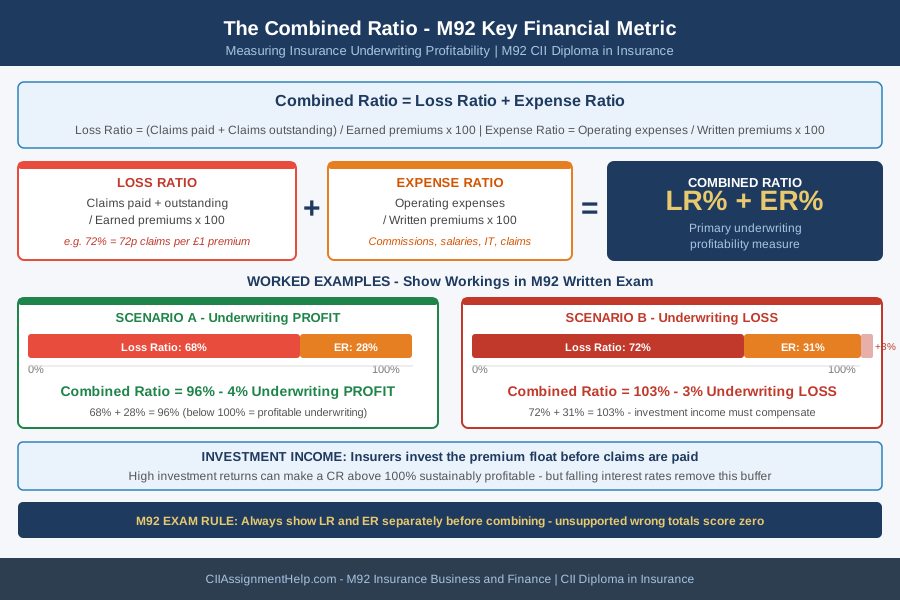
Formula: (Claims paid + claims outstanding) ÷ earned premiums × 100.
A loss ratio of 70% means 70p of every £1 of premium earned is consumed by claims. A deteriorating loss ratio indicates claims costs are rising faster than premiums.
Expense Ratio
Formula: operating expenses ÷ written (or earned) premiums × 100.
Measures the proportion of premium consumed by operating costs including acquisition costs, administrative costs, and management expenses.
Combined Ratio
Formula: loss ratio + expense ratio.
Below 100% = underwriting profit. Above 100% = underwriting loss — the insurer relies on investment income to achieve overall profitability.
Combined Ratio Worked Example — Always Show Components
An insurer reports a loss ratio of 72% and an expense ratio of 31%.
Step 1: Loss ratio = 72%
Step 2: Expense ratio = 31%
Step 3: Combined ratio = 72% + 31% = 103% — underwriting loss of 3p per £1 of premium earned.
Step 4: If investment income generates a return equivalent to 5% of premium, overall profit position = +2%.
Always show components separately before combining. A correct combined ratio with shown workings scores partial marks even if an arithmetical error occurs.
IBNR and Investment Income
IBNR (Incurred But Not Reported) reserves represent the insurer's estimate of claims that have occurred before the balance sheet date but have not yet been reported. Particularly significant in liability insurance classes — workers' compensation, employers' liability, professional indemnity — where claimants may not report until years after the event. Underestimating IBNR leads to overstated profits and inadequate reserves.
Investment income is the return generated by investing the premium float before claims are paid. In periods of high interest rates, investment income can offset underwriting losses. In low interest rate environments, the investment income cushion shrinks, placing greater pressure on underwriting profitability.
Reinsurance at Diploma Depth
Reinsurance is insurance purchased by an insurer (the cedant) from a reinsurer, transferring part of the cedant's risk in exchange for a proportionate share of the premium. M92 requires students to distinguish between proportional and non-proportional reinsurance and to identify the correct structure for a described risk situation.
Proportional Reinsurance
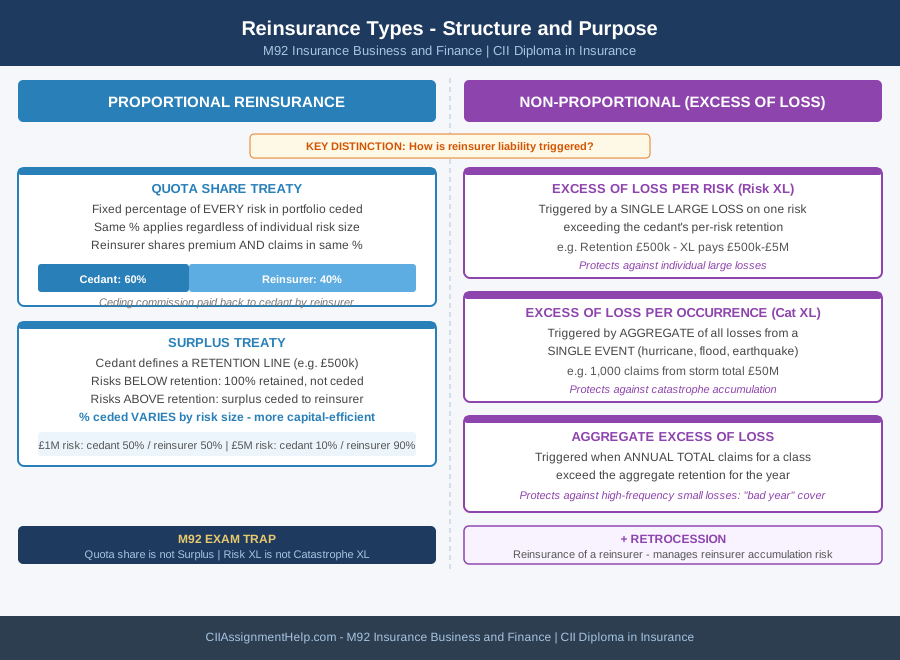
In proportional reinsurance, the reinsurer shares a fixed or variable proportion of every risk ceded — both premium income and claims are shared in the same proportion.
Quota Share Treaty
A fixed percentage of every risk in the portfolio is ceded to the reinsurer, regardless of the size of individual risks. Example: a 40% quota share means the reinsurer receives 40% of every premium and pays 40% of every claim.
Simple to administer; provides automatic capacity relief. Disadvantage: the cedant gives up premium on small risks where reinsurance is not needed.
Surplus Treaty
The insurer defines a retention line. For risks below the retention, no reinsurance applies. For risks above the retention, the surplus (amount in excess of the retention) is ceded up to a defined maximum (lines).
More efficient than quota share: cedant retains 100% of small risks, cedes proportionately more on large risks only.
Non-Proportional Reinsurance
In non-proportional reinsurance, the reinsurer pays only when the insurer's losses exceed a defined threshold — the retention or priority. Below the retention, the insurer bears 100% of losses.
Excess of Loss per Risk (Risk XL)
Triggered by a single large loss on one risk exceeding the cedant's per-risk retention. Protects against individual large losses on single risks.
Example: Retention £500,000; XL limit £4,500,000. A £3,000,000 loss — cedant pays £500,000; reinsurer pays £2,500,000.
Catastrophe XL (Per Occurrence)
Triggered by the aggregate of all losses from a single event exceeding the cedant's per-occurrence retention. Protects against accumulation of losses from a single catastrophic event.
Without catastrophe XL, one major natural catastrophe could destroy an insurer's capital base.
Aggregate Excess of Loss
Triggered when the insurer's total claims for a class across an entire policy year exceed the aggregate retention for that year. Protects against a high-frequency "bad year" rather than a single catastrophic event. More expensive than per-occurrence XL.
Ceding Commission
Under proportional treaties, the reinsurer pays a ceding commission back to the cedant — a percentage of the ceded premium. Compensates the cedant for acquisition and administrative costs. Typically 20–35% of ceded premium.
| Type | Trigger | Primary Purpose | Premium Sharing |
|---|---|---|---|
| Quota Share | All risks, fixed % | Capacity; stabilisation | Yes — fixed % |
| Surplus | Risks above retention line | Large risk capacity | Yes — variable % |
| Risk XL | Single risk loss > retention | Individual large loss protection | No |
| Catastrophe XL | Event aggregate > retention | Catastrophe accumulation protection | No |
| Aggregate XL | Annual total > aggregate retention | Frequency protection; bad year cover | No |
Solvency II — Capital Regulation Framework
Solvency II is the EU regulatory framework for insurance capital adequacy, implemented in the UK from 1 January 2016 and retained in UK law following Brexit. It replaced the previous EU Insurance Directives and established a risk-based, three-pillar capital framework that applies to all UK authorised insurers above the threshold for the Solvency II regime.
| Pillar | Focus | Key Requirement |
|---|---|---|
| Pillar 1 | Quantitative capital requirements | SCR (99.5% VaR, 1-year horizon); MCR (absolute floor) |
| Pillar 2 | Governance and risk management | ORSA — own assessment, forward-looking, scenario-based |
| Pillar 3 | Disclosure and regulatory reporting | SFCR (public annual report); QRTs (regulatory templates) |
Pillar 1 — SCR and MCR
SCR (Solvency Capital Requirement): Risk-based capital to absorb losses at 99.5% confidence over a one-year horizon — a 1-in-200-year loss event. Calculated using the Standard Formula or an approved Internal Model.
MCR (Minimum Capital Requirement): The absolute minimum capital floor. Breach of the SCR triggers a recovery plan; breach of the MCR triggers immediate supervisory action.
Pillar 2 — ORSA
The Own Risk and Solvency Assessment requires the insurer to conduct its own forward-looking analysis of its specific risk profile and capital needs over a multi-year planning horizon. The ORSA is not simply the SCR — it requires assessment under the insurer's own stress scenarios.
Pillar 3 — SFCR
The Solvency and Financial Condition Report is an annual public document covering business and performance, governance, risk profile, valuation, and capital management. Creates market transparency — analysts, brokers, and counterparties can assess an insurer's financial position from its SFCR.
Solvency UK — Post-Brexit Modifications
Following Brexit, the PRA has progressively adapted Solvency II through the Solvency UK reform programme. Key modifications include: adjustments to the risk margin calculation; reform of the Matching Adjustment (used by life insurers); and more proportionate requirements for smaller insurers. The underlying three-pillar structure and the 99.5% VaR calibration of the SCR have been retained.
Need M92 Exam Preparation Support?
Financial ratio calculation practice with worked examples, reinsurance diagram templates, Solvency II three-pillar framework reference sheets, and extended answer review.
💬 WhatsApp Us NowInsurance Distribution and Market Structure
Distribution Channels
Insurance reaches customers through multiple distribution channels, each with a distinct economics and regulatory profile. M92 requires understanding of how each channel operates and how each affects the insurer's expense ratio.
Direct Distribution
The insurer sells directly to the customer — online, by telephone, or through its own branch network — without an intermediary. Avoids broker commission but bears the full acquisition cost. Personal lines motor and household insurance are heavily direct-distributed in the UK, driven by price comparison website aggregators.
Broker Distribution
An independent intermediary accesses multiple insurers on behalf of the customer. The broker earns income through commission or a client fee. FCA-regulated. Dominates commercial insurance — SMEs typically access insurance through brokers who can access specialist markets, surplus lines capacity, and the Lloyd's market.
Managing General Agent (MGA)
The insurer delegates underwriting authority to an MGA, which binds risks on the insurer's behalf within defined parameters. The risk remains on the insurer's balance sheet. Common in Lloyd's — Lloyd's coverholders operate under binding authorities granted by syndicates.
Affinity Schemes
Group policies offered to members of trade associations, professional bodies, or loyalty programme participants. The insurer benefits from access to a defined, marketable group without individual acquisition cost per member.
Lloyd's vs Company Market
Lloyd's of London provides insurance and reinsurance capacity through syndicates managed by Managing Agents. Lloyd's is particularly dominant in marine, aviation, energy, catastrophe, and specialty lines — non-standard risks where individual underwriting judgement and specialist expertise are required. Company market insurers (Aviva, AXA, Zurich, RSA, Allianz) operate through corporate balance sheets and provide mainstream insurance capacity for personal lines, commercial lines, and life insurance.
M92 Written Exam Answer Technique
Quantitative Questions — Always Show Workings
When a question provides claims, expense, and premium data and asks for the combined ratio, present each component calculation separately before combining. Always follow with an interpretation — state whether the ratio indicates underwriting profit or loss and by how many percentage points.
Common M92 Exam Failures
Reinsurance confusion: Confusing quota share (fixed percentage of all risks) with surplus (variable percentage based on retention line). Confusing excess of loss per risk (triggered by a single large loss) with catastrophe XL (triggered by aggregate losses from one event).
Combined ratio without interpretation: Stating the combined ratio correctly but failing to state explicitly whether the ratio indicates underwriting profit (below 100%) or underwriting loss (above 100%) and by how much.
Solvency II without Pillar: Describing Solvency II without specifying which Pillar and which component (SCR vs MCR vs ORSA vs SFCR) is relevant to the question asked.
Reinsurance Diagram Technique
Draw a clear structural diagram showing the cedant's retention and the reinsurer's layers before writing the explanatory text. Label: the cedant, the retention amount, the reinsurer's layer start and end points, the reinsurer. A diagram that correctly labels the structure scores marks independently of the text explanation.
M92 Within the CII Diploma in Insurance
M92 Insurance Business and Finance is one of three compulsory core units for the CII Diploma in Insurance. Alongside M05 Insurance Law and 530 Economics and Business, it forms the mandatory foundation of the Diploma qualification. All three core units must be passed before the Diploma is awarded.
Students progressing to optional specialist Diploma units will find M92 financial concepts applied throughout: marine insurance (M96 and M98) uses reinsurance and financial metric concepts from M92; commercial underwriting units (M80, M81) apply the premium setting and combined ratio framework; London Market units apply the Lloyd's market structure and Solvency II analysis.
How M92 Connects to M05 and 530
The Solvency II capital framework covered in M92 connects directly to the broader economic analysis of insurance market supply and capacity constraints studied in 530 Economics and Business. The M05 Insurance Law framework establishes the legal obligations — including the Insurance Act 2015 — that underpin the financial decisions M92 analyses.
Frequently Asked Questions — M92 Insurance Business and Finance
Is M92 assessed by MCQ or written exam?
M92 is assessed by written examination — not MCQ. The written exam includes financial calculation questions (requiring demonstrated workings for combined ratio, loss ratio, and expense ratio), reinsurance structure analysis questions, and Solvency II framework questions. Students progressing from Certificate-level IF units must adapt from recognising correct answers in MCQ format to producing structured written analysis with shown calculations. Unsupported answers to calculation questions score zero even if the final number is correct.
What is the combined ratio and why is it important for M92?
The combined ratio = loss ratio + expense ratio. It measures whether an insurer is generating an underwriting profit (combined ratio below 100%) or an underwriting loss (combined ratio above 100%). A combined ratio below 100% means the insurer earns more in premium income than it pays in claims and expenses — pure underwriting profit. A combined ratio above 100% means underwriting losses — the insurer relies on investment income to achieve overall profitability. M92 exam scenarios typically provide claims and expense data and require students to calculate and interpret the combined ratio, including stating the underwriting profit or loss in percentage points.
What is the difference between a quota share and a surplus treaty?
A quota share cedes a fixed percentage of every risk in the portfolio to the reinsurer — the same percentage applies to all risks regardless of size. A surplus treaty only applies to risks above the cedant's defined retention line; the proportion ceded varies by risk size (larger risks cede a higher percentage). The practical difference: under a quota share, the cedant gives up premium (and protection) on small risks it could have retained; under a surplus treaty, the cedant retains 100% of small risks and cedes proportionately on large risks only — making better use of its own capital for risks within its retention capacity.
What is the SCR under Solvency II?
The Solvency Capital Requirement (SCR) is the risk-based minimum capital an insurer must hold under Pillar 1 of Solvency II, calibrated at a 99.5% Value at Risk (VaR) over a one-year horizon. In practical terms, the SCR represents the capital needed to absorb losses from a 1-in-200-year event. It is calculated using either the Standard Formula or an approved Internal Model. The SCR differs from the MCR (Minimum Capital Requirement): the MCR is the absolute floor below which immediate regulatory intervention occurs; the SCR is the preferred target capital level. Breach of the SCR triggers a recovery plan; breach of the MCR triggers immediate supervisory action.
Need Support With M92 Insurance Business and Finance?
Financial ratio calculation practice with worked examples, reinsurance diagram templates, Solvency II three-pillar framework reference sheets, and structured written answer templates for both quantitative and conceptual M92 questions.
Get Your Free Quote 💬 WhatsApp Us Now