LM3 is a 15-credit Level 3 CII unit assessed by MCQ scenario-based examination, covering the London market broker's role within the Lloyd's market structure, the slip-based placing process, Lloyd's regulatory framework, and the capital structure that supports syndicate underwriting. LM3 is specifically designed for professionals in Lloyd's broking roles, London market intermediaries, and anyone whose work involves placing insurance business directly into the Lloyd's market or understanding the Lloyd's market infrastructure.
Lloyd's of London – Market Structure and Key Participants
The Society of Lloyd's
The Society of Lloyd's is the corporation that governs the Lloyd's market. It was established under the Lloyd's Act 1871 and substantially reformed by the Lloyd's Act 1982. The Society provides market infrastructure, regulatory oversight, and central claims settlement, and maintains the Lloyd's Central Fund as the ultimate financial backstop for Lloyd's policyholders. The Society is not itself an insurer – it does not underwrite risks.
The Council of Lloyd's
The Council of Lloyd's is the governing body of the Society. It is responsible for setting Lloyd's Minimum Standards – the mandatory operational, governance, and conduct standards that all managing agents must meet.
Lloyd's Members – Names
Names are the capital providers at Lloyd's. They provide Funds at Lloyd's (FAL) that gives each syndicate its underwriting capacity. Corporate Names (limited liability companies) are now the dominant form of capital provision. Individual Names with unlimited personal liability still exist but form a smaller proportion.
Syndicates and Managing Agents
A syndicate is an annually renewing pool of capital managed by a managing agent. Each syndicate carries a unique identification number. The managing agent employs the underwriters and manages the syndicate's risk portfolio on behalf of the Names. Managing agents must submit an annual Syndicate Business Forecast to the Franchise Performance Directorate.
Members' Agents
The members' agent acts on behalf of individual Names – managing their participation across multiple syndicates and advising on risk allocation. The members' agent is distinct from the managing agent: the managing agent manages the syndicate; the members' agent advises the Name on where to deploy their capital.
Lloyd's Brokers
A Lloyd's broker is a firm specifically accredited by Lloyd's to access the Lloyd's market directly. Not all FCA-authorised brokers are Lloyd's brokers. Only Lloyd's-accredited firms can place business directly at Lloyd's.
Lloyd's Regulatory Framework – Act, Franchise, and Minimum Standards
Lloyd's Act 1982
The Lloyd's Act 1982 is the primary statutory instrument governing Lloyd's. It grants the Council the authority to make byelaws regulating Lloyd's members, managing agents, and Lloyd's brokers. Lloyd's is subject to FCA and PRA oversight while the Council provides additional market-specific regulation through its byelaw-making power.
Lloyd's Minimum Standards
Lloyd's Minimum Standards are mandatory conduct, governance, and operational standards that all managing agents must meet. They cover underwriting, claims management, exposure management, financial reporting, governance, and compliance.
Franchise Performance Directorate
The Franchise Performance Directorate (FPD) reviews each managing agent's annual Syndicate Business Forecast (SBF) against Lloyd's profitability, exposure, and strategic standards before approving the syndicate's underwriting capacity.
The London Market Placing Process – Slip, Leader, and Signing
The Slip
The slip is the core document in the London market placing process – a risk presentation prepared by the Lloyd's broker containing all material information about the risk. Key data: insured name and description, risk description, policy conditions and exclusions, period of insurance, estimated premium, lines available. The slip is not a policy document.
Lead Underwriter
The lead underwriter is the first underwriter to agree terms and stamp the slip. The lead's decision sets the commercial terms for the entire placement. Following market underwriters subscribe on the lead's terms without renegotiation.
Following Market
After the lead underwriter signs, the broker presents the slip to additional underwriters who subscribe their proportionate line. The placement is complete – "fully subscribed" – when the aggregate of all signed lines reaches 100%.
Lloyd's Policy Signing Office (LPSO)
The LPSO processes premium allocations to each participating syndicate and issues policies. Modern London market processing operates through electronic platforms including the Electronic Claims File (ECF).
Binding Authorities and Coverholders
Instead of placing individual risks through the slip process, a managing agent may grant a coverholder a delegated underwriting authority (DUA) to bind risks on its behalf within agreed parameters. The coverholder produces a bordereau (a list of all bound risks) periodically for submission to the managing agent. Coverholders must be registered on Lloyd's approved coverholder register.
Lloyd's Capital Structure – FAL and the Central Fund
The Chain of Security
| Layer | Resource | Description |
|---|---|---|
| Layer 1 | Syndicate premium income | Annual premium income earned in the relevant year of account |
| Layer 2 | Member's Funds at Lloyd's (FAL) | Capital deposited by each member to support underwriting capacity |
| Layer 3 | Lloyd's Central Fund | Society-level mutual reserve – last resort backstop for all Lloyd's policies |
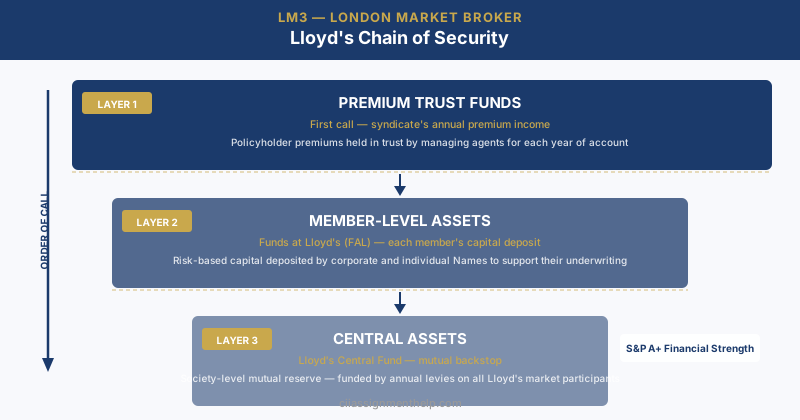
Funds at Lloyd's (FAL): Member-level capital set using a risk-based capital model (aligned to Solvency II). The FAL requirement is expressed as a percentage of the syndicate's maximum gross premium income.
Lloyd's Central Fund: A mutual fund at Society level used only after a syndicate's own resources are exhausted. Funded by levies on all Lloyd's market participants. Its existence maintains Lloyd's S&P A+ financial strength rating.
How to Pass the LM3 MCQ Exam – Exam Technique
Common LM3 Exam Traps
1. Confusing managing agent and members' agent – the managing agent manages the syndicate; the members' agent advises the Name.
2. Assuming all FCA-authorised brokers can access Lloyd's – only Lloyd's-accredited firms have direct access.
3. Confusing FAL with the Central Fund – FAL is member-level capital (Layer 2); the Central Fund is drawn in Layer 3 only after FAL is exhausted.
4. Assuming binding authority coverholders negotiate terms – they bind within pre-agreed DUA parameters only.
5. The placing sequence: broker prepares slip → lead underwriter signs → following market subscribes → slip fully subscribed → LPSO processes → policy issued.
Need LM3 MCQ Exam Support?
Structured topic summaries, Lloyd's market participant distinction cards, and scenario-based MCQ practice covering the full LM3 syllabus.
💬 WhatsApp Us NowLM3 Within the CII London Market Qualification Pathway
LM3 is the third unit in the CII London Market suite: LM1 (London Market Introduction), LM2 (London Market Underwriting), LM3 (London Market Broker). Progression leads to Diploma-level specialist units including M86 (Marine Insurance), M97 (Reinsurance), and M98. LM3 students who complete the Certificate may also progress to the CII Diploma in Insurance assignment help. For senior London market professionals, the 991 London Market Specialisation assignment help covers Lloyd's governance at Level 7 Advanced Diploma depth.
For CII Certificate in Insurance assignment help, this service provides structured exam preparation.
Frequently Asked Questions – LM3
Is LM3 specifically for Lloyd's of London employees?
LM3 is designed for anyone working in London market broking. It is not restricted to direct Lloyd's employees. Managing agencies, coverholders, and specialist insurers working with the Lloyd's market also take LM3.
What is the difference between a Lloyd's broker and a regular FCA-authorised broker?
FCA authorisation is necessary but not sufficient for Lloyd's market access. Only firms specifically accredited by Lloyd's through the Lloyd's Broker Accreditation process can access Lloyd's directly. Non-accredited FCA brokers must use a Lloyd's-accredited wholesale intermediary.
What does "fully subscribed" mean in the London market?
A risk is fully subscribed when the broker has obtained underwriter signings totalling 100% of the risk. If the market is oversubscribed (lines exceed 100%), lines are scaled back proportionately.
What is the difference between a written line and a signed line?
A written line is the percentage share agreed when subscribing the slip during placing. A signed line is the final allocated share after closing – if lines exceed 100%, each underwriter's share is scaled back proportionately. The signed line is the legally binding share.
How long does LM3 take to study?
Approximately 50–80 hours. Professionals already working in a Lloyd's broking environment may require fewer hours. Candidates from outside the Lloyd's market should allow the full 80 hours, particularly for the regulatory framework and capital structure components.
Need Support With LM3 London Market Broker?
Structured topic summaries, Lloyd's market participant distinction cards, placing process sequence guides, capital structure diagrams, and scenario-based MCQ practice covering the full LM3 syllabus.
Get Your Free Quote 💬 WhatsApp Us Now