
What Does IF3 Cover?
IF3 Insurance Underwriting Process is a 15-credit Level 3 unit within the CII Certificate in Insurance, assessed by a scenario-based MCQ examination. The unit covers the underwriting process from risk assessment through to policy terms — including physical and moral hazard identification, non-disclosure and misrepresentation rules under the Consumer Insurance Act 2012 and Insurance Act 2015, the Insurance Act 2015 s.10 warranty suspension rule, policy conditions (excesses, warranties, and exclusions), and underwriting actions at renewal and mid-term.
IF3 assesses your ability to apply the underwriting process from initial hazard identification through to the actions available at renewal and mid-term.
Underwriting Objectives and the Hazard Framework
The underwriting function serves three core objectives: to select risks profitably, to spread risk across the portfolio, and to avoid anti-selection. Underwriters assess risk through two distinct hazard categories.
Physical Hazard
Physical hazard comprises the material, measurable characteristics of the risk — factors that can be quantified and rated.
Motor insurance factors: Vehicle make and model (ABI insurance group 1–50), engine size, annual mileage, overnight parking location, security devices (Thatcham categories 1–7).
Property insurance factors: Construction type (standard brick/slate vs non-standard timber frame/flat roof), occupancy type, flood zone classification (Environment Agency zones 1, 2, 3a/3b), proximity to hazardous processes.
Moral Hazard
Moral hazard comprises the attitude and behaviour of the insured that may increase the likelihood or severity of a claim.
Moral hazard indicators: Claims frequency across multiple insurers, financial distress (bankruptcy, CCJs), inconsistent information between proposal and later communications, refusal to implement risk improvement recommendations, previous policy cancellations.
Insurance Act 2015: What Changed for Underwriting?
Pre-Insurance Act 2015
Any warranty breach permanently discharged the insurer from all liability from the date of the breach — regardless of causal connection to the loss.
Insurance Act 2015 s.10 — The Suspension Rule
For business insurance contracts entered into or renewed on or after 12 August 2016, a warranty breach suspends cover for the duration of the breach period only. If the breach is remedied before the loss, the insurer cannot use the previous breach as a defence. If the breach is ongoing at the time of the loss, the insurer is not liable.
Non-Disclosure and Misrepresentation Remedies
| Policyholder Type | Act | Misrepresentation Type | Remedy |
|---|---|---|---|
| Consumer | CIA 2012 | Inadvertent | Proportionate |
| Consumer | CIA 2012 | Deliberate/reckless | Avoid + retain premium |
| Business | IA 2015 | Deliberate/reckless | Avoid + retain premium |
| Business | IA 2015 | Careless | Proportionate |
| Business | IA 2015 | Neither deliberate nor careless | No remedy |
Policy Conditions: Excesses, Warranties and Exclusions
Excess Types
| Excess Type | Set By | Mechanics |
|---|---|---|
| Compulsory | Insurer | Insured always bears this amount; cannot be waived |
| Voluntary | Insured | Additional excess elected for premium reduction |
| Franchise | Insurer | Below threshold: insurer pays nothing; above threshold: insurer pays full loss from pound one |
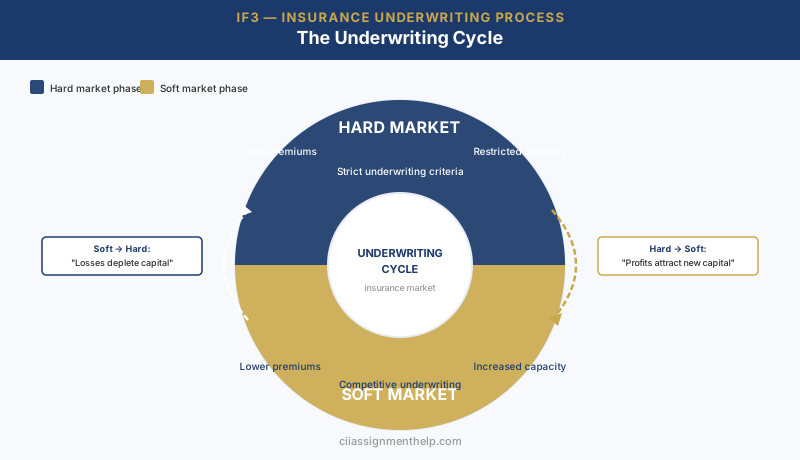
Underwriting Actions: Renewal, Mid-Term Adjustments and Surveys
At renewal, the underwriter reviews claims experience and may: increase premium, restrict coverage, require a risk improvement survey, or decline renewal. Mid-term adjustments trigger pro-rata premium adjustments where material facts change. Surveys are required for large or complex commercial risks; survey reports may include Risk Improvement Recommendations (RIRs).
How Is IF3 Assessed?
IF3 is assessed by a single-sitting scenario-based MCQ examination. The indicative pass mark is approximately 65%. Most candidates require 50–80 hours of structured study.
How to Approach IF3 MCQ Questions
Step 1 — Classify the question type: hazard, legal remedy, warranty, policy condition, or underwriting action.
Step 2 — For hazard questions: determine physical (measurable characteristic) vs moral (attitudinal indicator).
Step 3 — For legal remedy questions: consumer (CIA 2012) or business (IA 2015)? Deliberate or inadvertent?
Step 4 — For warranty questions: post-12 August 2016? Remedied before loss? If yes — insurer has no warranty defence.
Step 5 — Eliminate distractors applying the wrong Act or wrong remedy tier.
IF3 in the CII Certificate in Insurance Pathway
IF3 is the natural progression after IF1 insurance legal and regulatory assignment help, applying the legal principles from IF1 to operational underwriting decisions. IF3 directly underpins IF4 insurance claims handling process assignment help — the policy terms set in IF3 determine the coverage assessment decisions in IF4. Progression leads to the CII Diploma where M80 Underwriting Practice assignment help extends underwriting to professional written exam practice at Level 4.
For CII Certificate in Insurance assignment help across all Certificate units, this service provides structured exam preparation.
Frequently Asked Questions — IF3
How hard is IF3?
IF3 is consistently one of the harder Certificate units because it combines legal knowledge with operational underwriting application. The Insurance Act 2015 warranty suspension rule and the non-disclosure remedy framework — distinguishing consumer from commercial rules and inadvertent from deliberate misrepresentation — are the sections candidates most frequently misapply.
How long does IF3 take to study?
Candidates with underwriting experience require 50–70 hours. Candidates from claims, broking, or administrative backgrounds typically need 70–90 hours. The warranty suspension rule and non-disclosure remedy frameworks specifically benefit from scenario practice rather than passive reading.
Can I take IF3 without taking IF1 first?
There are no formal prerequisites. However, IF3 directly applies the legal framework from IF1 — candidates who complete IF1 before IF3 typically find the legal sections significantly easier.
What happens if I fail IF3?
Re-sits are unlimited with a minimum 30-day gap. Most candidates who fail do so because of the warranty suspension rule and non-disclosure remedy sections — targeted revision of those areas combined with MCQ practice is the most effective re-sit approach.
Need Support With IF3 Insurance Underwriting Process?
Structured MCQ scenario walkthroughs, physical and moral hazard identification practice, Insurance Act 2015 warranty suspension rule coaching, non-disclosure remedy framework drills, and excess type comparison revision for the CII Certificate in Insurance examination.
Get Your Free Quote 💬 WhatsApp Us Now