What Is IF5 Motor Insurance?
IF5 Motor Insurance is a 15-credit Level 3 unit within the CII Certificate in Insurance, assessed by a scenario-based multiple-choice question (MCQ) examination conducted at a CII-approved test centre or under remote invigilation. The unit covers the statutory motor insurance framework under the Road Traffic Act 1988, the three cover types available in the UK personal motor market (Third Party Only, Third Party Fire and Theft, and Comprehensive), the role of the Motor Insurers Bureau and Motor Insurance Database in protecting victims of uninsured and untraced drivers, No Claims Discount structure and protection mechanics, fleet underwriting rating factors, telematics-based underwriting, and the motor claims handling process including total loss valuation and subrogation. IF5 is taken by insurance professionals working in personal lines motor underwriting, claims, or broking roles, and by students building the CII Certificate in Insurance qualification who require a thorough grounding in the motor insurance market.
What Does IF5 Cover?
IF5 assesses your ability to apply the statutory and regulatory framework governing motor insurance in the United Kingdom to scenario-based MCQ questions. The unit does not test general motoring knowledge; it tests the precise statutory rule, the scope of each cover type, the conditions under which the MIB schemes apply, and the mechanics of NCD calculation — all in the context of described claim and underwriting scenarios.
The Road Traffic Act 1988 — Compulsory Motor Insurance
The statutory foundation of UK motor insurance is the Road Traffic Act 1988. Two sections are directly examined in IF5 scenarios.
RTA 1988 s.143 makes it illegal for any person to use, cause, or permit the use of a motor vehicle on a road or other public place in Great Britain without insurance that at minimum covers third party death, bodily injury, and emergency treatment costs. The obligation attaches to the use of the vehicle — not merely to its ownership. A vehicle owner who permits an uninsured driver to use the vehicle commits an offence under s.143 in the same way as the uninsured driver.
RTA 1988 s.151 provides that an insurer must satisfy a court judgement obtained against the insured by a third party, up to the limit of the policy, even where the insurer would otherwise be entitled to avoid the policy for non-disclosure or misrepresentation. Section 151 exists to protect innocent third parties. The insurer retains the right to recover what it has paid from the insured after satisfying the third party judgement. The IF5 exam rule: s.151 applies to the injured third party, not to the knowing driver — a driver who knows they are uninsured cannot rely on s.151 to compel their insurer to pay.
Continuous Insurance Enforcement (CIE): Vehicles must be insured at all times unless they are the subject of a Statutory Off Road Notification (SORN). The registered keeper is liable for maintaining insurance — the MID enforcement mechanism means that uninsured vehicles are identifiable to police and DVLA through automatic number plate recognition.
Certificate of Motor Insurance: The policyholder receives a certificate of motor insurance as evidence of compulsory cover. The certificate must be produced on request by police. It confirms the insured, the vehicle, and the period of cover.
Cover Types — TPO, TPFT, and Comprehensive
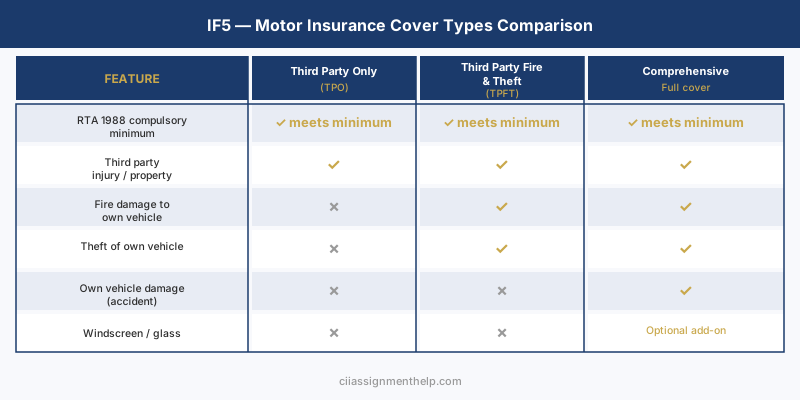
The three cover types are tested in IF5 by what each type excludes, not merely what it includes. The most common MCQ trap is assuming that a higher-tier cover includes a risk that is actually excluded even from comprehensive policies.
Third Party Only (TPO): The minimum legal cover required under RTA 1988 s.143. TPO covers death and bodily injury to third parties, damage to third party property, and emergency treatment costs. TPO does NOT cover own vehicle damage, loss of own vehicle by fire or theft, windscreen damage, or personal injury to the policyholder as driver.
Third Party Fire and Theft (TPFT): All TPO coverage, PLUS own vehicle loss or damage caused by fire or theft only. TPFT does NOT cover accidental damage to the insured's own vehicle — a collision that damages only the insured's own car is not covered under TPFT. Theft of the insured's own vehicle is covered under both TPFT and Comprehensive.
Comprehensive: All TPO and TPFT risks, PLUS accidental damage to the insured's own vehicle, windscreen damage, personal accident benefits to the policyholder, and (subject to specific policy wording) legal expenses cover and a courtesy car.
| Cover Type | Third Party Death/Injury | Third Party Property | Own Vehicle — Fire/Theft | Own Vehicle — Accidental Damage | Windscreen |
|---|---|---|---|---|---|
| TPO | Yes | Yes | No | No | No |
| TPFT | Yes | Yes | Yes | No | No |
| Comprehensive | Yes | Yes | Yes | Yes | Yes (subject to policy) |
Exam Tip — TPFT vs Comprehensive
MCQ scenarios distinguish TPFT from Comprehensive by whether own accidental damage is covered. Theft of the insured's own vehicle is covered under both TPFT and Comprehensive — this is a frequent distractor. If the scenario describes a vehicle stolen from the insured's driveway, both TPFT and Comprehensive respond. If the scenario describes a collision that damages only the insured's own car, only Comprehensive responds.
MIB and MID — Protecting Victims of Uninsured and Untraced Drivers
Motor Insurers Bureau (MIB): A non-profit company funded by all UK motor insurers, who are required by the Road Traffic Act to be MIB members as a condition of authorisation to write motor insurance in the UK. The MIB compensates victims where the at-fault driver is uninsured or cannot be identified, operating under two separate agreements with the Secretary of State.
Uninsured Drivers Agreement: The MIB satisfies unsatisfied court judgements against at-fault drivers who have no valid motor insurance. Conditions: the victim must report the accident to the police within five days (or as soon as reasonably possible); an MIB excess applies to property damage claims (currently £300); the MIB will not pay if the victim knew at the time of boarding the vehicle that the driver was uninsured.
Untraced Drivers Agreement: The MIB compensates victims of death or personal injury caused by a driver who cannot be identified — typically a hit-and-run accident. Property damage is covered only above £300 and subject to limitations. Application to the MIB under the Untraced Agreement must be made within three years of the accident. There is no requirement to have obtained a court judgement.
| Agreement | Trigger | Covers PI | Covers Property Damage | Key Conditions |
|---|---|---|---|---|
| Uninsured Drivers Agreement | At-fault driver identified but uninsured | Yes | Yes (above £300 excess) | Police report within 5 days; victim must not have known driver was uninsured |
| Untraced Drivers Agreement | At-fault driver cannot be identified | Yes | Limited — above £300 | Application within 3 years; no court judgement required |
Motor Insurance Database (MID): The central record of all UK motor insurance policies, maintained by the Motor Insurers Bureau. All UK motor insurers must update the MID within seven days of a policy being incepted, changed, or cancelled. Police use ANPR cameras linked to the MID to identify uninsured vehicles at the roadside.
No Claims Discount — How NCD Works in IF5
No Claims Discount (NCD) is a premium reduction applied to motor insurance premiums in recognition of consecutive claim-free years on a personal lines policy. NCD is one of the most precisely tested topics in IF5 — the exam requires candidates to apply specific percentage values, understand the step-back mechanism, and distinguish NCD protection from premium protection.
NCD Scale (Typical Personal Lines Structure)
| Claim-Free Years | NCD Percentage |
|---|---|
| 0 years | 0% |
| 1 year | 30% |
| 2 years | 40% |
| 3 years | 50% |
| 4 years | 60% |
| 5+ years | 65–70% (insurer-specific ceiling) |
NCD is earned per driver, not per vehicle. When a policyholder moves to a new insurer at renewal, they provide an NCD certificate from the previous insurer, which the new insurer validates before applying the accumulated discount.
Step-back clause: When an unprotected NCD is eroded by a claim, the NCD steps back by typically two years. A driver with five years' NCD who makes a claim on an unprotected policy steps back to three years' NCD at renewal.
NCD Protection: Available at 4+ years' NCD in most personal lines schemes. NCD protection allows the policyholder to make one claim — sometimes two in a rolling three-year period — without losing the accumulated NCD level at renewal. The critical IF5 exam distinction: NCD protection protects the discount percentage, not the premium level. The insurer can still increase the premium at renewal even if the NCD is protected — because the claims experience affects the base premium rate, not only the discount applied to it.
Fleet NCD: Commercial fleet policies use experience-rated pricing rather than a standard NCD step structure. The insurer calculates the claims ratio — the ratio of total claims cost to total premium paid — over a rolling three-to-five year period, and adjusts the fleet premium accordingly.
Fleet and Telematics Underwriting in IF5
Fleet underwriting and telematics rating are examined in IF5 as distinct underwriting approaches with their own rating factors and data sources.
Fleet rating factors: The premium for a commercial fleet policy is determined by: the number of vehicles in the fleet; the types and values of those vehicles; the ages and occupations of the drivers (open fleet — any driver — is rated more conservatively than a closed fleet of named drivers); the territorial use of the fleet; annual mileage across the fleet; business use class; and the fleet's claims experience over the preceding three-to-five years, expressed as both frequency (number of claims) and severity (average cost per claim).
Open vs closed fleet: A closed fleet policy specifies named drivers only — the insurer can underwrite the actual drivers and apply premium adjustments for age and driving record. An open fleet covers any driver meeting minimum criteria — the insurer prices for a broader risk profile and typically charges more unless the fleet has a strong claims record.
Telematics (black box) underwriting: A telematics device records the driver's behaviour continuously: speed, time of day, braking intensity, acceleration, cornering, and mileage. The data is transmitted to the insurer. At inception, the insurer sets a provisional premium based on standard rating factors. At renewal or at a mid-term review point, the premium is adjusted based on the telematics score generated by the recorded driving data.
Safe drivers with consistently low speed, smooth braking, and low night-time mileage receive a premium reduction. High-risk behaviour — recorded speeding, harsh braking, late-night driving — triggers a premium surcharge or a formal warning. IF5 MCQ scenarios test two points: (1) telematics data constitutes a valid rating factor; (2) telematics-evidenced reckless driving can support policy cancellation, but the insurer must give appropriate notice and meet FCA ICOBS requirements on cancellation.
Motor Claims Handling in IF5
Motor claims handling in IF5 follows the same four-stage process as general claims handling in IF4 — FNOL, investigation, coverage assessment, settlement — applied to motor-specific circumstances.
FNOL: The policyholder notifies the insurer promptly following an accident or loss. Prompt notification is a policy condition — unreasonable delay may allow the insurer to reject the claim if the delay prejudiced the investigation. At FNOL, the insurer records: date and location of accident, third parties and their insurer details, police report reference (if obtained), description of damage.
Total Loss Valuation: A vehicle is written off as a total loss when the estimated repair cost exceeds the vehicle's market value at the date of the loss, or when the damage is so severe that repair is not economically viable. The settlement for a total loss is based on market value — the cost of an equivalent replacement vehicle at the date of loss — not the new car value and not the amount originally paid for the vehicle. The ABI motor write-off categories apply:
- Cat A: Crush only — no parts salvageable
- Cat B: Break for parts — bodyshell destroyed, parts reusable
- Cat S: Structural damage — repairable, permanent DVLA marker
- Cat N: Non-structural damage — repairable, no DVLA marker
Betterment: Where repair requires the replacement of old parts with new parts, the insurer may apply a betterment deduction — reducing the settlement by the improvement in condition attributable to the new parts. Betterment applies where the parts replaced were worn rather than new — the principle of indemnity prevents the insured from receiving an improvement on their pre-loss position.
Subrogation in motor claims: After the insurer has paid the own damage claim, the insurer steps into the insured's shoes to pursue the at-fault third party for recovery of the amount paid. Subrogation must be pursued in the insured's name — the insurer cannot sue in its own name. The insured must cooperate fully with the subrogation action.
Motor fraud indicators: Staged accident patterns — low-speed impacts, multiple occupants with soft-tissue injury claims — are the most common form of organised motor fraud. Ghost broking — fraudulent policy documentation where the broker issues a false certificate of insurance — leaves the "policyholder" uninsured. Fronting — a parent declared as the main driver on a policy while the young driver is the actual primary user — constitutes material non-disclosure.
How to Pass the IF5 MCQ Exam — Exam Technique
IF5 uses scenario-based MCQ: a fact pattern describing an accident, a cover type question, or a regulatory situation, followed by four answer options — one correct and three plausible distractors.
Elimination technique: In cover type questions, work through the cover type hierarchy. If the scenario describes own vehicle accidental damage, eliminate TPO and TPFT immediately — only Comprehensive covers own accidental damage. If the scenario describes own vehicle theft, both TPFT and Comprehensive cover it — the question must specify another differentiating factor. In s.151 questions, confirm that the injured party is a third party (not the knowing driver) before concluding that s.151 requires the insurer to pay.
Common IF5 Exam Traps
1. Assuming TPO covers fire or theft of the insured's own vehicle — it does not. TPO covers third party exposure only.
2. Confusing NCD protection with premium protection — NCD protection preserves the discount percentage; it does not prevent the insurer from increasing the base premium at renewal.
3. Assuming the MIB Untraced Drivers Agreement covers property damage without limit — property damage above £300 only; full personal injury compensation applies.
4. Applying s.151 to the driver who knew they were uninsured — s.151 protects the innocent third party, not the guilty driver.
5. Applying UK NCD percentages where the scenario involves a non-UK market — IF5 is a UK unit; stay within the UK NCD scale.
Time allocation: IF5 typically consists of 75 questions in 90 minutes, giving approximately 72 seconds per question. Flag difficult questions and return to them — do not spend more than 90 seconds on any single question before moving on.
Need Expert Help With Your IF5 Exam?
Contact us today for structured exam preparation support across all IF5 syllabus areas.
💬 WhatsApp Us NowWhat Other CII Units Connect to IF5 — and Where Does It Lead?
IF5 motor insurance connects directly to IF4 (Insurance Claims Handling Process) through the motor claims section — total loss categories, subrogation timing, and FNOL procedure are shared between both units but examined from different angles. IF5 approaches claims from the motor product perspective; IF4 approaches them as part of the general claims process applicable across all classes. IF5 also connects to IF1 (Insurance: Legal and Regulatory) through the legal principles that underpin motor insurance — indemnity, subrogation, insurable interest — and the RTA 1988 statutory framework.
IF5 Within the CII Certificate in Insurance Pathway
IF5 is an optional unit within the CII Certificate in Insurance — it is not a compulsory core unit but is commonly chosen by students working in personal lines motor roles. The unit contributes 15 credits at Level 3 toward the 100-credit minimum required for the Cert CII designation. Students completing IF5 alongside IF1 (Insurance: Legal and Regulatory) and other IF units gain a broad foundation in the motor insurance market, combining the legal principles framework from IF1 with the product and statutory knowledge of IF5.
For students in personal lines motor underwriting roles, IF5 is the natural Certificate-level unit before progressing to the CII Diploma in Insurance, where the commercial motor and fleet content is developed further within units such as M86 (Commercial and Industrial Insurances) at Diploma level.
Frequently Asked Questions — IF5
Is IF5 compulsory for the CII Certificate in Insurance?
IF5 is an optional unit within the Certificate in Insurance. The CII Certificate in Insurance requires a minimum of 100 credits across the IF unit range, but does not mandate which specific optional units must be taken. IF5 is frequently chosen by students in personal lines motor underwriting, claims, or broking roles because it directly applies to their day-to-day work.
What is the pass mark for IF5?
The indicative pass mark for IF5 is 65%. The CII applies a scaled scoring approach, meaning the precise pass threshold may vary between sittings depending on the difficulty profile of questions used. Candidates should confirm the current pass mark on the official CII unit syllabus page before sitting the examination.
Does IF5 cover commercial vehicle insurance?
IF5 primarily covers personal motor insurance — private cars and motorcycles. Commercial and fleet vehicles are addressed at the margins within the fleet underwriting section. Students requiring deeper commercial motor content — goods vehicles, HGV, motor fleet programme structures — should consult the Diploma-level M86 (Commercial and Industrial Insurances) unit, which extends commercial motor to the depth that IF5 does not.
What is the difference between the MIB Untraced and Uninsured Drivers Agreements?
The Uninsured Drivers Agreement applies when the at-fault driver is identified but has no valid motor insurance — the driver is known but uninsured. The Untraced Drivers Agreement applies when the at-fault driver cannot be identified — the driver fled the scene and is unknown. The Untraced Agreement compensates death and personal injury in full; property damage is covered only above the £300 threshold and is subject to limitations. The Uninsured Agreement requires a police report within five days; the Untraced Agreement requires an application to the MIB within three years.
Need Support With IF5 Motor Insurance?
Structured MCQ preparation across all IF5 syllabus areas — RTA 1988, cover types, MIB agreements, NCD mechanics, telematics, and motor claims handling. Targeted support for scenario-based exam questions.
Get Your Free Quote 💬 WhatsApp Us Now