What Is M80 Underwriting Practice?
M80 Underwriting Practice is a 20-credit Level 4 optional unit of the CII Diploma in Insurance, assessed by written examination — not MCQ. The written exam presents complex underwriting scenarios and requires candidates to apply professional underwriting judgment: selecting risks, setting technically adequate rates, managing portfolio aggregation, overseeing delegated authority arrangements, and making informed decisions across the underwriting cycle. M80 is taken by insurance professionals in underwriting roles — at Lloyd's, the London Market, and company market insurers — who have completed the Certificate-level IF3 unit and are building toward the full Diploma qualification. What distinguishes M80 from IF3 is the level of application required: IF3 tests awareness of the underwriting process; M80 tests the ability to practise it under conditions of incomplete information, adverse loss history, and competitive cycle pressure.
Written Examination — Not MCQ
M80 is assessed exclusively by written examination. The assessment format changes entirely from the Certificate-level MCQ approach — and the preparation methodology must change with it. Short-answer questions require definition followed by application to the specific scenario. Extended answer questions (25 marks) require an underwriting decision — accept, decline, refer, or accept with conditions — supported by technical reasoning from the scenario facts. Generic descriptions without decisions will not score.
What Does M80 Cover? — Risk Selection and Analysis
M80 covers every stage of the professional underwriting workflow at practice level — from risk selection and analysis through pricing methodology, portfolio management, delegated authority, facultative reinsurance placement, and underwriting cycle management. Practice level means the candidate must demonstrate underwriting judgment, not just describe tools. An M80 exam answer that lists the components of the COPE framework without assessing a specific risk against those components will not achieve a passing score.
The COPE Framework — Property Risk Analysis
Construction
Building materials and fabric — brick, frame, prefabricated steel, mixed construction. Each material carries a different fire resistance profile and structural loss propensity. A frame-constructed warehouse presents a materially higher fire loss potential than a brick-built equivalent; the underwriter must reflect this in both rate and conditions.
Occupancy
The activities conducted on the premises and their associated hazard profile. Storage of flammable materials, food processing, and chemical manufacturing each generate a different risk profile from standard office occupancy. The underwriter identifies the occupancy category and cross-references it against the expected loss cost for that category in the actuarial database.
Protection
Active protection systems (sprinkler type — wet pipe, dry pipe, pre-action; fire alarm monitoring — ARC-monitored versus local only) and passive protection (building compartmentation, fire doors). An ARC-monitored sprinkler-protected risk carries demonstrably lower expected fire loss than an unprotected equivalent — and the rate must reflect this difference.
Exposure
Adjacency to external hazards — neighbouring premises with high fire risk, proximity to a flood plain, coastal erosion zones, industrial areas with pollution risk or flammable material storage. Exposure from an adjacent risk can trigger losses independently of the insured's own risk quality.
Survey Types and Moral Hazard
Survey types and commissioning criteria: A desktop survey is appropriate for renewals of low-value risks with no occupancy change. A drive-by survey — external inspection only — is commissioned when the underwriter needs to verify the building's physical condition without site access. A full physical survey is required for risks above an agreed sum insured threshold (typically £5 million), risks with adverse loss history, risks with complex hazards such as cold storage or chemical processing, and listed buildings where reinstatement cost verification is essential.
Moral hazard indicators require the underwriter to look beyond physical risk quality to the insured's conduct and financial position. Indicators warranting scrutiny in M80 scenarios include: claims frequency disproportionate to the sum insured; large cash content in a retail risk without commensurate security; deteriorating financial position in the insured's accounts (current ratio below 1.0, negative net asset value, persistent losses); recent senior management changes before a large loss; policies taken out for short periods on high-value assets.
Underwriting Tools — Actuarial Databases, Industry Statistics, and Catastrophe Models
Actuarial databases — internal loss databases holding the insurer's own claims history by class, COPE category, territory, and sum insured band — allow the underwriter to test whether the current rate being charged is adequate relative to historical loss experience for that risk type.
Industry statistics from the ABI enable the underwriter to benchmark the portfolio's loss ratio against the market average. A portfolio loss ratio materially above the market average signals adverse selection — the insurer is attracting disproportionately worse-than-average risks.
Catastrophe modelling uses vendor models — RMS RiskLink, AIR Touchstone — to estimate probable maximum loss (PML) from natural catastrophe perils by geocoding each insured risk location and simulating event loss scenarios. The three key output metrics are: Average Annual Loss (AAL); Return Period Loss; and Probable Maximum Loss (PML). These outputs directly govern catastrophe XL reinsurance purchasing and the setting of accumulation limits by territory.
How Is M80 Assessed? — Written Exam Format
M80 is assessed by written examination — not multiple choice. This is the defining distinction between M80 and Certificate-level IF units that use MCQ. The written exam requires structured written responses to scenario-based questions. Candidates who have only sat Certificate-level MCQ assessments must rebuild their preparation methodology entirely for M80.
The exam combines two question formats. Short-answer questions (approximately 10–15 marks each) require a definition followed by application to the scenario — a candidate who defines rate adequacy without applying it to the specific portfolio scenario in the question will not score at the required level. Extended answer questions (25 marks) present a complex underwriting scenario and require the candidate to analyse the risk, make an underwriting decision, and justify it with specific reference to the scenario facts.
The indicative pass mark for M80 is approximately 55%. Study hours for M80 are estimated at 100–130 hours, with the recommended distribution weighted toward pricing methodology, delegated authority, and underwriting cycle management — the three areas most consistently tested in the written exam.
Pricing Methodology — Technical Rate vs Market Rate
The distinction between technical pricing and market pricing is the single most important conceptual distinction in M80 and is tested in almost every exam sitting.
Technical Pricing and Rate Adequacy
The technical rate is the rate calculated from first principles to produce a break-even or target-profit result over the long run. It has four components:
- Expected loss cost — the pure premium: expected claims frequency multiplied by expected average claims severity, derived from the actuarial database or industry benchmark.
- Expense loading — acquisition costs (broker commission, typically 10–20% of premium), administrative costs, claims handling overhead, and overhead allocation.
- Profit target loading — the return on capital required by the insurer's shareholders, expressed as a percentage of premium.
- Risk loading (contingency loading) — additional loading for uncertainty and volatility. Higher for risks with thin loss data, unusual hazard concentrations, or highly correlated exposures.
Rate adequacy is the relationship between the rate actually charged and the technical rate. Rate adequate means market rate is at or above technical rate. Rate inadequate means the market rate has fallen below the technical rate — the insurer is accepting exposure without receiving sufficient premium to cover expected claims and expenses over the medium term. An underwriting portfolio with persistent rate inadequacy will produce underwriting losses within two to four years.
Rate relativity identifies whether a specific risk should be priced above or below the class average. A risk with a rate relativity of +20% has an individual hazard profile that warrants a rate 20% above the class average. If only the class-average rate is charged on that risk, it is underpriced by 20% relative to its true expected loss cost.
Market Pricing and the Underwriting Cycle
Market pricing is the rate achievable in the current competitive environment. In a hard market, market rates exceed technical rates — producing healthy underwriting margins. In a soft market, competitive pressure drives market rates toward or below technical rates, eroding margins progressively.
An underwriter may accept below-technical-rate pricing in a soft market only under documented, limited conditions: the risk has an above-average quality score; the long-term client relationship value justifies a short-term concession within defined parameters; the rate reduction is within the documented underwriting authority limit. Accepting below-technical-rate pricing outside these criteria is a failure of underwriting discipline — not a commercial decision.
Portfolio Management — Aggregation, Catastrophe Exposure, and Mix of Business
Aggregation Management and Probable Maximum Loss
Aggregation risk arises when multiple individual risks share a common loss scenario — a single event triggers multiple claims simultaneously. All commercial property risks in a Thames flood plain, all risks in a single business park, all risks in the same supply chain — each represents an aggregation concentration where individual underwriting decisions that are each acceptable in isolation create an unacceptable portfolio accumulation.
Aggregation limit controls operate at three levels. Geographic accumulation limits set the maximum permitted PML from a single catastrophe event in a defined territory, measured against the catastrophe XL reinsurance programme purchase. Sector limits cap total exposure to a single industrial sector to manage supply-chain correlation risk. Single-location limits cap the maximum sum insured from all policies attaching to one postcode, one industrial estate, or one shared building.
PML monitoring: The underwriter maintains a portfolio PML register — for each class of business and catastrophe peril zone, the estimated maximum loss from a single event is tracked against the catastrophe XL reinsurance purchase. If portfolio growth in a specific zone causes the estimated PML to approach the catastrophe XL limit, the underwriter must act: cease writing new risks in that zone until the PML position improves; purchase additional catastrophe XL capacity; or increase retentions on new risks to reduce net accumulation.
Mix of Business Management
A portfolio concentrated in a single class or territory is exposed to class-specific loss cycles. A diversified mix of classes, territories, and risk types smooths the underwriting result across years. The practising underwriter controls mix through the business plan allocation — an agreed proportion of total premium income from each class and territory. Deviation from the business plan mix requires underwriting manager sign-off. In a soft market, the temptation is to write volume in whatever class is still generating adequate rates — but this can create an unintended concentration that surfaces as a major loss in the next catastrophe event.
Delegated Authority — Binding Authorities, Lineslips, and Coverholder Management
Delegated authority is one of the most consistently examined topics in M80. The exam tests both the structural mechanics of binding authority and lineslip arrangements and the operational management of coverholders through the bordereau review process.
Binding Authorities and Lineslips
A binding authority is a contractual arrangement under which an insurer (the capacity provider) grants a coverholder — a broker or managing general agent — the authority to bind risks on the insurer's behalf without referring each individual risk for approval. The binding authority agreement specifies: class of business; territory; risk parameters (maximum sum insured per risk, excluded risk types); policy wording (any departure requires prior written consent); premium rate schedule (any risk priced below the minimum must be referred to the insurer); and maximum aggregate premium income.
A lineslip differs structurally from a binding authority. Under a lineslip, a broker presents risks from a defined class to a pre-agreed panel of insurers, each of whom has committed a fixed line percentage. Unlike a binding authority, a lineslip requires the broker to present each risk to the leading underwriter for individual approval — the following market then binds automatically at their agreed line percentage. Key distinction for M80 exams: in a binding authority, underwriting discretion rests with the coverholder within agreed parameters; in a lineslip, underwriting discretion rests with the leading underwriter on each individual risk submission.
Coverholder Due Diligence and Monitoring
Pre-appointment due diligence assesses five areas: financial strength; regulatory status (FCA authorisation or Lloyd's coverholder approval); underwriting experience and track record; systems capability (policy administration system, data security, GDPR compliance); and management and governance.
Bordereau review is the primary ongoing monitoring tool. The insurer receives a bordereau — a data feed listing every risk bound in the period — containing risk details and claims notifications. The underwriter reviews each bordereau to identify: rogue risks bound outside the agreed parameters; loss ratio development against expected; and premium income vs plan.
Performance management and termination follows a documented escalation process. Persistent parameter breaches: formal written warning with a remediation timeline. Adverse loss ratio development: increased monitoring frequency to monthly audit with on-site visit. Material compliance failures: suspension of authority to bind new risks pending investigation. Repeated or serious failures: termination of the binding authority with run-off provisions — existing bound risks remain covered; no new risks may be bound after the termination date. Failure to act on a deteriorating coverholder is the primary source of delegated authority underwriting losses.
Facultative Reinsurance — The Underwriter's Perspective
Facultative reinsurance is a pre-binding decision tool for the practising underwriter — not an afterthought. M80 tests whether the candidate understands when and why the underwriter uses facultative, and the specific sequence of the placement process.
The underwriter uses facultative reinsurance in four specific circumstances:
- The risk exceeds the capacity of the obligatory treaty — the underwriter must place the excess facultatively before binding the original risk.
- The risk is excluded from the treaty — for example, the treaty excludes chemical processing risks; the underwriter must secure separate facultative cover.
- The underwriter wants to reduce the net retention on a specific high-hazard risk below the treaty retention level.
- The underwriter wants a facultative reinsurer's independent assessment of the risk as a second pricing opinion.
Facultative Placement — Pre-Binding Requirement
The direct underwriter must confirm full facultative placement before binding the original risk. Binding a risk without confirmed reinsurance creates a net exposure exceeding the underwriter's authority and constitutes an unauthorised risk. This is the critical M80 exam sequence — facultative placement confirmation is a pre-condition of binding, not a post-binding administrative step.
Hard Market, Soft Market — Underwriting Cycle Management in M80
The underwriting cycle is the pattern of alternating hard and soft market conditions driven by capital flows, major loss events, investment returns, and competitive dynamics.
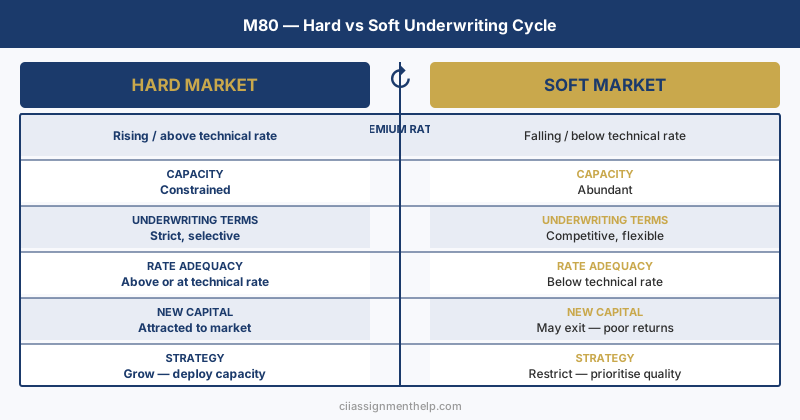
Hard Market Response
Selectively grow the book in classes where rate adequacy is confirmed at technical rate plus a margin. Apply technical rates without market discounts. Raise minimum quality thresholds — decline risks that would have been marginal in softer conditions. Rebuild portfolio profitability by prioritising rate adequacy over volume.
Soft Market Response
Reduce exposure in classes where market rate has fallen below technical rate. Decline risks previously acceptable if now priced below the minimum adequate rate. Tighten binding authority parameters to prevent coverholders writing at inadequate rates. Focus on certainty of loss experience rather than premium volume. Review aggregation positions to ensure no unintended concentrations have built up during the volume-driven soft market phase.
Cycle Management Questions in M80 — What Examiners Require
In M80 exam scenarios, cycle management questions require the candidate to identify the current market phase from the scenario indicators (falling rates, broadening terms, loss reserve deterioration from prior years indicating earlier inadequate pricing) and recommend specific corrective actions. A generic answer — "be more selective in a soft market" — will not score. Specific actions required: which classes to reduce, how much to adjust rates upward, what binding authority amendments to implement, and what reinsurance adjustments to consider.
Policy Documentation from the Underwriting Perspective
The insurance slip is the core contract document in the London Market. It describes the insured risk, coverage, terms, conditions, and premium. The lead underwriter's initials on the slip create the contract — following underwriters then agree their lines and proportions. The slip must be complete and accurate before the risk is bound; any material gap or ambiguity in the slip will generate coverage disputes at the claims stage.
Debit/credit policies (adjustable premium policies) are used where the exposure base is variable — employers' liability (payroll), public liability (turnover), motor fleet (fleet count). At inception, a deposit premium is agreed on an estimated exposure figure. At expiry, the insured declares the actual exposure. Final premium equals actual exposure multiplied by the agreed rate. If actual exposure exceeds the estimate, a debit — additional premium — is raised. If actual is below estimate, a credit — return premium — is issued.
Endorsements are mid-term changes to the policy. Each endorsement — adding a new insured location, increasing the sum insured, adding a new named insured, changing the activity covered — is a mini underwriting exercise. The underwriter must assess whether the requested change materially alters the risk profile; if it does, additional premium is required and the endorsement terms must reflect the changed risk.
Need Expert Help With Your M80 Written Exam?
Scenario analysis practice, underwriting decision justification templates, rate adequacy calculation exercises, delegated authority case studies, and binding authority review exercises.
💬 WhatsApp Us NowHow to Write M80 Exam Answers — Applying Underwriting Judgment
M80 extended answer questions present complex scenarios: a risk submission with incomplete information; an adverse loss history on a major client account; a binding authority with deteriorating loss ratios; a portfolio approaching its catastrophe accumulation limit. The candidate must not merely describe underwriting — they must make a decision and justify it with specific reference to the scenario facts.
Step 1: Identify Risk Factors
Identify all risk factors in the scenario and categorise them as positive (strong COPE profile, clean loss history, strong management) or negative (moral hazard indicators, adverse loss history, aggregation exposure, soft market pricing pressure).
Step 2: State the Decision
Accept, decline, refer, or accept with conditions — with explicit justification citing specific underwriting principles from the scenario data. A recommendation without justification does not score at M80 level.
Step 3: Identify Implications
Identify any reinsurance, delegated authority, or portfolio management implications the decision creates — aggregation impact, cycle management adjustments, reinsurance considerations.
Step 4: Policy Documentation
State the policy documentation requirements for the proposed terms — slip wording, endorsement conditions, premium adjustment provisions where applicable.
The Four Most Common M80 Exam Failure Modes
1. Listing underwriting tools without applying them to the scenario facts.
2. Ignoring aggregation and portfolio-level implications when a single large risk is presented.
3. Failing to distinguish between technical pricing and market pricing when asked a pricing question.
4. Describing coverholder monitoring in general terms without identifying the specific concern the scenario presents.
M80 in the CII Diploma in Insurance Pathway
M80 Underwriting Practice is the natural Diploma-level progression unit for professionals who have completed IF3 (Insurance Underwriting Process) at Certificate level. IF3 introduced the underwriting process and basic risk analysis concepts at Level 3 using MCQ assessment; M80 extends this to professional practice at Level 4 — requiring written scenario analysis and applied underwriting judgment. The step from IF3 to M80 is not a continuation of the same learning task — it is a change in cognitive demand from recognition to application.
M80's counterpart unit in claims is M85 Claims Practice, which covers the claims-side perspective — the subrogation recovery, coverage analysis, and proximate cause doctrine that complement M80's underwriting focus. Understanding both units together gives Diploma candidates the most complete view of how underwriting decisions drive claims outcomes. The CII Diploma in Insurance hub page covers all optional and compulsory units within the Diploma pathway, including the three core compulsory units: M05 Insurance Law, M92 Insurance Business and Finance, and 530 Economics and Business.
Frequently Asked Questions about M80
How hard is M80 compared to other CII Diploma units?
M80 is one of the more demanding Diploma optional units because it tests applied underwriting judgment, not knowledge recall. The most common failure reason is producing descriptive answers that list tools or processes without making a decision or applying judgment to the specific scenario facts. Candidates who are practising underwriters tend to perform better if they connect their workplace experience to the technical framework — but must avoid relying on their employer's specific internal procedures, which may not match the CII's expected answer structure. Structured answer preparation focused on scenario analysis, pricing decisions, and delegated authority management is the most effective study approach for M80.
How long does M80 take to study?
Most candidates with an underwriting background complete preparation in 90–120 hours across 10–15 weeks. Candidates without underwriting experience — claims or broking professionals studying for the full Diploma — typically need 120–140 hours. Study priorities are pricing methodology (technical rate versus market rate is almost always tested), delegated authority and coverholder management (consistently examined in extended answer format), and underwriting cycle management (scenario questions on cycle phase identification and recommended actions).
How is M80 different from IF3?
IF3 (Certificate, Level 3, 15 credits, MCQ) introduces the underwriting process — what information is collected, what the underwriter does, and what the basic tools are. M80 (Diploma, Level 4, 20 credits, written exam) requires the candidate to perform the underwriting process: analyse risk information from multiple sources, make a pricing decision against a technical rate, manage portfolio aggregation, set up and monitor a binding authority, and make cycle-phase-appropriate strategic choices. IF3 tests awareness; M80 tests practice. The assessment format changes entirely — from MCQ to written scenario analysis — and the preparation methodology must change with it.
What written answer structure does M80 require?
M80 written answers must demonstrate four things in sequence: identification of the relevant underwriting principle or tool being tested in the scenario; application of that principle to the specific scenario facts rather than a general description; a recommendation or decision with explicit justification; and portfolio-level consequences where relevant — aggregation implications, cycle management adjustments, reinsurance considerations. The IRAC structure (Issue, Rule, Application, Conclusion) transfers well to M80 extended answers: identify the underwriting issue in the scenario, state the technical principle that applies, apply it to the specific facts, and conclude with a recommended action.
What is the pass mark for M80 and how is it scored?
The indicative pass mark for M80 is approximately 55% — lower than the 65% indicative pass mark for Certificate MCQ units, reflecting the difficulty of written examination at Level 4. The CII applies scaled scoring. Candidates should demonstrate underwriting judgment across all major syllabus areas — pricing, portfolio management, delegated authority, and cycle management — rather than concentrating on any single topic. Extended answer questions (25 marks each) carry the highest individual mark weight and require the most focused preparation.
Need Support With M80 Underwriting Practice?
Scenario analysis practice, underwriting decision justification templates, rate adequacy calculation exercises, COPE framework application, delegated authority case studies, and binding authority review exercises for M80 written exam preparation.
Get Your Free Quote 💬 WhatsApp Us Now