What Is M85 Claims Practice?
M85 Claims Practice is a 20-credit Level 4 optional unit of the CII Diploma in Insurance, assessed by written examination — not MCQ. The written exam presents complex claims scenarios and requires candidates to apply professional claims judgment: appointing the right specialists with documented justification, determining coverage using proximate cause doctrine, calculating business interruption indemnities using the full turnover basis methodology, valuing personal injury claims using the Judicial College Guidelines and Ogden Tables, identifying organised fraud and selecting the correct insurer remedy, and setting adequately supported claims reserves. M85 is taken by insurance professionals in claims roles — at direct insurers, Lloyd's syndicates, and loss adjusting firms — who have completed the Certificate-level IF4 unit and are building toward the full Diploma qualification.
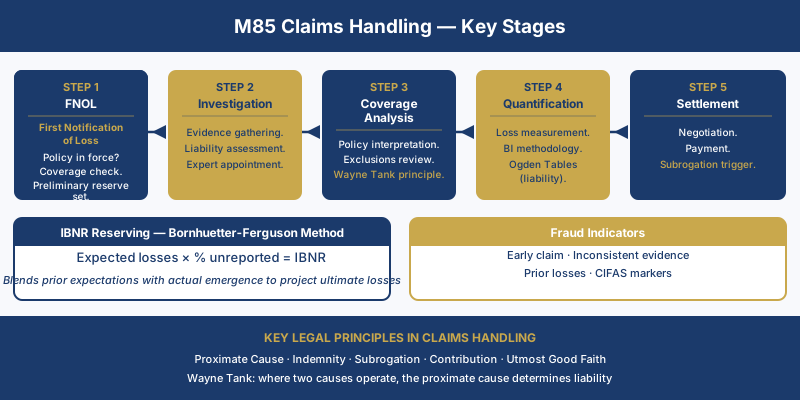
From IF4 to M85 — What Practice Level Means
IF4 (Certificate, Level 3, 15 credits, MCQ) introduces the claims handling process at a foundational level. M85 (Diploma, Level 4, 20 credits, written exam) requires the candidate to practise the process using professional tools: specialist appointment decisions with documented justification; proximate cause analysis applying the Wayne Tank concurrent causes rule; business interruption indemnity calculation using the full turnover basis methodology including the Trends Clause adjustment; personal injury valuation using Judicial College Guidelines and Ogden Tables at the current -0.25% discount rate; fraud identification and the correct insurer remedy; and claims reserve setting with explicit justification.
How Is M85 Assessed? — Written Exam Format
M85 is assessed by written examination — not multiple choice. Candidates who have only sat Certificate MCQ assessments must change their preparation methodology fundamentally. MCQ technique — elimination, pattern recognition, working from knowledge recall — does not transfer to M85 written answers.
Short-answer questions (approximately 10–15 marks) require a definition followed by immediate application to the scenario. A candidate who defines the Rate of Gross Profit formula without calculating it from the figures in the question will not score at M85 level. Extended answer questions (25 marks) present a complex, multi-issue claim requiring the candidate to manage the claim, assess coverage, appoint the appropriate specialists, and advise on reserve level and recovery strategy.
The indicative pass mark for M85 is approximately 55%. Study hours are estimated at 100–130 hours, with priority weighting toward BI methodology (the full turnover basis calculation is tested in almost every sitting), personal injury valuation (Ogden Tables and JCG brackets are tested in every PI scenario), and fraud remedies (the distinction between void ab initio, rescission, and repudiation is a consistent examiner focus).
Claims Investigation Management — Appointing the Right Specialist
Specialist appointment is the first active decision in any large or complex claim. M85 tests whether the candidate can identify which specialist is required, justify the appointment based on the specific claim characteristics, and instruct the specialist effectively. Generic answers recommending "appoint a specialist" without naming the specialist type and justification will not score.
Loss Adjusters — Appointment Criteria and Role
Loss adjusters are appointed for large property claims exceeding the insurer's internal handling threshold — typically claims above £25,000–£50,000. They are also appointed for: complex claims where determining the cause of loss requires on-site investigation; claims with multiple interested parties requiring coordinated communication; catastrophe events where the insurer's in-house capacity is overwhelmed; and claims where fraud indicators suggest the need for a documented independent field investigation.
The instruction letter to the loss adjuster must specify the coverage issues requiring investigation (not just "investigate the claim"), the reserve the insurer has set, any fraud indicators already identified, and whether legal advice is required alongside adjusting.
Engineers, Forensic Accountants, and Solicitors
Engineers
Appointed for: machinery breakdown claims (to determine whether the failure mode is a sudden and unforeseen breakdown — covered — or gradual deterioration — excluded); construction defect claims; structural damage claims; fire origin and cause investigations to establish whether ignition was electrical fault, arson, or excluded process combustion.
Forensic Accountants
Essential for business interruption claims of any material size. The forensic accountant verifies the insured's trading accounts, calculates the Rate of Gross Profit, assesses actual turnover during the interruption period, projects the turnover that would have been achieved but for the loss, and checks whether the Additional Increased Cost of Working figure is economically justified.
Solicitors
Appointed for: subrogation recovery actions; large liability claims where litigation is probable; coverage disputes requiring a legal opinion on policy interpretation; and fraud investigation civil recovery actions where the insurer seeks to recover a fraudulent payment from the fraudster through civil proceedings.
Coverage Analysis at Practice Level — Proximate Cause and Policy Interpretation
Coverage analysis in M85 requires the candidate to apply proximate cause doctrine and policy interpretation rules to multi-cause scenarios — not state definitions. The examiner tests whether the candidate can reach a coverage conclusion from the facts presented.
Proximate Cause — Wayne Tank and Concurrent Causes
Proximate cause is the dominant, effective, or operative cause of the loss — not the most recent event in a chain, and not the first in time. In M85 scenarios with a single unbroken chain of causation, the principle from Leyland Shipping v Norwich Union [1918] applies: the first cause in efficiency is the proximate cause, and all consequential losses flowing from that cause are covered if the proximate cause is an insured peril.
Wayne Tank & Pump Co v Employers Liability [1974] QB 57 — The Concurrent Causes Rule
In Wayne Tank, a plastic duct overheated (excluded peril — faulty design and materials) and ignited a fire in the insured's premises (insured peril — fire). Both the excluded peril and the insured peril were concurrent proximate causes of the same loss. The Court of Appeal held that the entire loss was excluded — an insured cannot recover where an excluded peril is one of the proximate causes alongside an insured peril, even if the insured peril also independently qualifies as proximate.
Applying Wayne Tank in M85 exam answers: identify each cause; classify as insured, excluded, or neutral; determine whether the causes are sequential (Leyland Shipping analysis) or concurrent (Wayne Tank analysis); conclude on coverage.
Policy Interpretation — Contra Proferentem and Conditions Precedent
Contra proferentem is the rule that genuine ambiguity in policy wording is construed against the insurer who drafted it. The ambiguity must be real — courts will not create ambiguity by reading wording artificially. Contra proferentem is a last-resort rule, applied only after all standard rules of construction have failed to resolve the ambiguity.
Conditions precedent to the claim are obligations the insured must satisfy before the insurer's liability to pay is triggered. Post-Insurance Act 2015, for commercial policyholders, the insurer can only rely on a condition precedent breach where it was actually prejudiced by the breach — by operation of the implied term under s.13A. This distinction matters in M85 exam scenarios where the contract date is given and the policyholder is identified as commercial.
Business Interruption Claims — Full Methodology
Business interruption methodology is the highest-weighted calculation topic in M85 and is tested in almost every exam sitting. The candidate must work through the full turnover basis calculation, apply the Trends Clause where scenario data indicates a business trend, and assess the AICOW for economic validity.
The Turnover Basis of Settlement — Core Framework
Standard BI Indemnity Formula
Indemnity = (Rate of Gross Profit × Reduction in Turnover during the Indemnity Period) + Additional Increased Cost of Working (subject to the economic limit)
Rate of Gross Profit = (Gross Profit ÷ Turnover) × 100
Gross Profit in BI insurance = Turnover minus Uninsured Working Expenses.
BI Calculation — Worked Example
Gross Profit = £600,000; Turnover = £1,500,000. Rate of Gross Profit = 40%.
Projected turnover for a 6-month interruption period = £750,000. Actual turnover achieved = £300,000 (partial trading). Reduction in Turnover = £450,000.
BI indemnity before AICOW = 40% × £450,000 = £180,000.
Trends Clause — Adjusting for Business Trends
The Trends Clause adjusts both the Rate of Gross Profit and the projected turnover to reflect any trend or circumstance affecting the business independently of the insured event. This is one of the most frequently mis-applied elements in M85 exam answers — candidates who mention the Trends Clause without applying it to the specific scenario data will not score the available marks.
Two adjustments the Trends Clause governs: (1) Adjusting the Rate of Gross Profit: if the business was growing or declining before the loss, the Rate of Gross Profit from the last accounting year may overstate or understate the rate applicable during the interruption period. (2) Adjusting projected turnover: the projected turnover must reflect what the business would actually have achieved during the interruption period but for the loss — including any trend affecting it independently. In M85 exam scenarios, the Trends Clause adjustment direction must be stated (upward for growth trends, downward for decline) and its quantified effect on the calculated indemnity must be shown.
Maximum Indemnity Period and AICOW
Maximum Indemnity Period (MIP) is the period during which the BI policy provides indemnity — selected by the insured at inception. Common options are 12, 18, 24, and 36 months. Underinsurance of the MIP is a frequent cause of BI claim underpayment: if the business has not fully recovered by the end of the MIP, the BI indemnity ceases at that date regardless of ongoing trading loss.
Additional Increased Cost of Working (AICOW) covers expenditure beyond normal that the insured incurs during the indemnity period to reduce the turnover loss. AICOW is recoverable only to the extent that it is economic — the expenditure must cost less than the BI loss it saves. If £50,000 expenditure reduces the projected BI loss by £80,000, the AICOW is economic (£50,000 saves £80,000) and is recoverable in full. If the expenditure had cost £90,000 to save the same £80,000, only £80,000 would be recoverable.
Liability Claims — Personal Injury Valuation at Practice Level
Personal injury valuation in M85 requires the candidate to apply two distinct tools — the Judicial College Guidelines for general damages and the Ogden Tables for special damages — and reach a quantified assessment, not a general description of how claims are valued.
General Damages — Judicial College Guidelines
General damages compensate for non-financial losses — pain, suffering, and loss of amenity (PSLA). They are assessed by reference to the Judicial College Guidelines (JCG), which provide bracket ranges for awards by injury type and severity. JCG brackets are not binding on courts but are the standard reference used in settlement negotiations across the UK personal injury market.
Applying JCG brackets in M85 exam answers: identify the injury category from the scenario; name the relevant JCG chapter and injury category bracket; and apply aggravating or mitigating factors that affect where within the bracket the award falls. The PSLA figure must be stated with reasoning for the position within the bracket.
Special Damages — Ogden Tables and the Discount Rate
Special damages cover financial losses: past losses from the date of injury to trial and future losses (future loss of earnings, future care costs, future medical treatment).
Future Loss Calculation — Ogden Tables Method
Future loss = Annual loss × Ogden multiplier
The Ogden multiplier reflects the claimant's life expectancy and the discount rate.
The current discount rate is -0.25% (set August 2019). A negative discount rate produces higher multipliers and therefore larger lump sum awards. M85 candidates must state the current discount rate of -0.25% when applying Ogden Tables in exam answers — using an outdated rate (such as +2.5%) will produce a materially wrong calculation and lose significant marks.
Periodical Payment Orders (PPOs) are available for very large personal injury claims with long-term care needs. Under a PPO, the court orders periodic payments instead of a lump sum — typically indexed to ASHE 6115 (the Annual Survey of Hours and Earnings index for care workers). PPOs protect the claimant against care cost inflation and remove investment risk. For the insurer, PPOs create long-tail reserving uncertainty: the total cost is unknown at settlement because it depends on the claimant's actual lifespan.
Fraud Management at Professional Level
Fraud management in M85 tests whether the candidate can identify organised fraud patterns from scenario data, apply the correct SIU referral process, and select the right insurer remedy for the specific type of fraud present. Not all fraud scenarios warrant the same remedy — applying the wrong remedy to the wrong scenario type is one of the most common M85 exam failures.
Fraud Indicators and SIU Referral
Staged motor accident indicators include: multiple claimants in one vehicle; all claimants represented by the same firm of solicitors before any notification to the insurer; CCTV footage inconsistent with the alleged collision; vehicle hire and storage charges disproportionate to the vehicle's market value.
Property fraud indicators include: the insured appearing multiple times on CUE for similar losses; high-value items claimed with no evidence of ownership; the loss occurring within the first 30 days of inception; claim figures submitted initially being significantly higher than subsequently evidenced losses.
SIU referral thresholds: The insurer's Special Investigations Unit must be instructed when two or more fraud indicators are identified simultaneously; the CUE database shows prior fraud history; the claim value exceeds the internal referral threshold combined with at least one indicator; or organised ring activity is suspected. Each referral must be documented — the claims handler records the specific indicators observed and the factual basis for the referral.
Insurer Remedies — Void Ab Initio, Rescission, Repudiation
Void Ab Initio
The policy is treated as if it never came into existence. This remedy applies where there was fraudulent misrepresentation at inception — the policyholder deliberately provided false information to obtain the policy. All claims are refused; the insurer may retain the premium paid. This is an inception-stage remedy, not a claims-stage remedy.
Rescission
The policy is set aside from inception due to material non-disclosure or misrepresentation. Under the Insurance Act 2015, proportionate remedies apply before avoidance is automatic. For deliberate or reckless misrepresentation at inception, the insurer may avoid the contract. For non-deliberate misrepresentation, a proportionate remedy — reducing the claim proportionately or treating the contract as if amended terms applied — is required before avoidance can be considered.
Repudiation of the Claim
The specific fraudulent claim is denied, but the policy itself continues to cover other legitimate claims. Under the common law fraud principle confirmed in Versloot Dredging BV v HDI Gerling [2016] UKSC, a fraudulent claim allows the insurer to repudiate the entire claim. However, a fraudulent device used to support an otherwise valid claim (exaggerating rather than fabricating) does not forfeit the claim if the exaggeration was immaterial to the insurer's decision to pay.
Key M85 Exam Distinction — Which Remedy Applies
A fraud scenario requires identifying the type of fraud (inception-stage versus claims-stage), selecting the correct remedy with justification, and specifying what evidential steps are required before the remedy is applied. Void ab initio is an inception-stage remedy (deliberate fraud to obtain the policy). Repudiation is a claims-stage remedy (fraud in the claim itself). Recommending void ab initio in a repudiation-only scenario is one of the four most common M85 exam failures.
Claims Reserving and Subrogation Recovery Strategy
Claims Reserving Methodology
Accurate reserving is a core professional obligation in claims practice. An inadequate reserve misrepresents the insurer's financial position; an excessive reserve overstates liabilities and creates false financial signals. M85 tests whether the candidate can set a justified reserve — not just name the reserve types.
Case reserve is set at first notification based on the claims handler's assessment of the likely settlement cost. The case reserve must reflect: the probability of liability being established; the estimated quantum including general and special damages; anticipated claimants' legal costs; and loss adjustment expenses. Case reserves must be reviewed and updated as new information emerges.
IBNR — Incurred But Not Reported is the reserve for claims that have occurred within the policy period but have not yet been notified to the insurer. IBNR is most material in employers' liability (latent disease — mesothelioma claims arising 30–40 years after asbestos exposure); professional indemnity; and casualty reinsurance.
Claims inflation adjustment is the most commonly understated reserve component. Reserves must be adjusted for expected future inflation: medical treatment cost inflation; care cost inflation linked to ASHE wage growth; legal cost inflation. Failure to apply adequate claims inflation loading is a systematic source of reserve deficiency, particularly on long-tail liability claims with 10–20 year development periods.
Subrogation Recovery Management Strategy
Subrogation recovery reduces the insurer's net claims cost by recovering from the third party responsible for causing the loss. The decision to pursue recovery requires cost-benefit analysis: expected recovery (probability of success multiplied by the likely recovery amount) compared against the legal costs of pursuit.
Conducting recovery in the insured's name: Subrogation proceedings are brought in the insured's name — the insurer does not sue in its own name. The insured must cooperate fully: providing documents, attending court as a witness where required, and giving instructions to solicitors at the insurer's direction.
Recovery proceeds allocation where recovery is only partial: the insured's uninsured excess or deductible is recovered first from the proceeds; the insurer then recovers its claim payment from the balance. Where recovery is insufficient to satisfy both, the proceeds are shared pro rata between the insured (for the uninsured element) and the insurer (for the indemnified element).
Need Expert Help With Your M85 Written Exam?
BI calculation practice with worked examples, personal injury valuation exercises using Ogden Tables, fraud scenario analysis, coverage dispute drafting, and structured answer templates for M85 extended questions.
💬 WhatsApp Us NowHow to Write M85 Exam Answers — Professional Claims Judgment
M85 extended answer questions present multi-issue claims. The candidate must manage the claim, assess coverage, appoint the right specialists, quantify the loss, and advise on reserve and recovery strategy — all in a structured written answer that demonstrates professional judgment, not general process description.
Step 1: Coverage Assessment
Identify each cause of the loss; classify as insured, excluded, or neutral; apply Wayne Tank if concurrent causes are present; state the coverage conclusion clearly.
Step 2: Specialist Appointment
Identify each specialist required; justify the appointment with specific reference to the claim's characteristics.
Step 3: Quantum Assessment
For BI, calculate the indemnity step by step including the Trends Clause adjustment. For PI, identify the relevant JCG bracket and apply the Ogden Tables method for future losses, stating the discount rate of -0.25%.
Step 4: Reserve and Recovery
State the case reserve with explicit justification and flag any IBNR, ULAE, or claims inflation considerations. Identify any fraud indicators; state the appropriate remedy with justification; assess subrogation recovery prospects and the cost-benefit calculation.
The Four Most Common M85 Exam Failures
1. Applying Wayne Tank incorrectly by treating concurrent causes as a sequential chain.
2. Calculating the BI indemnity without applying the Trends Clause adjustment when the scenario indicates a business trend.
3. Using Ogden multipliers without stating the current discount rate of -0.25%.
4. Recommending void ab initio in a repudiation-only scenario (fraud in the claim itself, not at inception).
M85 in the CII Diploma in Insurance Pathway
M85 Claims Practice is the natural Diploma-level progression for professionals who have completed IF4 (Insurance Claims Handling) at Certificate level. IF4 introduced the claims process at Level 3 using MCQ; M85 adds the professional tools that define claims practice at Level 4 — BI methodology, PI valuation frameworks, fraud investigation remedies, and actuarial reserving concepts.
M85's coverage analysis content — particularly proximate cause doctrine and policy interpretation — shares significant ground with M05 Insurance Law, which covers the Insurance Act 2015 framework, conditions precedent, and contra proferentem at the Diploma legal analysis level. The reserving and recovery content in M85 connects to the financial framework covered in M92 Insurance Business and Finance, which analyses how reserve adequacy and recovery income affect the insurer's combined ratio.
Frequently Asked Questions about M85
How hard is M85 compared to other CII Diploma units?
M85 is one of the more technically demanding Diploma optional units because it combines quantitative methodology — BI calculation, PI valuation using Ogden Tables — with professional judgment requirements — specialist appointment decisions, fraud investigation strategy, and coverage analysis using case law. The most common failure is producing generic claims management answers without applying the specific tools required at M85 level. Practising BI calculations with worked examples and PI valuation using Ogden Tables is the single most important exam preparation activity.
How long does M85 take to study?
Most candidates with a claims background complete preparation in 90–120 hours across 10–15 weeks. Key study priorities are BI methodology (the full turnover basis calculation including the Trends Clause — tested in almost every sitting), personal injury valuation (Ogden Tables discount rate at -0.25% and JCG brackets — tested in every PI scenario), and fraud remedies (the distinction between void ab initio, rescission, and repudiation is a consistent examiner focus). Candidates without a BI or liability claims background typically need 120–140 hours.
How is M85 different from IF4?
IF4 (Certificate, Level 3, 15 credits, MCQ) introduces the claims handling process at a foundational level. M85 (Diploma, Level 4, 20 credits, written exam) requires the candidate to apply professional claims tools to complex scenarios: BI methodology with the full turnover basis calculation, personal injury valuation using Ogden Tables and the -0.25% discount rate, Wayne Tank coverage analysis for concurrent causes, SIU fraud referral and insurer remedies, and IBNR reserving. IF4 tests awareness; M85 tests competence in applying the tools under examination conditions.
What written answer structure does M85 require?
M85 extended answers must work through a scenario systematically: coverage assessment first (is the loss covered? — proximate cause analysis, concurrent causes check, conditions precedent compliance); then quantum (BI calculation or PI valuation as required by the scenario); then specialist appointment recommendations with justification; then reserve and recovery strategy. Answers that jump to quantum without addressing coverage lose significant marks. Answers that describe the claims process in general terms without applying the specific methodology to the scenario figures do not demonstrate the professional judgment M85 requires at Level 4.
What is the pass mark for M85 and how is it scored?
The indicative pass mark for M85 is approximately 55%. The CII uses scaled scoring. Candidates should ensure competence across all major syllabus areas — BI methodology, PI valuation, fraud management, and reserving are all tested. Concentrating only on BI at the expense of PI, fraud, or reserving topics creates a material risk of failing to score adequately in those question areas. Extended answer questions (25 marks each) carry the highest individual mark weight and are where the most significant marks are gained or lost depending on the quality of professional judgment demonstrated.
Need Support With M85 Claims Practice?
BI calculation practice with worked examples, personal injury valuation exercises using Ogden Tables at -0.25%, fraud scenario analysis with correct remedy selection, Wayne Tank coverage analysis, and structured answer templates for M85 extended questions.
Get Your Free Quote 💬 WhatsApp Us Now